

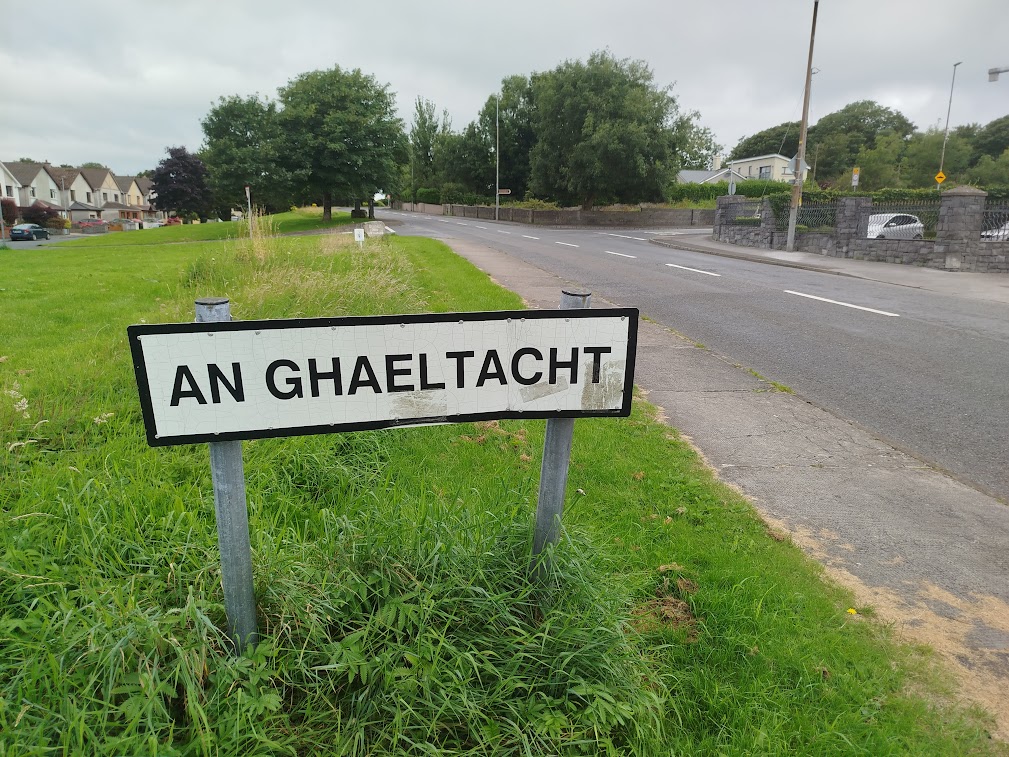
You pull over to read a road sign and something strikes you: there’s no English on it. The shop ahead has a handwritten notice in a language that sounds like rainfall. And the old man at the stone wall is on his mobile phone, speaking fast and easy in syllables you’ve never heard before. You’ve just crossed into a Gaeltacht.
What Is a Gaeltacht?
The Gaeltacht (pronounced gwal-tacht) is the collective name for Ireland’s Irish-speaking regions — areas where Irish, not English, is the language of everyday life. These aren’t heritage villages or living museums. They’re actual communities where people shop, argue, laugh, and fall in love in the oldest spoken language in Western Europe.
Ireland’s government officially designates Gaeltacht areas and funds them to help keep the language alive. Roughly 90,000 people live in recognised Gaeltacht regions today, though the number of daily Irish speakers varies across those communities.
The word itself tells you what matters. “Gaeltacht” simply means “Irish-speaking place.” And in the best of them, that’s exactly what you get — a place where Irish is the language the day begins and ends in.
Where the Gaeltacht Regions Are Found
The main Gaeltacht areas stretch along Ireland’s wild western edge. Connemara, in County Galway, is the largest — a rugged sweep of bog, lake and Atlantic coast where Irish has been spoken continuously for more than a thousand years. Villages like An Cheathrú Rua and Carraroe are proper Irish-speaking communities, not tourist recreations.
The Dingle Peninsula in County Kerry holds one of the most concentrated Gaeltacht areas in the country. West of Dingle town, Irish becomes the default language. The Blasket Islands, visible from the peninsula’s tip, once produced three celebrated Irish-language memoirs — proof of how rich the literary tradition runs here.
Donegal has the most geographically spread Gaeltacht in the country, with Irish-speaking communities from the Inishowen Peninsula in the north to the Glencolmcille area in the south. And the Aran Islands — sitting in the mouth of Galway Bay — remain one of the most immersive Irish-language experiences anywhere in the country.
What You Actually Hear and See
The signs change first. Road signs in the Gaeltacht appear in Irish only — or Irish first, with English a smaller afterthought underneath. You’ll pass through An Spidéal before you reach Spiddal. You’ll turn off for Baile an Fheirtéaraigh, which your map calls Ballyferriter.
Then comes the radio. Raidió na Gaeltachta — Ireland’s national Irish-language radio station — drifts from car windows and kitchen radios across the region. It sounds different from any other language you’ve heard. Soft consonants, aspirated sounds, vowels that open unexpectedly. It sounds, if anything, like the landscape it came from.
In the shops, the post office, the pub — Irish is what people reach for first. Not because they can’t speak English, but because this is their language. A visitor who tries even a word — “Go raibh maith agat” (thank you, pronounced gorrav mah agut) — will be met with a smile that says something was understood.
☘️ Enjoying this? 64,000+ Ireland lovers get stories like this every week.
Thinking about it seriously?
If you’ve started actually planning a move, our complete the full Move to Ireland guide walks through every step, every cost, and the paperwork that catches most people out.
Subscribe free →
The Summer Language Schools
Every July and August, Gaeltacht villages fill with Irish teenagers on a very particular kind of adventure. The coláistí samhraidh — summer Irish colleges — have been running for over a century. Young people come for three weeks, stay with local families, and agree to speak only Irish for the duration.
It’s a rite of passage for most Irish teenagers, and many describe it as the moment the language stopped being a school subject and became something they actually wanted to speak. The tradition of sending teenagers to Gaeltacht villages is one of the reasons the language has survived where other minority languages did not.
Increasingly, Irish diaspora families are sending their children too — a deliberate act of reconnection, a roots journey framed as a language school.
Why Visitors Often Go Quiet
There’s something particular about visiting a Gaeltacht when you carry Irish ancestry. Hearing the language spoken casually — across the counter, through a half-open window — does something to people whose grandparents or great-grandparents once spoke it. It’s not nostalgia exactly. It’s more like recognising something you didn’t know you’d lost.
Even visitors with no Irish connection often fall into a quieter version of themselves. The pace is different here. There’s no hustle. The Atlantic is always close. Roads narrow. Fields become bog. The language wraps everything in a sound that belongs specifically to this island, to this edge of Europe, to this particular quality of light.
You don’t need to speak Irish to visit a Gaeltacht. You just need to arrive with your ears open. Planning a trip to include the Irish-speaking west adds a dimension to any Irish journey that a city break simply can’t offer.
The Gaeltacht isn’t a language project. It isn’t a survival story. It’s just Tuesday morning in a Connemara kitchen, with the radio on and the kettle boiling, and every word of it in Irish. That’s been true for a very long time. With luck, it’ll stay true for a very long time yet.
Love more? Join 43,000 Scotland lovers → · Join 30,000 Italy lovers → · Join 7,000 France lovers →
Free forever · · Unsubscribe anytime
Tours & experiences you might love


Powered by Viator. Some links are affiliate links — we may earn a small commission at no extra cost to you.
Secure Your Dream Irish Experience Before It’s Gone!
Planning a trip to Ireland? Don’t let sold-out tours or packed attractions spoil your journey. Iconic experiences like visiting the Cliffs of Moher, exploring the Rock of Cashel, or enjoying a guided walk through Ireland’s ancient past often sell out quickly—especially during peak travel seasons.

Booking in advance guarantees your place and ensures you can fully immerse yourself in the rich culture and breathtaking scenery without stress or disappointment. You’ll also free up time to explore Ireland’s hidden gems and savour those authentic moments that make your trip truly special.
Make the most of your journey—start planning today and secure those must-do experiences before they’re gone!
Subscribe Free