

Why Arctic and Mediterranean Plants Grow Side by Side in the Burren, County Clare
There is a moment, walking across the Burren in late April, when you crouch down and realise you are looking at something that should not exist. Growing from a crack in grey limestone, no taller than your thumb, is a flower of such vivid cobalt blue it looks like someone dropped a jewel. That is the spring gentian — an alpine species that, by every rule of biogeography, belongs at altitude in the Swiss Alps, not at sea level on the Atlantic coast of County Clare. A metre away, a plant called mountain avens spreads its eight-petalled white flowers across the pavement. That one belongs in the Arctic. And a little further, tucked deep into a shaded fissure, hangs a maidenhair fern — the kind of fern that grows in Mediterranean gorges and on Spanish sea cliffs.
Three plants. Three different climate zones. One limestone slab in the west of Ireland.
This is what makes the Burren genuinely extraordinary — not in a vague, touristic sense, but botanically, scientifically, verifiably. It is one of the only places in Europe, possibly in the world, where Arctic-alpine and Mediterranean species grow side by side in this way. Ecologists who study it tend to run out of words for the paradox. The rest of us just stand there in the thin April wind, looking at blue flowers, trying to work out what is going on.
For the practical side of visiting — when to go, what the name means, where it sits near the Aran Islands — see our guide to the Burren, County Clare. This piece goes deeper into the science of why it exists at all.
What the Limestone Is, and What It Did
To understand why the Burren is the way it is, you have to go back a long way. The stone under your feet was laid down during the Carboniferous period, in a warm, shallow tropical sea that covered much of what is now Ireland. Over millions of years, the calcium carbonate skeletons of sea creatures accumulated on that ancient seafloor — corals, crinoids, brachiopods — compressing into the thick grey limestone that defines the Burren today. Fossils of those creatures are still visible in the rock if you know where to look, the record of an ocean that no longer exists.
For a long time after that, the stone was buried under other rock layers. What exposed it was ice.
Around 20,000 years ago, at the peak of the last ice age, glaciers hundreds of metres thick moved down from the north and northeast, grinding across the landscape. They stripped away the softer material on top, scraped off the soil, and left the bare limestone underneath. When the ice began to retreat — around 13,000 years ago — what remained was close to a blank slate: a vast grey pavement swept nearly clean, open to the sky.
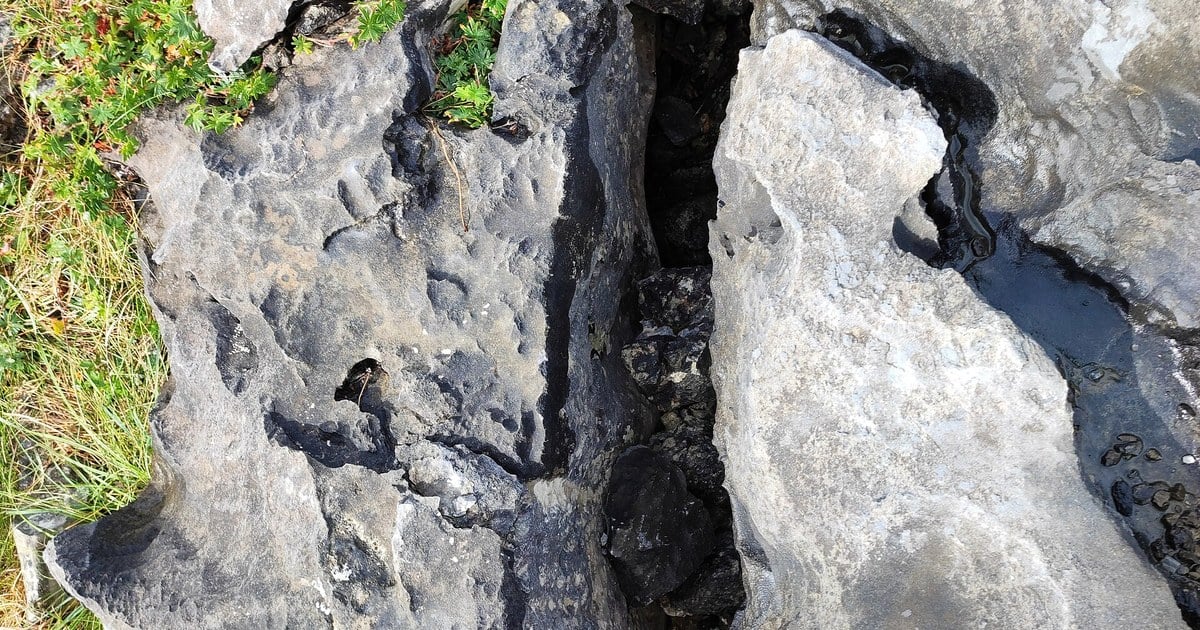
Since then, rain has been quietly doing its work. Water, slightly acidic from dissolved carbon dioxide in the atmosphere, dissolves limestone over time. The result is the Burren’s defining physical feature: a landscape of flat limestone blocks called clints, divided by deep fissures called grykes. Most grykes are less than two metres deep and just a few centimetres wide — though some extend down six metres into the rock. They are the slow product of ten thousand years of rain working its way into every joint and crack.
The Burren today covers something in the region of 530 square kilometres in north County Clare. The whole thing is essentially a vast, three-dimensional biological laboratory, and the grykes are where the experiment runs.
The Microclimate That Changes Everything
🇮🇪 Discover Hidden Ireland
Get our free 25 Hidden Gems of Ireland guide — the places most visitors never find — when you join 64,000 Ireland lovers.
Get My Free Hidden Gems Guide →
Free. No spam. Unsubscribe any time.
Here is the thing about a gryke: it is not just a crack in a rock. It is a world unto itself.
Step back and look at the surface of the limestone pavement on a bright day, and you are looking at something exposed and extreme — open to Atlantic wind, beaten by sun, washed by rain, drained immediately because there is essentially no soil. The clint surfaces are harsh. But drop your gaze into a gryke and you enter a completely different environment: sheltered from wind, humidified by trapped moisture, shaded or sunlit depending on which way it faces. A gryke oriented north and east stays cool and dark through the summer. One facing south and west catches every hour of available sunlight.
This means that within a single square metre of limestone pavement, you can have a north-facing fissure that mimics conditions in the Scottish Highlands and a south-facing fissure that feels — to a plant, if not to a person — something like coastal Portugal.
The limestone itself amplifies the effect. It absorbs heat through the day and releases it slowly overnight, acting as a slow thermal battery. In winter, when an alpine plant from the Arctic would normally freeze solid, the stone keeps releasing warmth long after the sun has set. The Atlantic climate helps — the Gulf Stream keeps Ireland’s winters mild by the standards of the same latitudes in mainland Europe. But the limestone is doing something more targeted than the climate: it is creating hundreds of individual micro-environments at ground level, each slightly different, each harbouring a slightly different community of plants.
The result is that plants which evolved for very different climates can find, within the same outcrop, a small pocket of the exact conditions they need. An arctic-alpine plant that needs cool, moist shade finds a north-facing gryke. A Mediterranean plant that needs warmth and good drainage finds a sun-baked southern clint or a south-facing crack. They never compete directly, because they are occupying different microclimatic niches separated by a few centimetres of stone.
The Species Themselves
The spring gentian — Gentiana verna — is regarded by many botanists as the Burren’s signature plant. It flowers from late April through May, rarely growing taller than five to ten centimetres, producing flowers of brilliant blue that are disproportionately large for the plant — fifteen to twenty millimetres across. In Britain, it is an upland species; in England, it grows at elevations from roughly 400 to 730 metres. In the Burren, it grows on dry limestone grassland and pavement at sea level. The stone’s thermal properties make it possible: the gentian needs the cold-enough winters and mild-enough springs that the limestone moderates, without the deep soil that warmer lowlands usually provide.
Mountain avens — Dryas octopetala — has been in the Burren since the ice retreated. It is an Arctic-alpine relict, a survivor from a time when the post-glacial landscape of Ireland was open tundra, and species like this were common across the northern hemisphere. As the climate warmed and forests advanced, most populations retreated north and uphill. In the Burren, they stayed, finding the bare limestone conditions they needed. The plant has an unusual place in science: the geological period known as the Younger Dryas — the sudden cold snap about 12,900 years ago that interrupted the warming after the ice age — was named after Dryas octopetala because of the quantities of its pollen found in sediment cores from that time. Older Dryas and Oldest Dryas, too. Every time climate scientists examine a cold episode from the deep past, they often find this plant’s pollen waiting in the record. In the Burren, it forms dominant stands on thin soils over limestone, growing today where it has grown since those tundra days.
The maidenhair fern — Adiantum capillus-veneris, whose Latin name translates as “Hair of Venus” — is the Mediterranean representative. It grows in grykes in the limestone pavement, relying on the shelter and moisture that collects in the fissures. It is an evergreen fern with delicate fan-shaped segments on thin, dark, wire-like stems — visually unlike almost anything else in the Irish flora. Native populations in Ireland are largely restricted to the west coast: the Burren, the Aran Islands, and a few scattered stations in the northwest. In the nineteenth century, collectors went after it so aggressively that native populations were damaged; most site losses happened before 1930. What survives today is fragile, site-specific, and completely dependent on the particular conditions the Burren provides.
Beyond these three, the tally of what lives here is staggering. The Burren contains something like 75 per cent of Ireland’s native wildflower species — within an area that represents a fraction of the country’s land mass. Twenty-three of Ireland’s 27 native orchid species are found here, including the dense-flowered orchid, a Mediterranean species at the northernmost edge of its range. There is bloody cranesbill — another southern plant — growing next to hoary rock-rose and shrubby cinquefoil. The landscape that looks, from a distance, like a grey lunar wasteland is, once you are in it and low to the ground, one of the most botanically rich places in Europe.
The Farmers Who Made It Possible
Here is the part of the Burren story that most people do not know, and that inverts the usual narrative about conservation: what keeps this botanical miracle intact is not wilderness. It is farming.
For thousands of years, the farmers of the Burren have practised a form of livestock management that is almost unique in Europe. They call it winterage — a reverse transhumance, the opposite of what most pastoral cultures do. In a normal transhumance system, farmers move their herds to high summer pastures when the weather is warm and bring them back down in winter. In the Burren, they do the opposite. Come autumn, the cattle move up onto the limestone uplands, where they graze through winter. The uplands are warmer in winter than the lowlands — the limestone holds heat — and the cattle clear rank vegetation and scrub that would otherwise advance across the pavement.
In summer, the cattle come down. The limestone pavement is left alone. The wildflowers bloom undisturbed.
This matters enormously. Without grazing, hazel scrub — which would happily colonise the Burren if left unchecked — would advance across the limestone, shading out the light-dependent pavement plants and eventually smothering the rare species entirely. The winterage system, practised over generations, has been actively maintaining the habitat. The farmers did not know they were doing conservation science. They were just farming the way their parents farmed. But the outcome was a landscape of almost impossible botanical richness.
By the late twentieth century, though, something was going wrong. Traditional farming was in decline. Younger generations were leaving the land. As farming activity reduced, the scrub began to creep back. Botanists and ecologists watching the Burren noticed it: the pavement was changing, the grasslands were closing over, the delicate mosaic of open limestone and thin soil was being replaced by rank vegetation.
Brendan Dunford and the Case for Paying Farmers to Farm
Brendan Dunford grew up on a farm in County Waterford, far from the Burren’s limestone. When he arrived in north Clare to undertake a PhD on the relationship between farming and biodiversity, he was entering a debate that had been circling the landscape for years. The argument then — as it often is in conservation — was about whether farmers were the problem or the solution.
His research answered the question clearly: they were the solution. The Burren’s extraordinary biodiversity was not despite the farming; it was because of it. Generations of winterage and the management practices that came with it had created and maintained the habitat. The plants were there because the farmers had been there first.
That finding reshaped what came next. Dunford went on to lead the BurrenLIFE project from 2005 to 2010, working with twenty Burren farmers across roughly 2,500 hectares. The premise was straightforward: if traditional farming was what kept the ecosystem alive, then the way to protect the ecosystem was to support the farmers doing that farming. Not through regulation, not through removing people from the land, but through paying them for the conservation value of their work.
The project was selected as one of the “Best of the Best” EU LIFE Nature projects in 2010 — a recognition from Brussels that this approach, farmer-centred and results-based, had produced measurable outcomes in a landscape of European significance.
What followed was the Burren Programme, which Dunford led until 2022. By 2013, more than 14,500 hectares of Special Areas of Conservation in the Burren were covered by the farming for conservation scheme — roughly 46 per cent of the total Burren SAC area. The programme eventually expanded to cover 23,000 hectares and 328 farms. Over ten years, the combined value of habitat and landscape improvements delivered through the programme was estimated at €32.8 million. Scrub was cleared from 241 hectares. Stock paths were reopened through vegetation. Stone walls were repaired. The limestone pavements, left alone in summer, continued their slow annual theatre of blue flowers and arctic relicts.
Dunford was named an Ashoka Fellow in 2011 and received an honorary doctorate from NUI Galway in 2018 for his work in championing farmland biodiversity. But the real measure of what he helped build is simpler: the Burren’s farmers are still farming, the scrub is still being held back, and in late April the spring gentian still turns the pavement blue.
Why This Place Matters Beyond Itself
The Burren’s botanical paradox is scientifically interesting in its own right, but what it also demonstrates — at scale, with real evidence — is something about how the relationship between human activity and wild landscapes actually works. The impulse is often to separate them: to fence off the valuable habitat, to exclude the farmers, to manage from a distance. The Burren’s lesson runs the other direction. The farmers are the habitat managers. The winterage cattle are doing the conservation work. The stone walls and the stock paths and the grazing rotations that look, from the outside, like ordinary rural life are in fact the mechanism that holds together one of Europe’s most unusual ecosystems.
The limestone stores the heat. The grykes shelter the plants. The farmers keep the scrub back. The gentians bloom in April, cobalt blue, on a grey pavement that has been building toward this for ten thousand years.
Nowhere else in Europe gets the combination quite right. And the combination — glacial geology, Atlantic climate, limestone physics, and a farming tradition old enough to have been recorded on Ireland’s Intangible Cultural Heritage list — is not something you can easily replicate. You can only understand it by going there, crouching down, and looking at what is growing in a crack in the rock.
It turns out that a great deal of the world’s most interesting ecology lives in the small spaces. The Burren is just unusually good at making that obvious.
☘️ Join 64,000+ Ireland Lovers
Every weekday morning, get Ireland’s hidden gems, local secrets, and travel inspiration — the kind you won’t find in any guidebook.
Subscribe free — enter your email:
📲 Know someone who’d love this? Share on WhatsApp →
Love more? Join 43,000 Scotland lovers → · Join 29,000 Italy lovers → · Join 7,000 France lovers →
Free forever · Unsubscribe anytime
Tours & experiences you might love


Powered by Viator. Some links are affiliate links — we may earn a small commission at no extra cost to you.
Secure Your Dream Irish Experience Before It’s Gone!
Planning a trip to Ireland? Don’t let sold-out tours or packed attractions spoil your journey. Iconic experiences like visiting the Cliffs of Moher, exploring the Rock of Cashel, or enjoying a guided walk through Ireland’s ancient past often sell out quickly—especially during peak travel seasons.

Booking in advance guarantees your place and ensures you can fully immerse yourself in the rich culture and breathtaking scenery without stress or disappointment. You’ll also free up time to explore Ireland’s hidden gems and savour those authentic moments that make your trip truly special.
Make the most of your journey—start planning today and secure those must-do experiences before they’re gone!