

What’s the best Irish dish of all time? ☘️
Vote in our Best Irish Food poll — recipes nominated by the community.
What’s your Irish county’s signature dish? ☘️
Different counties claim different dishes — Your County’s Signature Food tells you which one your county is known for, with a short story behind it.
Why Ireland Started Baking Soda Bread in the 1840s (And What They Baked Before It)
Here is the version of Irish soda bread most people carry around: ancient, timeless, passed down through generations from some era of turf fires and Gaelic farmhouses, as old as the island itself. You see it on menus from Dublin to Boston framed exactly this way — a thing of deep roots and long memory.
The oldest documented recipe for Irish soda bread is from 1836. It appeared in a Northern Irish newspaper called the Newry Commercial Telegraph, was reprinted that same year in a London publication called The Farmer’s Magazine, and only existed because a new industrial chemical had recently become affordable enough for ordinary families to experiment with.
Before that? Most Irish people weren’t eating bread at all.
The actual story of soda bread is better than the legend — it involves bad wheat, a molecule, a price spike in the middle of a famine, and a piece of chemistry so elegantly suited to Ireland’s specific agricultural problem that it almost seems designed for it. Almost.
The Famine scattered Irish families across the world. If you’re one of the 70 million people with Irish roots, you can often trace exactly which townland your ancestors fled from. Our Irish Townlands Ancestry Research Guide explains how.
Why Ireland Couldn’t Make Bread
The reason Ireland didn’t have a bread culture for most of its history comes down to what the island can grow. Ireland’s climate — wet, mild, Atlantic — is excellent for grass and disastrous for wheat. Specifically, it produces what agronomists call soft wheat: varieties with low protein content and correspondingly weak gluten structures.
Gluten is the network of proteins that gives bread dough its elasticity. When yeast ferments, it produces carbon dioxide bubbles over hours of slow fermentation — and it’s gluten that holds those bubbles suspended in the dough, allowing the loaf to rise and then set firm in the oven. Hard wheat, grown in sunnier, drier climates, produces plenty of strong, stretchy gluten. Soft wheat doesn’t produce enough, and what it does produce isn’t strong enough to hold the pressure.
The consequence is this: make yeasted bread with soft Irish wheat flour, and the gluten network fails to contain the gas. The bubbles collapse, the dough deflates, and what emerges from the oven is a dense, flat disappointment. Irish farmers understood this as practical fact. Wheat bread made with local grain was unreliable at best. So for most of Irish history, wheat bread was a luxury — something wealthy households imported better flour to make.
So what did everyone else eat?
For centuries, the answer was oats. Simple oatcakes, cooked on iron griddles over open fires, were the everyday staple of Gaelic Ireland. But from the late 1500s onwards, another crop increasingly took over the Irish plate: the potato. By the early 19th century, the potato had become the dominant caloric source for the Irish working classes — not in a “we eat potatoes often” sense, but in a “we eat almost nothing else” sense. Historians have calculated that a typical family of two adults and four children required roughly five tons of potatoes each year, translating to around five pounds per person, per day. The potato was calories, and calories were survival.
This meant the country was one crop failure away from catastrophe. But it also meant that for the first four decades of the 19th century, most Irish people had little reason to think about bread.
A New Chemical Changes the Equation
In the 1830s, chemists in Britain, Europe, and America were experimenting with a new leavening agent. Bicarbonate of soda — sodium hydrogen carbonate, a white powder that today sits unremarkably in every kitchen cupboard — had been known as a substance for some time, but producing it cheaply enough for ordinary domestic use was only becoming possible. The key property was this: bicarbonate of soda reacts with acid to release carbon dioxide gas. If you could introduce both into bread dough simultaneously, the CO2 would be produced instantly inside the loaf. No yeast, no fermentation, no waiting.
The problem was finding a suitable acid. Early experiments went in alarming directions. In 1817, an editor at The Gentleman’s Magazine in London published an experimental recipe using soda mixed with muriatic acid — what we now know as hydrochloric acid. Whether many readers attempted this is not recorded.
The practical breakthrough was sour milk, and later buttermilk. Both contain lactic acid, which reacts readily with bicarbonate of soda, producing CO2 without requiring anything corrosive. They were also cheap, widely available, and already a feature of Irish dairy country.
In 1836, a correspondent to the Newry Commercial Telegraph in County Down submitted a recipe. Four ingredients: wheaten meal, salt, super-carbonate of soda dissolved in cold water, and very sour buttermilk. The dough was mixed, formed into a cake about an inch thick, and baked in a Dutch oven with coals on the lid for roughly fifty minutes. The Farmer’s Magazine in London reprinted it the same year, in Volume 5, Page 328. From there, American publications including the Journal of the Franklin Institute in Pennsylvania picked it up. The first Irish soda bread recipe was in international circulation almost immediately.
What made the recipe work — and this is the part that still feels almost too neat — is precisely the soft wheat problem. Bicarbonate and buttermilk produce their CO2 in a rapid burst, not a slow fermentation. The bread goes into the oven quickly, before any structural integrity is needed from gluten. Soft Irish wheat, which had always failed the yeast test because its gluten couldn’t hold gas for hours, turns out to be perfectly adequate at holding gas for the few minutes needed for a fast-risen soda bread to set. The agricultural liability became a match for the chemical solution.
The Famine Accelerant
By the late 1830s, soda bread was documented and circulating. It was not yet ubiquitous. That transformation came through catastrophe.
In the autumn of 1845, a water mold called Phytophthora infestans — potato blight — appeared in Ireland’s crop. Over seven years of repeated failures, the Great Famine, An Gorta Mór, killed approximately one million people and forced another million to emigrate. The society that survived was one in which the potato was no longer a reliable staple. Something had to replace it.
Bicarbonate of soda became, in a very specific economic sense, a famine food. During the famine years, hard wheat and bicarbonate of soda were shipped from North America to help feed the population. The scale of uptake was measurable. The Dublin Quarterly Journal of Medical Science noted in 1850 that “due to the failure of the potato crop, a large quantity of bicarbonate of soda was employed by the poorer classes in the preparation of bread” — and that demand had grown so sharply that bicarbonate of soda became scarce, and the price rose accordingly.
Pause on that for a moment. In the middle of one of the worst famines in European history, the market for a chemical that barely existed in Irish kitchens a decade earlier was being strained by demand. Soda bread wasn’t a comfort or a curiosity. It was load-bearing infrastructure for a society in collapse.
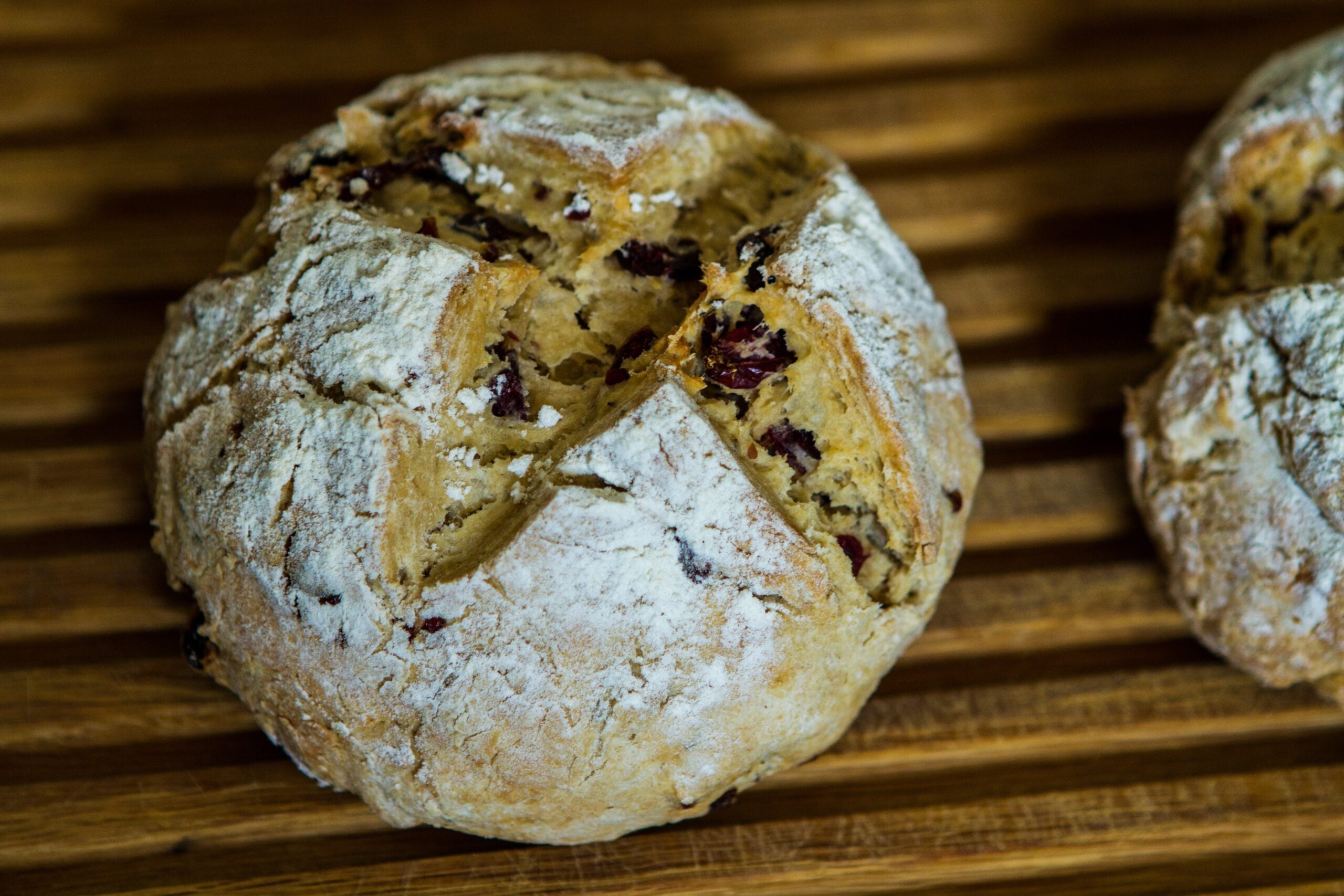
It spread partly because it fit how ordinary Irish homes actually functioned. Most families didn’t own ovens. Cooking happened over open turf fires, using flat griddles or three-legged cast iron pots called bastibles — a type of Dutch oven placed directly in the embers with hot coals heaped on the lid. Soda bread required no fermentation time, no temperature precision, no special equipment beyond the pot that was already in the kitchen. You mixed the four ingredients, formed the dough by hand, scored it with a cross, and put it in the bastible. In forty to fifty minutes, you had bread. This was a process that could be learned quickly and repeated daily with minimal resources.
By the 1860s — within a single generation of the famine — soda bread had become the common everyday bread made in homes across Ireland. In 1861, Ireland’s Commissioners of National Education included an explanation of soda bread’s chemical composition in an educational text on chemistry and chemical analysis. A technology that had been novelty in 1836 had, by 1861, become basic knowledge worth teaching to schoolchildren.
The Cross and What It Actually Means
The tradition of scoring a cross into the top of the loaf before baking is older than most people assume, and its origins are not primarily religious — whatever the comfortable popular version says.
Irish folk belief held that bread could be cursed. The older folk reading of the cross was specific: you scored it to let the fairies out — to drive off whatever malign presence might have entered the dough. Bread was considered a living thing in the way anything fermented or risen seemed alive, and evil spirits or the Fair Folk could enter it. The cross was protection.
As the Catholic Church became increasingly central to daily Irish life through the 19th century, the cross absorbed a Christian meaning alongside its older one. Blessing the bread before the fire made the gesture feel natural, continuous, pious. The folk protection and the religious blessing folded together until it became difficult to remember which had come first.
The practical explanation, which doesn’t get nearly enough credit, is this: the cross helps the loaf expand evenly as it bakes, preventing it from splitting unpredictably. It also divides the round loaf naturally into four portions — farls — that can be broken apart at the table. Fairies kept out, bread distributed neatly. The scoring turns out to be genuinely useful regardless of which story you prefer.
A Note on Raisins
The soda bread most tourists encounter outside Ireland — the kind loaded with dried fruit and subtly sweetened — is not what Irish people call soda bread.
In Ireland, that loaf is called spotted dog. Sometimes spotted dick. Sometimes tea cake. It exists, it is eaten, it is liked, but it is understood to be something different from traditional soda bread, which contains exactly four ingredients and nothing else. The fruit-laden version developed largely within Irish-American emigrant communities over the 20th century, where the recipe drifted, was dressed up for festive occasions, and eventually got exported back to Ireland as “traditional.” Culinary historian Lucy Long has documented this confusion directly: what is marketed as authentic Irish soda bread in tourist contexts frequently represents the diaspora’s interpretation of the bread rather than the bread itself.
The actual traditional version is austere by design. Flour, buttermilk, salt, bicarbonate. The simplicity isn’t a appealing rustic affectation — it’s a historical record of what was available to families in the 1840s who needed to eat.
What the Story Actually Is
Soda bread isn’t old. The earliest confirmed recipe dates from a County Down newspaper in 1836, when the first railways were only just opening in Ireland and Queen Victoria had not yet been crowned. The bread became a national staple not through centuries of slow tradition but through a decade of catastrophe that eliminated the food it was replacing.
What’s striking about the soda bread story isn’t the antiquity people project onto it. It’s the efficiency of the solution. A country that couldn’t reliably make wheat bread — because its climate grew the wrong kind of wheat — found, in bicarbonate of soda, a leavening agent that worked precisely because of the property that had always made Irish wheat difficult. The weakness became an advantage. And the result was a bread that could be made by almost anyone, in almost any kitchen, with almost nothing.
When the Ireland Folklore Commission sent researchers around the country in the late 1930s to document traditional food practices, they found kitchens where soda bread was made daily, often twice, by women who had never measured a single ingredient in their lives. The knowledge had become instinctive within a single century. That’s how fast a survival technology can become a tradition.
Every time the four ingredients go into a bowl together today — the soft flour going in first, the buttermilk souring the mix, the quick work with your hands to bring it together before the reaction gets ahead of you, the cross pressed in — you’re running the same chemistry that kept people alive in the 1840s. There’s nothing ancient about it. What it is, instead, is exactly right.
Something made fast, from what was at hand, in conditions that didn’t allow for anything more complicated — and it turned out to be the thing that lasted.
Want to try it yourself? Here’s how to make traditional Irish wheaten bread at home — and if you’re planning what to serve alongside a warm slice, here’s what pairs perfectly with soda bread fresh from the oven.
☘️ Join 64,000+ Ireland Lovers
Every weekday morning, get Ireland’s hidden gems, local secrets, and travel inspiration — the kind you won’t find in any guidebook.
Subscribe free — enter your email:
📲 Know someone who’d love this? Share on WhatsApp →
Love more? Join 43,000 Scotland lovers → · Join 29,000 Italy lovers → · Join 7,000 France lovers →
Free forever · Unsubscribe anytime
Tours & experiences you might love


Powered by Viator. Some links are affiliate links — we may earn a small commission at no extra cost to you.
Secure Your Dream Irish Experience Before It’s Gone!
Planning a trip to Ireland? Don’t let sold-out tours or packed attractions spoil your journey. Iconic experiences like visiting the Cliffs of Moher, exploring the Rock of Cashel, or enjoying a guided walk through Ireland’s ancient past often sell out quickly—especially during peak travel seasons.

Booking in advance guarantees your place and ensures you can fully immerse yourself in the rich culture and breathtaking scenery without stress or disappointment. You’ll also free up time to explore Ireland’s hidden gems and savour those authentic moments that make your trip truly special.
Make the most of your journey—start planning today and secure those must-do experiences before they’re gone!