

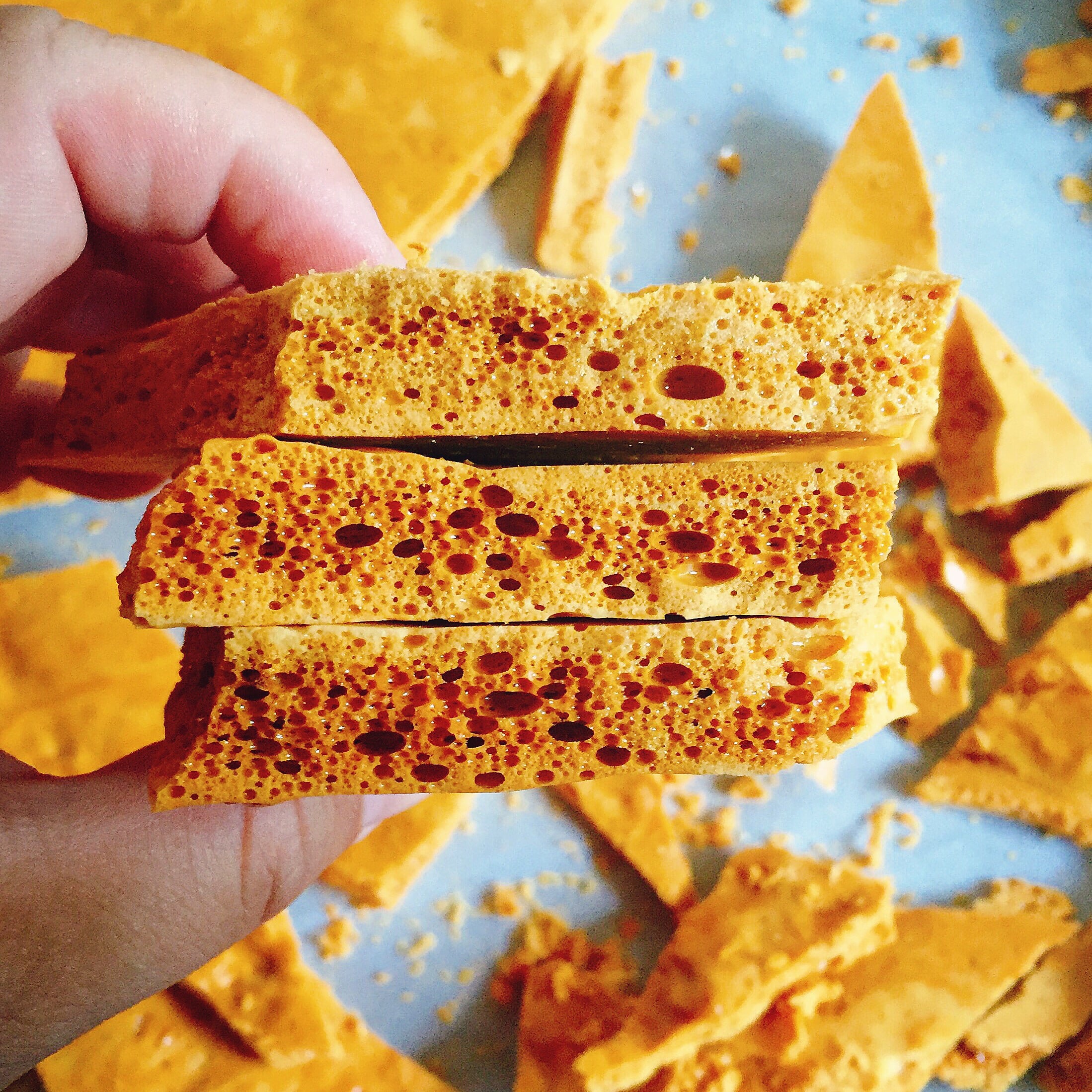
Yellowman Recipe: The Golden Honeycomb Toffee of the Ould Lammas Fair
If you have ever wandered the cobbled streets of Ballycastle in County Antrim on the last Monday and Tuesday of August, you will have heard the old song before you even reached the fairground. “Did you treat your Mary Ann to dulse and yellowman, at the Ould Lammas Fair in Ballycastle-O?” The Ould Lammas Fair is one of Ireland’s oldest traditional fairs, dating back to 1606, and yellowman is as inseparable from it as the Atlantic breeze rolling in off the North Channel. This brittle, golden honeycomb toffee — all crunch, caramel depth, and gentle sweetness — has been made and sold at the fair for centuries, wrapped in paper and handed over sticky-fingered to children and grown-ups alike.
Yellowman belongs to that wonderful category of confectionery that seems almost magical in the making. A dark, bubbling pot of treacle and sugar is transformed, by the simple addition of bicarbonate of soda, into a soaring, golden, porous slab of toffee that shatters with a satisfying crack. The name comes simply from its colour — a deep amber-gold that catches the late summer light like stained glass. Alongside dulse, the dried and chewy edible seaweed also sold at the fair, yellowman is one of the defining tastes of Ulster’s folk heritage, and biting into a piece is, for many Irish people, the taste of childhood summers in the north.
Making yellowman at home requires nothing more exotic than a heavy-based pan, a sugar thermometer, and a little courage — because the mixture gets very hot indeed and moves fast once the bicarb goes in. The result is deeply rewarding: a whole tray of gleaming, honeycomb toffee that keeps well in an airtight tin and makes a genuinely special edible gift. This is the traditional recipe, kept simple and honest, just as it has always been made.
Ingredients
- 450g (1 lb) golden syrup
- 225g (8 oz) soft dark brown sugar
- 30g (1 oz / 2 tablespoons) unsalted butter, plus extra for greasing
- 2 tablespoons white wine vinegar or malt vinegar
- 2 teaspoons bicarbonate of soda
Method
- Generously butter a large baking tray (roughly 30cm x 20cm / 12in x 8in) and set it on a heatproof surface close to the hob. Have a wooden spoon, your sugar thermometer, and the measured bicarbonate of soda ready to hand before you begin — things move quickly at the end.
- Place the golden syrup, soft dark brown sugar, butter, and vinegar into a large, heavy-based saucepan over a low heat. Stir gently until the sugar has fully dissolved and the butter has melted. Do not allow the mixture to boil at this stage.
- Once the sugar has dissolved, increase the heat to medium and bring the mixture to a steady boil. Stop stirring and clip your sugar thermometer to the side of the pan. Allow the mixture to boil without stirring until it reaches 150°C (300°F) — the hard crack stage. This will take approximately 10 to 15 minutes. Keep a close eye on it.
- Remove the pan from the heat immediately once the temperature is reached. Working quickly and carefully — the mixture is extremely hot — tip in the bicarbonate of soda and beat it in vigorously with the wooden spoon. The mixture will foam up dramatically and turn a lighter, honeycomb gold. This is exactly what you want.
- Pour the foaming mixture straight onto your prepared buttered tray without spreading or pressing it down. Allow it to settle naturally so you preserve all those lovely air bubbles.
- Leave to cool completely at room temperature for at least one hour, until fully set and hard. Do not refrigerate, as this can make the toffee sticky and soft.
- Once cold and set, break the yellowman into irregular shards using the handle of a wooden spoon or a small toffee hammer. Store in an airtight container between layers of baking parchment.
Tips
- Use a large pan. The mixture more than doubles in volume when the bicarb is added, so you need far more headroom than you might expect.
- A sugar thermometer is essential. Without one, it is very difficult to judge the hard crack stage reliably. Under-cooked yellowman will be chewy rather than brittle.
- Don’t stir once boiling. Stirring can cause the sugar to crystallise and turn grainy. Leave it alone and let the thermometer do the work.
- Work fast with the bicarb. Once you take the pan off the heat, add the bicarbonate of soda without hesitation and pour immediately — the mixture begins to set quickly.
- Store carefully. Yellowman is hygroscopic, meaning it absorbs moisture from the air and turns sticky. Keep it in a truly airtight tin and it will stay crisp for up to two weeks.
There is something genuinely lovely about making yellowman at home — the transformation in the pan still feels a little like alchemy, no matter how many times you do it. Whether you first tasted it at Ballycastle on a blustery August afternoon or you are coming to it entirely fresh, this golden, glassy toffee carries with it centuries of Irish fair tradition in every sweet, shattering bite. Share it with people you love, and it tastes all the better for it.
Yellowman is one of Ireland’s oldest confections, traditionally sold at the Auld Lammas Fair in County Antrim for over 400 years. Irish emigrants brought sweet-making traditions like this to their new homes around the world. If your family has Ulster roots, our free Irish Ancestral Heritage Guide covers county-specific emigration records for Antrim and all of Ireland. Trace your Irish roots here — free.
☘️ Join 64,000+ Ireland Lovers
Every weekday morning, get Ireland’s hidden gems, local secrets, and travel inspiration — the kind you won’t find in any guidebook.
Subscribe free — enter your email:
📲 Know someone who’d love this? Share on WhatsApp →
Love more? Join 43,000 Scotland lovers → · Join 29,000 Italy lovers → · Join 7,000 France lovers →
Free forever · Unsubscribe anytime
Tours & experiences you might love


Powered by Viator. Some links are affiliate links — we may earn a small commission at no extra cost to you.
Secure Your Dream Irish Experience Before It’s Gone!
Planning a trip to Ireland? Don’t let sold-out tours or packed attractions spoil your journey. Iconic experiences like visiting the Cliffs of Moher, exploring the Rock of Cashel, or enjoying a guided walk through Ireland’s ancient past often sell out quickly—especially during peak travel seasons.

Booking in advance guarantees your place and ensures you can fully immerse yourself in the rich culture and breathtaking scenery without stress or disappointment. You’ll also free up time to explore Ireland’s hidden gems and savour those authentic moments that make your trip truly special.
Make the most of your journey—start planning today and secure those must-do experiences before they’re gone!