

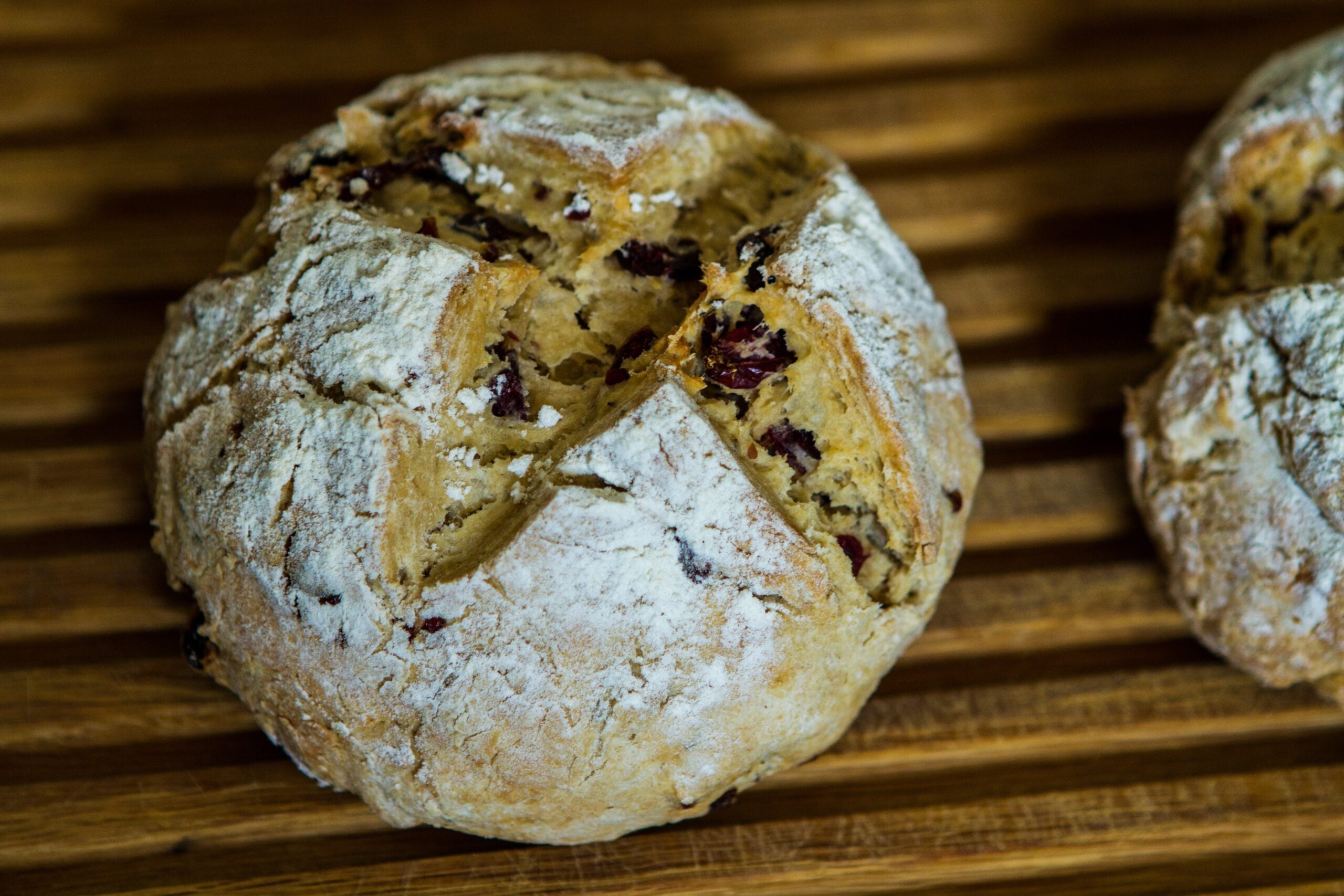
Every visitor to Ireland remembers the bread. Dense, slightly tangy, crumbling at the touch of a knife. It sits on every B&B table beside the butter dish. And every single loaf — no matter where it came from — carries a cross scored deep into the top. Ask an Irish grandmother why, and the answer might surprise you.
What’s the best Irish dish of all time? ☘️
Vote in our Best Irish Food poll — recipes nominated by the community.
What’s your Irish county’s signature dish? ☘️
Different counties claim different dishes — Your County’s Signature Food tells you which one your county is known for, with a short story behind it.
The Bread That Wasn’t Always Irish
Soda bread only became part of Irish life in the 1840s. Before that, bread was largely for the wealthy. Most rural families lived on porridge, flatbreads, and potatoes. Then bicarbonate of soda arrived from America — and changed Irish kitchens for ever.
The combination of sour buttermilk and baking soda created a reliable chemical reaction. The loaf rose without yeast. It baked quickly in a covered cast iron pot called a bastible, hung over an open hearth. For families who had little fuel and no oven, this was everything.
Within a generation, soda bread had become the bread of Ireland. Its simplicity made it possible. Its taste made it loved.
The Real Reason for the Cross
Ask most people why soda bread has a cross, and they will say it is a religious blessing. This is almost certainly not the original reason.
The older explanation is far more interesting. The cross was cut to let the fairies out. In Irish folk belief, evil spirits could be trapped inside food — particularly bread, which was considered alive in the way that anything fermented or risen was alive. Scoring a cross before baking was a form of protection, a ward against anything that might curse the household’s meal.
There was also a practical dimension. The deep cut helped the dense dough cook through evenly. And it divided the round loaf neatly into four portions — known as farls — which could be shared out at the table.
The religious framing came later. As the Catholic Church became central to Irish domestic life, the cross simply absorbed a new meaning. But the folk protection came first, and it ran older and deeper than any blessing.
A Nation Divided by Its Bread
Ireland cannot agree on what soda bread looks like. And depending on which county you are from, this is a serious matter.
In Ulster, the soda farl is the standard. It is cooked flat on a griddle, square and soft, needing no cross at all. It appears on a full Ulster Fry and is torn apart at the table rather than sliced.
In Munster, the baked round cake loaf is what people expect. A deep cross on top, four farls breaking apart along the scored lines. This is what most people picture when they hear “Irish soda bread”.
The brown versus white debate runs alongside this. Wheaten bread — made with wholemeal flour — is technically a separate tradition, though in many homes the two have blurred into one broad category. Every Irish family insists their version is the original. None of them are entirely wrong.
☘️ Enjoying this? 64,000+ Ireland lovers get stories like this every week.
Thinking about it for retirement? If you’ve started thinking seriously about retiring there, our complete our full Retire in Ireland guide covers the visa, healthcare, cost-of-living, and the regions worth shortlisting.
The Smell That Pulls People Home
For Irish emigrants, soda bread carries a specific weight. Not the weight of the loaf itself, but the weight of memory.
It is the smell of a grandmother’s kitchen. The sound of a knife dragging across a floured board. The way a B&B owner sets it on the table without ceremony, beside a dish of cold Irish butter and a pot of tea that has been brewing too long.
This emotional pull has made Irish soda bread travel well beyond Ireland. You will find it in delis in New York and Boston, on café menus in Sydney and Toronto. It rarely tastes the same outside Ireland. Everyone who has eaten both versions knows this, even if they cannot explain why.
Sitting down to a full Irish breakfast in a country guesthouse — with proper soda bread, real butter, and no particular hurry — is one of the quieter pleasures of visiting Ireland that nobody ever seems to mention in advance.
Where to Find the Best in Ireland
Cork is a good place to start. The English Market has been trading since 1788. Among its stalls you will find soda bread baked without ceremony, because here it has never needed any.
In Kerry, the Dingle Bakery draws visitors for its brown soda loaves as much as for anything else on the menu. In County Mayo, Tartine Bakery in Westport has earned a serious reputation for getting the bread exactly right.
But the best soda bread in Ireland is usually the one left on your breakfast table by someone who made it that morning without thinking twice about it. It will not be listed on any menu. It will simply appear.
Ireland did not invent soda bread. It inherited a technique born of necessity, cut a cross into it out of old caution, and made it into something it cannot imagine being without. If you are planning a trip to Ireland, eat the bread. Notice who made it and where. The whole story is in those details.
☘️ Join 64,000+ Ireland Lovers
Every Friday, get Ireland’s hidden gems, local secrets, and travel inspiration — the kind you won’t find in any guidebook.
Subscribe free — enter your email:
Get the free guide
Enter your email and we will send you straight to the download.
Love more? Join 43,000 Scotland lovers → · Join 30,000 Italy lovers → · Join 7,000 France lovers →
Free forever · · Unsubscribe anytime
Tours & experiences you might love


Powered by Viator. Some links are affiliate links — we may earn a small commission at no extra cost to you.
Secure Your Dream Irish Experience Before It’s Gone!
Planning a trip to Ireland? Don’t let sold-out tours or packed attractions spoil your journey. Iconic experiences like visiting the Cliffs of Moher, exploring the Rock of Cashel, or enjoying a guided walk through Ireland’s ancient past often sell out quickly—especially during peak travel seasons.

Booking in advance guarantees your place and ensures you can fully immerse yourself in the rich culture and breathtaking scenery without stress or disappointment. You’ll also free up time to explore Ireland’s hidden gems and savour those authentic moments that make your trip truly special.
Make the most of your journey—start planning today and secure those must-do experiences before they’re gone!
Subscribe Free