

There is a village in County Clare with one main street, three pubs, and a car park bigger than most of the village itself. Yet musicians from Japan, Argentina, Australia, and every corner of Europe book plane tickets specifically to play there.
Nobody advertises sessions. Nobody auditions anyone. They just come.
The Village at the Edge of the World
Doolin sits where the Burren limestone meets the Atlantic. It is roughly three miles from the Cliffs of Moher, surrounded by grey rock and salt wind, with a small harbour where a ferry departs for the Aran Islands every morning.
It is not a large place. It has never been. For most of its history, it barely appeared on maps.
A single road runs through it. The population numbers in the hundreds. There are no museums, no castle, no visitor centre that would tell you why the village matters.
What put it on the map was music.
Why County Clare Produces Musicians Like No Other
County Clare has been called the heartland of Irish traditional music for generations. Something about the landscape — or perhaps the people — produces players the way other places produce fishermen or farmers.
The Clare style has a distinctive quality. Flute players ornament their notes lightly. Fiddle players push the rhythm forward. The music has a drive that makes it hard to sit still.
Musicologists who study regional styles say Clare players share a particular way of reading a tune — looser in some ways, more rhythmically insistent in others. It is a style learned by ear, passed down through families and sessions, and essentially impossible to fake.
For centuries, that music lived in kitchens and farmhouses. Doolin is where it surfaced, gathered, and became impossible to ignore.
How the World Found Doolin
In the 1950s and 1960s, a family of musicians called the Russell brothers played regularly in Doolin. Micho Russell, in particular, played the tin whistle and flute with a clarity and gentleness that recorded beautifully. He became one of the first traditional Irish musicians to build an international following from a single remote village.
Folklorists and collectors who visited to record his music spread word of Doolin beyond County Clare. In the 1970s, backpackers from America and Europe began travelling the west of Ireland. They came to see the Cliffs of Moher and ended up in a pub at midnight, listening to something they could not name but could not leave.
They told their friends. Their friends came. By the 1980s, Doolin was known in folk music circles around the world — an unlikely pilgrimage site for anyone who had heard what Clare music sounded like and needed to hear it live.
☘️ Enjoying this? 64,000+ Ireland lovers get stories like this every week.
Thinking about it for retirement? If you’ve started thinking seriously about retiring there, our complete our full Retire in Ireland guide covers the visa, healthcare, cost-of-living, and the regions worth shortlisting.
The Three Pubs That Set the Tone
Doolin has three pubs, and all three have hosted sessions for decades.
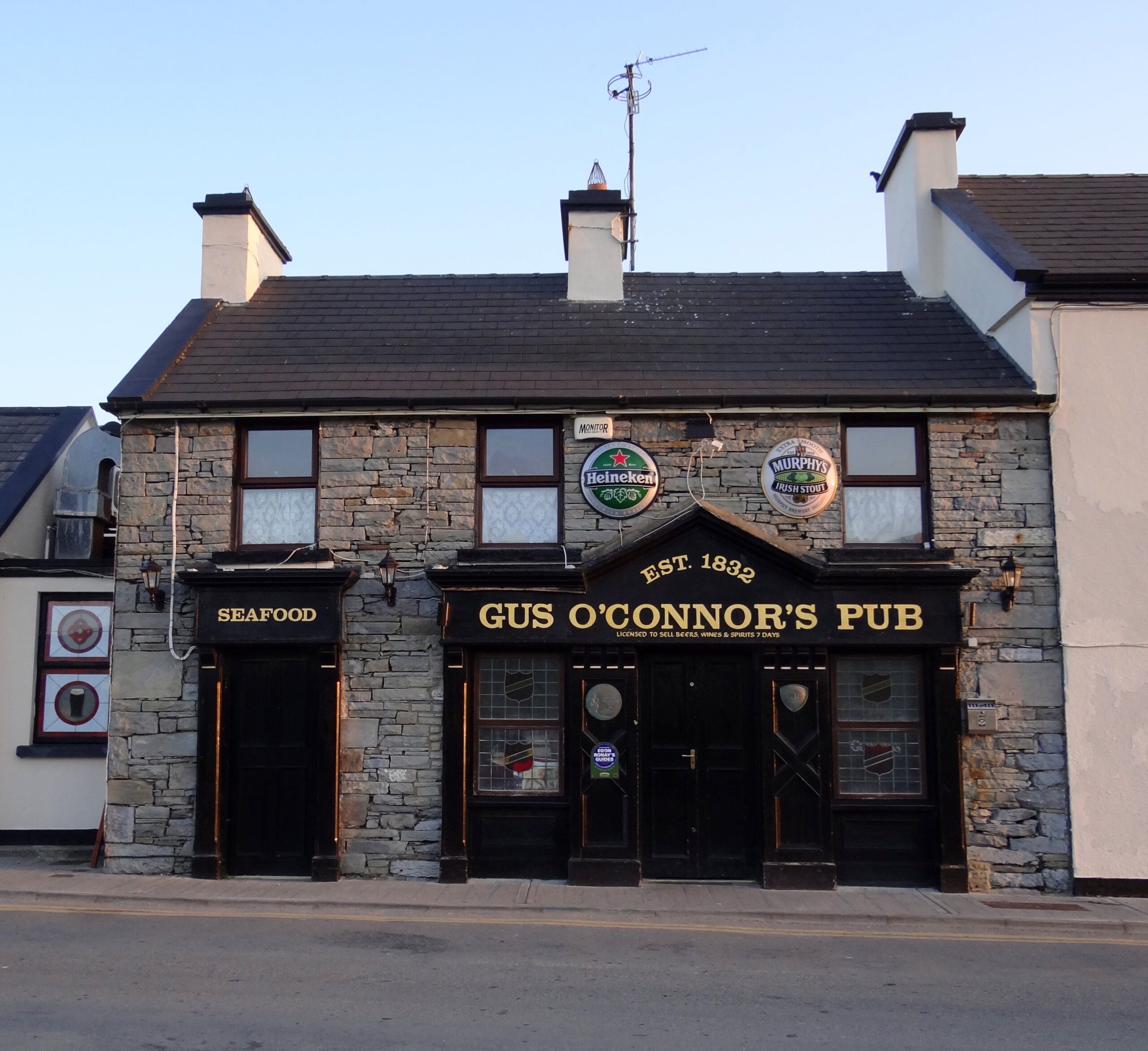
Gus O’Connor’s Pub
The most famous of the three. A low-ceilinged, open-fire pub just metres from the harbour. Sessions have been running here since the 1950s and the bar has barely changed. It is the pub most first-time visitors to Doolin find themselves in on their first night.
McGann’s Pub
A smaller, quieter room where sessions can feel more concentrated. Favoured by local musicians and regulars who want less tourist traffic and more music.
McDermott’s Pub
Set slightly apart from the others, McDermott’s has its own loyal following. Sessions here tend to run later and can be livelier at weekends.
All three pubs follow the same informal rule: sessions start when musicians arrive, and end when they decide to leave.
What Doolin Feels Like Today
Sessions still run most nights in Doolin, with summer being the busiest period. The village connects to the Aran Islands via the Doolin Ferry, making it a natural base for exploring the Atlantic coast and island life beyond.
Doolin also hosts its own annual music festival each June, drawing players from across Ireland and beyond for several days of sessions, workshops, and performances.
The best pubs in County Clare have long been celebrated by locals and visitors alike — but Doolin’s three hold a particular place even in that company. Before you sit down for your first session, it helps to understand the unwritten rules of an Irish trad session.
The Thing Nobody Warns You About
Most people who visit Doolin once come back.
Not because the village is particularly scenic, or the food is extraordinary, or the pub decor is remarkable. But because something happens in those rooms that is difficult to explain to someone who has not been there.
You sit while rain runs down the windows. A musician in a corner begins to play. People who were mid-conversation stop talking. The room fills with a sound that is technically just a fiddle and a flute, but somehow feels like more.
That feeling — the moment a session hits its stride — is what County Clare has always known and what Doolin gave to the rest of the world.
You do not need to play an instrument to feel it. You just need to walk through the right door on the right night. Start planning your trip with the Love Ireland trip planner.
☘️ You Might Also Love
☘️ Join 64,000+ Ireland Lovers
Every Friday, get Ireland’s hidden gems, local secrets, and travel inspiration — the kind you won’t find in any guidebook.
Subscribe free — enter your email:
Love more? Join 43,000 Scotland lovers → · Join 30,000 Italy lovers → · Join 7,000 France lovers →
Free forever · · Unsubscribe anytime
Tours & experiences you might love


Powered by Viator. Some links are affiliate links — we may earn a small commission at no extra cost to you.
Secure Your Dream Irish Experience Before It’s Gone!
Planning a trip to Ireland? Don’t let sold-out tours or packed attractions spoil your journey. Iconic experiences like visiting the Cliffs of Moher, exploring the Rock of Cashel, or enjoying a guided walk through Ireland’s ancient past often sell out quickly—especially during peak travel seasons.

Booking in advance guarantees your place and ensures you can fully immerse yourself in the rich culture and breathtaking scenery without stress or disappointment. You’ll also free up time to explore Ireland’s hidden gems and savour those authentic moments that make your trip truly special.
Make the most of your journey—start planning today and secure those must-do experiences before they’re gone!