

For millions of Irish-Americans, the journey home starts with a ship manifest. Your great-grandmother’s name is there in black ink. A county is listed. County Clare.
That record is not the end of the search. It is the beginning.
Watch: Do You Qualify for an Irish Passport?
Tracing your Irish family? If one of your grandparents was born in Ireland, you may be able to become an Irish citizen. This 14-minute guide explains who qualifies, what it costs and how long it takes. Thinking of making the move? Get the free Moving to Ireland checklist.
This guide takes you from the immigration records at Ellis Island to the stone walls and Atlantic cliffs of County Clare. It shows you how to find your family, trace them to a specific townland, and stand where they once stood.
The Clare Families Who Came to America
County Clare sits on the western edge of Ireland. The Atlantic lies to the west. The Shannon estuary runs along the south. When the Great Famine struck in 1845, Clare was among the hardest-hit counties in the country.
🇮🇪 Discover Your Irish Heritage
Join 64,000 people staying connected to their Irish roots. Get our free Irish Ancestry Guide — surnames, counties, parish records and emigration history — when you subscribe free.
Get My Free Irish Ancestry Guide →
Free weekly Ireland stories • 64,000 subscribers • Unsubscribe any time
Tens of thousands of Clare families boarded ships for America between 1845 and 1855. Most sailed from Limerick or Galway. Many landed in New York, Boston, or New Orleans. The surnames they carried are still common in Irish-American communities today.
- O’Brien — the royal family of Thomond, the ancient kingdom that became County Clare. Descended from Brian Boru, High King of all Ireland.
- McNamara — lords of East Clare for centuries, from the Gaelic Mac Conmara
- MacMahon — a great Clare clan spread across the north and east of the county
- Moloney — from Ó Maoldhomhnaigh, meaning “devotee of the church”
- Clancy — from Mac Fhlannchaidh, a sept based around Killaloe on the Shannon
- Quinn — from Ó Cuinn, found across the county
- Flanagan — from Ó Flannagáin, meaning “ruddy” or “red-haired”
- Sheedy — a smaller Clare sept, mostly found in mid-Clare
- Keane — from Ó Catháin, common in north Clare and around Ennis
If your family carries one of these names, Clare is where your story begins.
Finding Your Clare Family Before You Travel
Whether your family left from Cobh, Queenstown, or a quiet Clare townland, our guide to Irish Townlands: Discover Where Your Ancestors Really Came From can help you trace the exact place they called home before emigrating.
Research before you travel. A heritage trip without preparation is sightseeing. With preparation, it becomes homecoming.
Ellis Island records are the starting point for most Irish-American families. The Ellis Island Foundation database is free at libertyellisfoundation.org. Search your surname with spelling variations. O’Brien was often recorded as Brien. McNamara became Namara. Quinn was written as O’Quinn. Many records from after 1895 list the county of origin.
Irish civil registration began in 1864. Births, marriages, and deaths from that year are searchable for free at irishgenealogy.ie. Catholic parish records go back further. The National Library of Ireland has digitised many of these at registers.nli.ie.
Griffith’s Valuation listed every landholder in Ireland in the 1840s and 1850s. The Clare section was completed in 1855. Search it free at askaboutireland.ie. This survey often shows the exact townland your family lived in — the specific piece of ground they left behind.
The 1901 and 1911 Census are fully searchable for free at nationalarchives.ie/collections/search-the-census. These records show entire family units at a single address. If your family left relatives behind in Clare, you may find them there.
Our full guide to tracing your Irish roots from America covers every archive and database in detail. You can also read about finding Irish ancestors through free online records before you spend anything.
☘️ Enjoying this? 64,000 Ireland lovers get stories like this every week. Subscribe free →
The Clare Heritage and Genealogy Centre
The Clare Heritage and Genealogy Centre is the best single resource for anyone researching a Clare family name. It sits in Corofin, a quiet village in the middle of the county.
In the 1840s, families from parishes across mid-Clare walked through Corofin on their way to the emigration ports at Limerick and Galway. Many of the surnames on the centre’s databases are the same names those families carried west.
The centre holds records you will not find online:
- Catholic and Church of Ireland parish registers for dozens of Clare parishes
- Land records, including Griffith’s Valuation and the Tithe Applotment Books
- Famine-era emigration records from Clare workhouses
- Burial records from rural cemeteries across the county
- Newspaper archives and estate papers
Their database connects to rootsireland.ie, the national genealogy network. Search online before you travel. Then visit in person to go deeper into specific records. Staff there are experienced in helping Irish-Americans trace families to particular townlands.
Book your visit in advance. Summer is busy. A weekday visit in May, June, or September gives you the most time with staff. The nearby Dysert O’Dea complex — a round tower, castle ruins, and a Romanesque church in one field — is worth an hour on the same day.
Before you go, read our Irish heritage trip planning guide. It covers how to organise a genealogy visit to any Irish county.
A Five-Day Heritage Itinerary for County Clare
This itinerary balances research time with the experience of the county itself.
Day 1 — Arrive in Ennis. Ennis is the county town and a good base. The town has medieval bones. Ennis Friary dates from 1240. The streets still follow their original lines. Walk the town in the evening. Traditional music sessions start early in the pubs.
Day 2 — Corofin and the Heritage Centre. Spend the morning at the Clare Heritage and Genealogy Centre. Bring everything — ship manifests, birth certificates, any family stories you have. In the afternoon, visit the rural parishes around Corofin. The churchyards hold headstones going back centuries. Read the names on the stones.
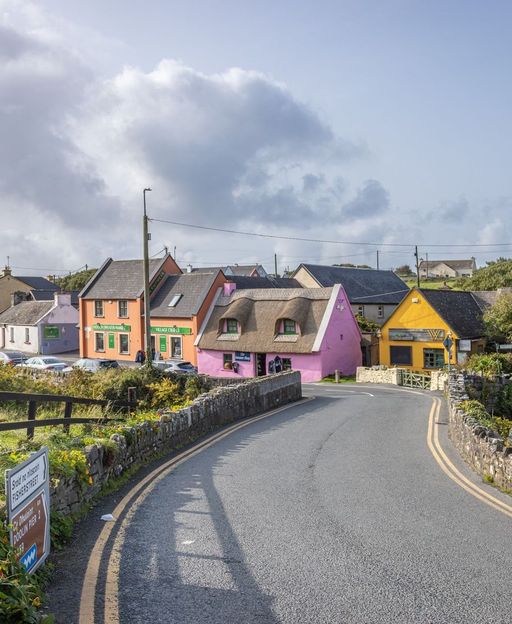
Day 3 — North Clare: Doolin and the Cliffs. Doolin was a fishing village when many Clare families left for America. It sits on the Atlantic, three kilometres from the Cliffs of Moher. The cliffs rise 214 metres above the sea and run for eight kilometres along the coast. These were among the last things many Clare emigrants saw as the ship turned west. Walk the cliff path in the early morning before the coaches arrive.
Day 4 — The Burren and Lisdoonvarna. The Burren is limestone karst landscape. Ancient tombs sit in open fields. Wildflowers grow from cracks in the rock. The Poulnabrone dolmen dates from 4200 BC. Lisdoonvarna sits on the edge of the Burren. In the 19th century, Clare farmers came here in September to find a spouse. The Lisdoonvarna Matchmaking Festival still runs today.
Day 5 — Loop Head and the Shannon Coast. Loop Head is the far western tip of Clare. A light has warned ships off this headland since 1670, though the current tower dates from 1854. On a clear day, the Kerry mountains are visible to the south. The Aran Islands sit to the north. Face west. Somewhere across that water is where your family arrived.
For a longer trip that takes in counties beyond Clare, see our 7-day Irish ancestry itinerary for first-time visitors.
Finding the Townland
A townland is the smallest land division in Ireland. Smaller than a village. Sometimes just a handful of fields. There are over 60,000 across the country. Many Ellis Island records include a townland name alongside the county.
If you have a townland name, find it on townlands.ie. Historical Ordnance Survey maps show every Clare townland with its boundaries and nearby features. The maps are free at map.geohive.ie, run by Tailte Éireann.
Once you find the townland, you can visit it. Most in County Clare are still marked on road signs. Some have 19th-century cottages still standing. Others are open fields with stone walls. Even a field is something. Your great-grandmother walked that field. The walls she passed are still there.
Talk to people while you are there. An older man in Corofin who shares your family name is a living connection. His memory of his grandfather’s stories holds evidence that no archive contains. Ask at the heritage centre. Ask in the local pub. People in Clare know the old family names and where they lived.
Clare was not the only county that sent families through Ellis Island. Our article on Cobh — Ireland’s main emigration port on the south coast — covers how the crossing worked for those who sailed from Cork.
What to Bring Home
The best things you bring home are not bought in a shop.
A photocopy of a baptism record from a Clare parish church is worth more than any souvenir. A photograph of the view from your ancestral townland — not staged, just what you actually saw — is a real document.
If you found a specific burial entry or marriage record, write down the exact wording. The date. The witnesses. Those details often lead to the generation before.
Come home with a name, a townland, and a sense of what your family left behind. That is what this journey is for.
Frequently Asked Questions About County Clare Ancestry
How do I find out if my family came from County Clare?
Start with Ellis Island arrival records at libertyellisfoundation.org. Records from after 1895 often list the county of origin. Search irishgenealogy.ie for civil registration records and askaboutireland.ie for Griffith’s Valuation. A DNA test through AncestryDNA or 23andMe can also help narrow down the county.
Where is the best place to research Clare ancestry in Ireland?
The Clare Heritage and Genealogy Centre in Corofin holds the most complete records for County Clare. Their database covers Catholic and Church of Ireland parish registers, land surveys, and emigration data. Staff can help trace a family to a specific townland and identify which records survive for that area.
What are the most common surnames from County Clare?
The most historically significant Clare surnames include O’Brien, McNamara, MacMahon, Moloney, Clancy, Quinn, Flanagan, Sheedy, and Keane. O’Brien is the ancient royal surname of the county. The family descended from Brian Boru, the last High King of all Ireland, who ruled from Killaloe on the Shannon in the early 11th century.
Can I visit the townland my ancestors came from?
Yes. If you have a townland name from a ship manifest or civil record, find it on townlands.ie. Most townlands in County Clare are still marked on rural road signs. The Clare Heritage Centre can identify which parish a townland belongs to and which records survive for that area.
When is the best time to visit County Clare for a heritage trip?
Late spring — May and June — and early autumn — September — offer the best conditions. Crowds are lower. The heritage centre is less busy. The west Clare coast is at its most dramatic. July and August are peak season and very busy around the Cliffs of Moher.
☘️ Join 64,000+ Ireland Lovers
Every Friday, get Ireland’s hidden gems, local secrets, and travel inspiration — the kind you won’t find in any guidebook.
Subscribe free — enter your email:
📲 Know someone who’d love this? Share on WhatsApp →
Love more? Join 43,000 Scotland lovers → · Join 29,000 Italy lovers → · Join 7,000 France lovers →
Free forever · One email per week · Unsubscribe anytime
Tours & experiences you might love


Powered by Viator. Some links are affiliate links — we may earn a small commission at no extra cost to you.
Secure Your Dream Irish Experience Before It’s Gone!
Planning a trip to Ireland? Don’t let sold-out tours or packed attractions spoil your journey. Iconic experiences like visiting the Cliffs of Moher, exploring the Rock of Cashel, or enjoying a guided walk through Ireland’s ancient past often sell out quickly—especially during peak travel seasons.

Booking in advance guarantees your place and ensures you can fully immerse yourself in the rich culture and breathtaking scenery without stress or disappointment. You’ll also free up time to explore Ireland’s hidden gems and savour those authentic moments that make your trip truly special.
Make the most of your journey—start planning today and secure those must-do experiences before they’re gone!