

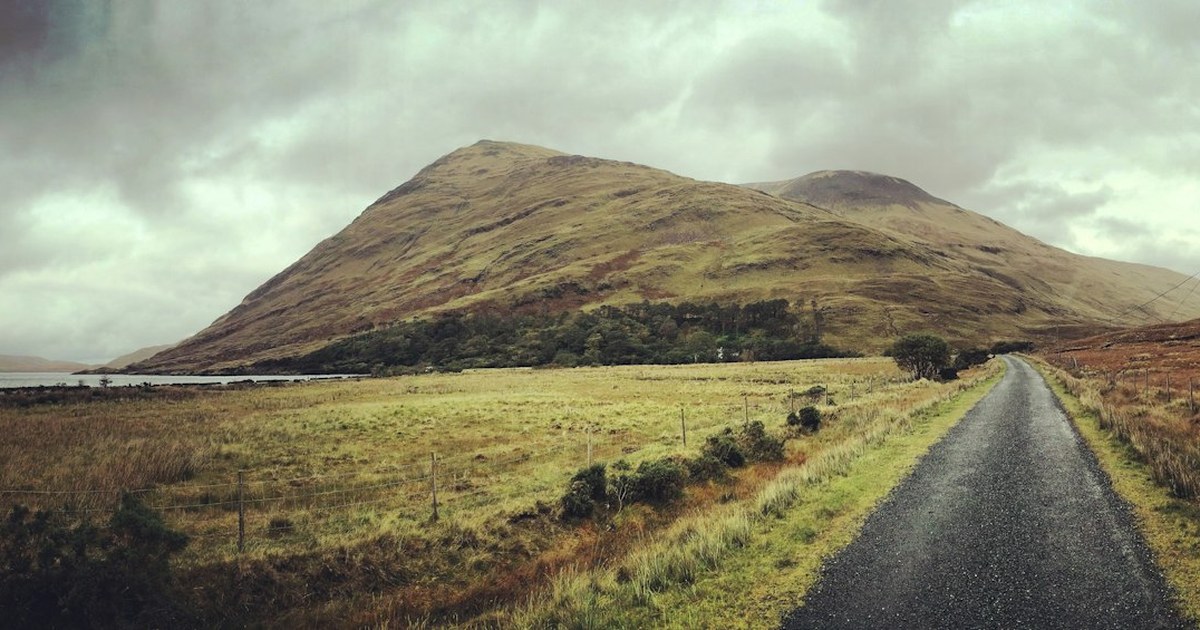
County Mayo gives you 1,168 kilometres of Wild Atlantic coastline, one of Ireland’s holiest mountains, the country’s most photographed island, and a handful of towns that routinely appear on lists of Ireland’s best places to live. It sits on Ireland’s north-west coast, bordered by Galway to the south and Sligo to the north, and it attracts the kind of visitors who come once and start looking at property. This guide covers the best things to do in County Mayo — from the sea stacks at Downpatrick Head to the Georgian harbour at Westport.
Westport: Ireland’s Most Walkable Town
If you visit only one town in County Mayo, make it Westport. Sitting at the head of Clew Bay, with Croagh Patrick filling the skyline to the south, it is one of a small number of planned towns in Ireland — designed in the late 18th century with a tree-lined canal, wide Georgian streets, and a formal octagonal central plaza called The Octagon. The result is a town that feels European in its bones but unmistakably Irish in character.
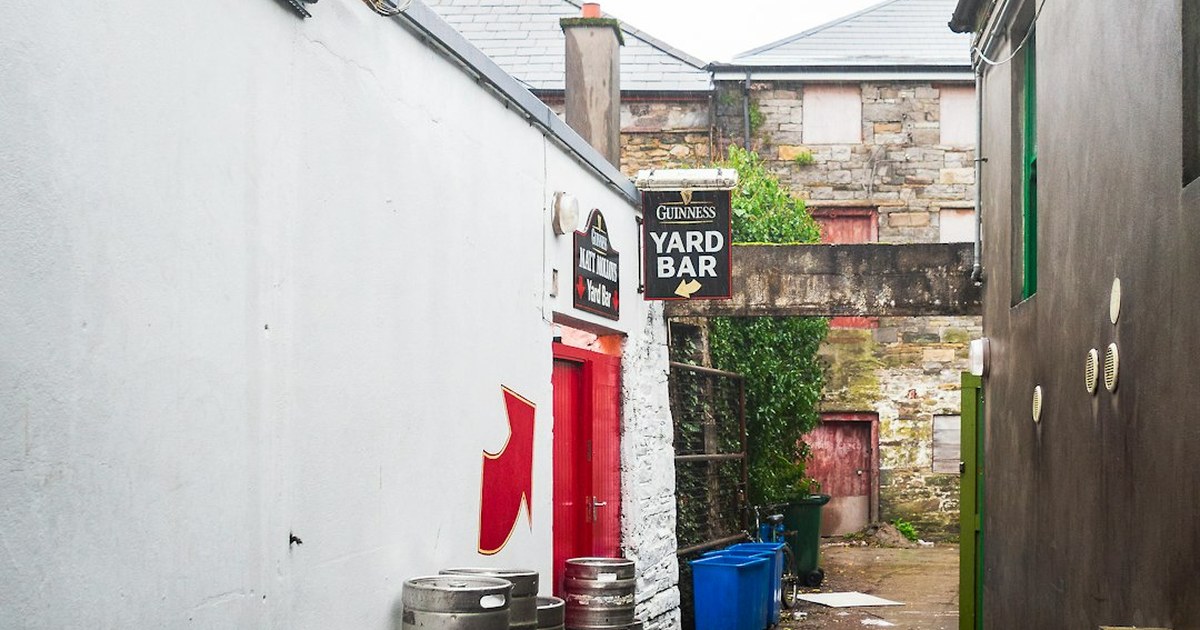
The town centre runs along Bridge Street and James Street, connecting the Quay to the Octagon and linking three or four different pub-and-restaurant circuits — including Matt Molloy’s — that make a full evening’s walk feel natural. Westport House and Country Estate, a 17th-century mansion on the site of Grace O’Malley’s original castle, sits at the edge of town with its lawns running down to the water. Entry costs approximately €18 per adult, and the estate includes formal gardens and a small adventure park.
Westport consistently ranks in national surveys as one of Ireland’s best places to live. The specific combination of walkability, a strong arts scene, a working harbour, good food, and genuine community character puts it on a short list with places like Kilkenny, Westport, and Kinsale. American visitors regularly describe it as the Ireland they imagined before they came — and the one they want to return to permanently. Official info: en.wikipedia.org/wiki/Westport.
Croagh Patrick: Ireland’s Holy Mountain
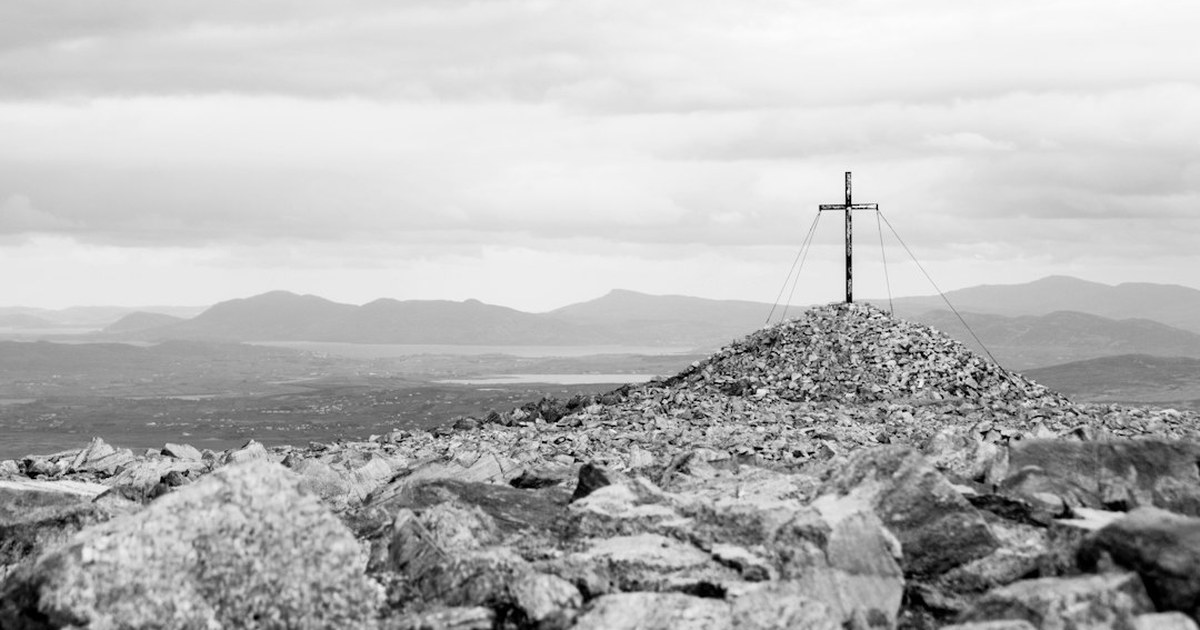
The 764-metre quartzite peak visible from Westport is Croagh Patrick — “the Reek” to locals — Ireland’s holiest mountain and the site of an annual pilgrimage that has drawn people up its slopes for at least 1,500 years. Each year on the last Sunday of July (Reek Sunday), between 15,000 and 25,000 pilgrims climb the mountain. Many walk barefoot, following a tradition that stretches back to at least the 5th century, when St. Patrick is said to have spent 40 days fasting on the summit.
The climb takes most people about two to three hours up and one to one and a half hours down, depending on fitness. The path from the car park at Murrisk follows a well-worn route along the south-western ridge. The upper section, known as “the Cone,” is loose quartzite scree that requires care in wet conditions. On a clear day, the view from the summit takes in Clew Bay with its 365 drumlins — one for every day of the year according to local legend.
The mountain holds particular significance for Irish diaspora visitors. For many families whose ancestors left Mayo during the Famine years of the 1840s, standing on the summit carries emotional weight that simple sightseeing does not. More than 50,000 people emigrated from County Mayo during the Famine — the county was among the hardest hit in Ireland.
☘️ Enjoying this? 64,000+ Ireland lovers get stories like this every week. Subscribe free →
Achill Island: Ireland’s Largest Island
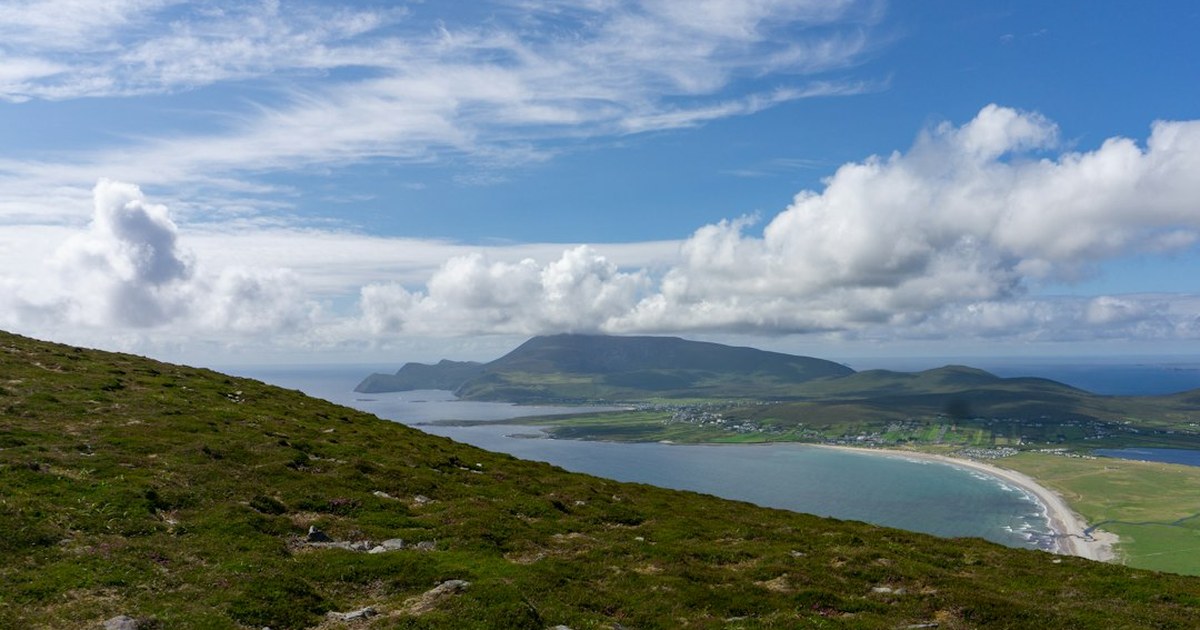
Achill Island connects to the mainland by a bridge and covers 148 square kilometres of mountains, blanket bog, and Atlantic coastline. It is Ireland’s largest island and one of the most dramatic landscapes in the country. The main settlements — Achill Sound, Keel, and Dugort — sit in valleys between the Minaun and Slievemore mountains, with five Blue Flag beaches spread around the island’s coastline.
Keel Beach, a 3-kilometre stretch of Atlantic sand with Cathedral Rocks at its western end, is one of Mayo’s best-known beaches. Keem Bay, at the island’s western tip, requires a drive along a narrow cliff road but rewards you with a sheltered turquoise bay that looks nothing like most people’s mental image of the Irish west coast. The abandoned village at Slievemore, empty since the Famine, stretches across the southern slope of the mountain in rows of roofless stone cottages — an atmospheric and sobering reminder of the scale of what the Famine destroyed.
The island has drawn artists and writers for well over a century. Heinrich Böll, the German Nobel laureate, lived on Achill in the 1950s and wrote his Irish Journal here — still one of the best accounts of mid-20th century rural Irish life. His cottage at Dugort is now a cultural centre that hosts residencies and events. Official info: en.wikipedia.org/wiki/Achill_Island.
Clew Bay and the Famine Road
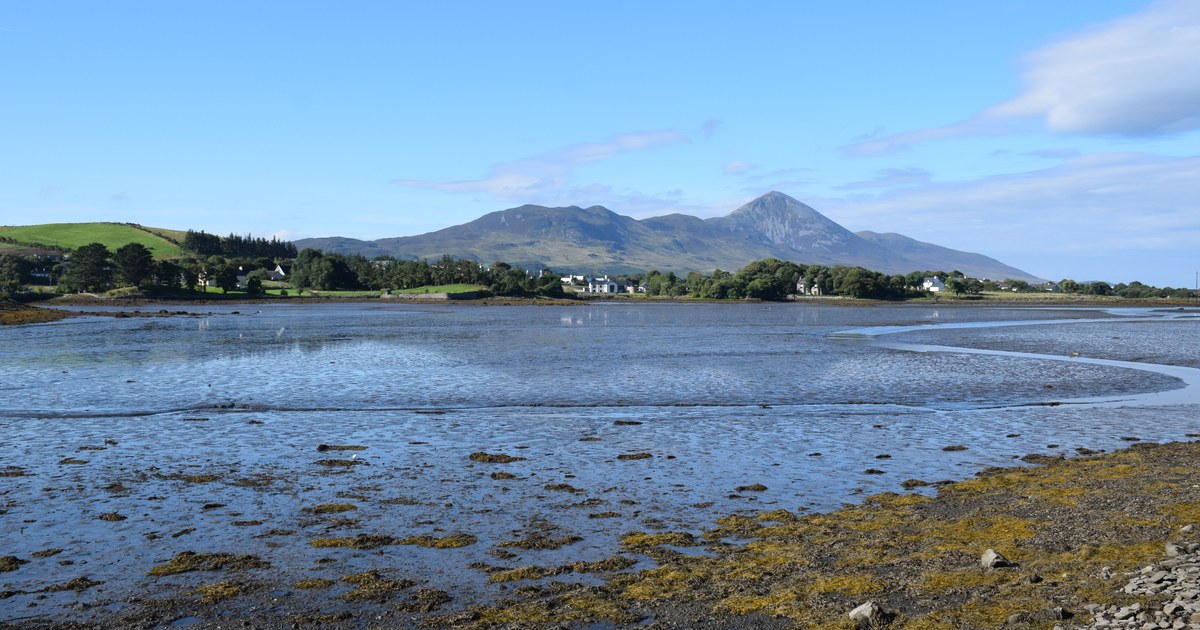
Clew Bay stretches between Westport and Achill Sound, a broad sheltered inlet dotted with more than 100 small islands formed by the last Ice Age. At low tide, the bay takes on an almost otherworldly quality as shallow channels between the drumlins catch the light differently at every angle. Sea kayaking on the bay is popular in summer, and the Great Western Greenway — a 42-kilometre off-road trail from Westport to Achill — runs along the southern shore and offers the best land-level views of the water.
The Greenway follows the route of the former Westport–Achill railway line, opened in 1894 and closed in 1937. Along the route, interpretive signs mark the locations of famine-era events and historical sites — including the spot where hundreds of Mayo people boarded “coffin ships” headed for the east coast of America and Canada in the 1840s. The Famine is woven into the physical landscape of County Mayo in a way that visitors from the Irish diaspora find impossible to ignore.
Cong and the Quiet Man Country
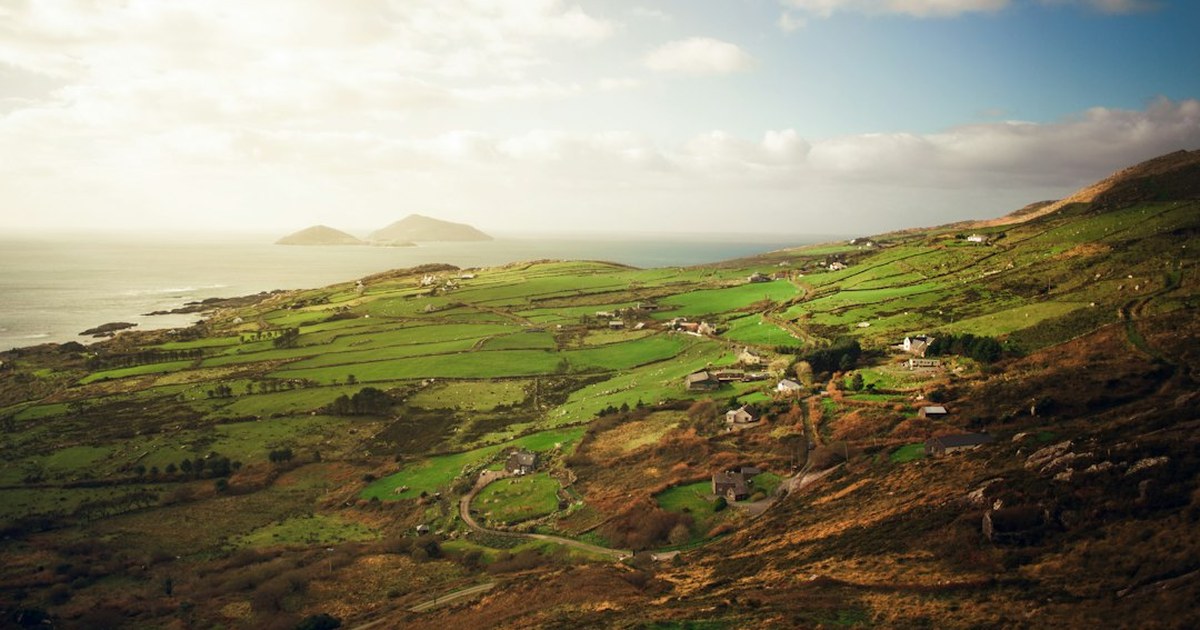
Cong sits on a narrow strip of land between Lough Corrib and Lough Mask at Mayo’s southern border, a village of about 200 people most famous as the filming location for John Ford’s 1952 film The Quiet Man. The film starred John Wayne and Maureen O’Hara, and its image of rural Ireland — white-washed cottages, turf smoke, horse-drawn traps — has shaped American ideas about the country for over 70 years.
The village is small enough to walk in an afternoon. The Quiet Man Museum occupies a thatched cottage on the main street and contains memorabilia from the film. Ashford Castle, a five-star hotel dating to 1228 that sits immediately outside the village, allows non-guests to walk the grounds and visit the property as a day visitor for a charge of approximately €10 per person. The castle offers falconry, shooting, and fishing activities and occupies one of the most dramatic estate landscapes in Ireland.
Cong Abbey, founded in the 12th century by the last High King of Ireland Ruaidrí Ua Conchobair, stands in the village centre in a good state of partial preservation. The cloister and several doorways are intact, and the fishermen’s house — a small stone structure built over the river with a trapdoor in the floor so monks could lower a line into the current — is one of the most unusual surviving monastic features in Ireland.
Downpatrick Head and the North Mayo Coast
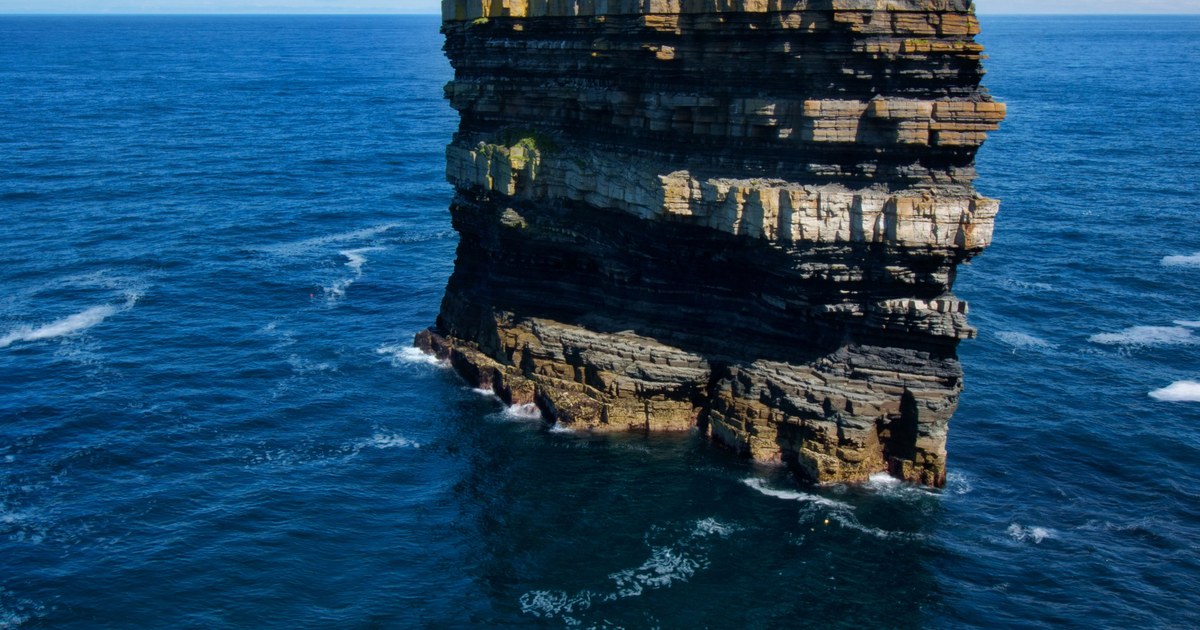
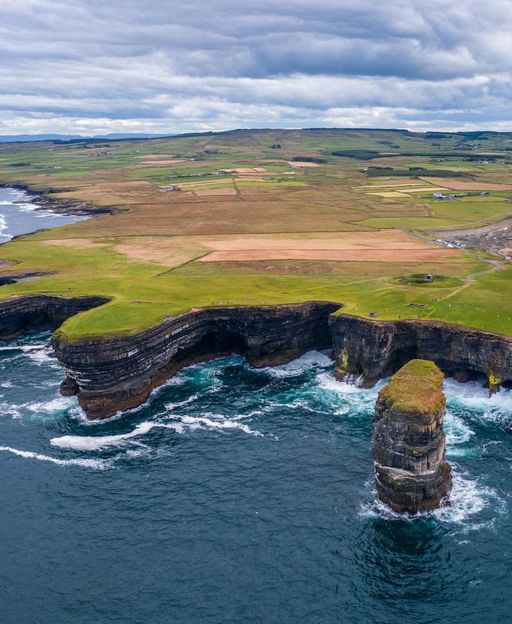
The north coast of County Mayo, running east from Belmullet to Killala Bay, is the quietest and most remote part of the county. Downpatrick Head, near Ballycastle, is where a free-standing sea stack called Dún Briste rises 50 metres out of the Atlantic, separated from the mainland by a chasm that opened in 1393 according to local records. The stack is a striking geological feature and has become one of the county’s most distinctive landmarks.
Near Ballycastle, the Ceide Fields — the most extensive Neolithic site in the world — lie beneath the blanket bog covering the cliffs north of the village. The fields, stone-walled and preserved intact under 5,000 years of peat growth, represent a Neolithic farming landscape from approximately 3500 BCE. Excavations by archaeologist Seamus Caulfield since the 1930s have uncovered evidence of a landscape in which several hundred people farmed these clifftops before the climate changed and the bog grew over their fields. The visitor centre at the site, designed by Peter Rice, explains the context well and the guided tours last about 45 minutes.
Belmullet, the main town on the Mullet Peninsula, has a reputation for being one of the last places in Ireland where Irish is spoken as the everyday language of domestic life. It sits at the northern tip of Erris, a peninsula of bog and Atlantic coast that stretches into the ocean for 30 kilometres west of the mainland. The light here in summer evenings is unlike anywhere else in Ireland.
Foxford, Ballina and the East of the County
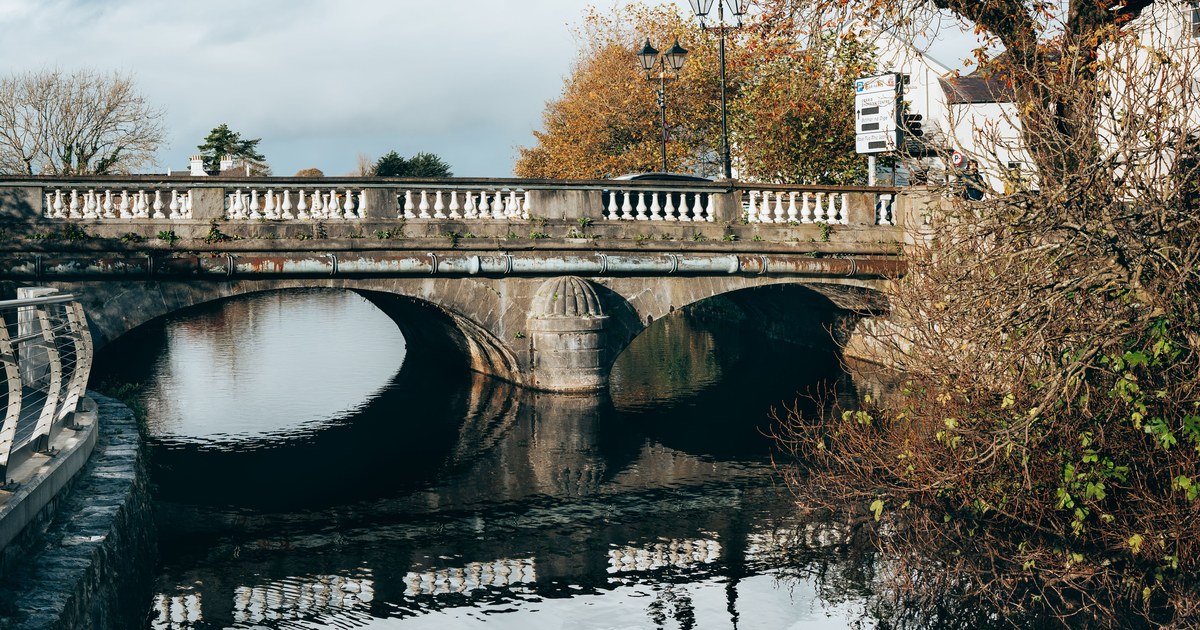
County Mayo’s eastern towns have a different character from the wild Atlantic coast. Ballina, Mayo’s largest town with a population of about 10,000, sits on the River Moy at the point where it opens into Killala Bay. The Moy is one of Ireland’s finest salmon rivers, and the Ridge Pool in the centre of town — where anglers wade in the river as it flows past the backs of the houses — is a sight that stops visitors on the riverside walkway. Salmon fishing permits cost approximately €50 per day, available from local tackle shops.
Foxford, 20 kilometres south of Ballina, is home to the Foxford Woollen Mills, founded in 1892 by a Dominican nun, Mother Agnes Morrogh-Bernard, as a response to local poverty. The mill still operates and produces the Foxford blankets and tweed that have been part of Irish homes for generations. The visitor centre includes a heritage trail explaining the founding story and a shop selling current production — one of the more unusual industrial histories in Ireland and told with genuine warmth. Official info: en.wikipedia.org/wiki/Foxford.
What It Is Actually Like to Live in County Mayo
Americans who have moved to County Mayo consistently describe it in terms of pace and space (see our full guide to living in County Mayo for more on day-to-day life). Property prices remain significantly lower than in Galway or Dublin — a three-bedroom house in a town like Swinford, Ballinrobe, or Charlestown typically costs between €150,000 and €250,000. The county has reasonable broadband infrastructure in the main towns, a regional airport at Knock with direct connections to several European cities, and a slower rhythm of daily life that many people describe as the primary reason they chose it.
The winter weather on the Atlantic coast is the honest caveat. Wind and rain are a genuine feature of life in north and west Mayo from October to March. People who thrive here tend to treat weather as irrelevant or are genuinely drawn to the drama of the Atlantic in winter. Those who need reliable sunshine find it difficult. If the idea of watching a January storm come in from the ocean while sitting in a warm pub appeals to you, County Mayo suits you well.
Community life is the quality most commonly mentioned by people who have settled in rural Mayo. The GAA, local festivals, the arts community around Foxford and Castlebar, and the particular warmth of small-town social life create a texture of belonging that people who have moved from larger cities describe as something they did not expect to find so quickly. If you are researching a permanent move, the full Move to Ireland guide covers the practical questions in depth.
When to Visit County Mayo
- May and June: The best combination of dry weather and long evenings. Crowds build in June but are still manageable outside Westport and Achill.
- July and August: High season. Westport fills up significantly, and Achill Island beaches get busy on good days. Book accommodation at least six to eight weeks ahead.
- September and October: Often the most pleasant time for walking and driving. Crowds thin, the light changes, and the Atlantic weather grows more dramatic without being unpleasant.
- November to March: Quiet to the point of emptiness on the Mullet Peninsula and in Belmullet. Good for people who want to see Mayo as it actually lives rather than as it performs for tourists. Westport retains a local life year-round.
Getting to and Around County Mayo
- By car from Dublin: The N5/N4 motorway to Castlebar takes approximately two and a half to three hours without stops.
- By train: Dublin Heuston to Westport takes approximately three hours and fifteen minutes with two to four services daily, depending on the day.
- Ireland West Airport Knock: Located between Charlestown and Knock, the airport serves Ryanair and Aer Lingus routes from London, Manchester, Birmingham, Edinburgh, and several continental cities. Car hire at the airport makes it straightforward to reach any part of the county within an hour.
- Getting around Mayo itself: A car is essential for exploring Achill Island, the north coast, and the Mullet Peninsula. Westport and Cong are walkable. Bus Éireann routes connect the main towns.
What is County Mayo famous for in Ireland?
County Mayo is famous for Croagh Patrick (Ireland’s holy mountain, climbed by 25,000 pilgrims each July), Achill Island (Ireland’s largest island), Westport (consistently voted one of Ireland’s best towns), and the Céide Fields (the world’s most extensive Neolithic farming landscape). Mayo also has significant connections to the Irish diaspora as one of the counties hardest hit by the 1840s Famine.
How long does it take to drive around County Mayo?
A basic loop from Westport — taking in Achill Island, the north coast through Downpatrick Head, and returning via Ballina and Foxford — covers roughly 250 kilometres and takes about five to six hours without stops. To do justice to the county, allow at least three days: one for Westport and Croagh Patrick, one for Achill Island, and one for the north coast and Céide Fields.
Is County Mayo worth visiting if you have ancestry connections?
Yes. Mayo was among Ireland’s most heavily impacted Famine counties, and more than 50,000 people emigrated from the county in the 1840s, with significant communities settling in Boston, New York, and Pennsylvania. For anyone with Mayo roots, the county offers genuine ancestral resonance — particularly the Famine road along Clew Bay, the abandoned village on Achill Island, and the emigration records held at the County Mayo Library in Castlebar.
What is the best base for exploring County Mayo?
Westport is the best all-round base for County Mayo. It sits centrally within the county, has the best concentration of accommodation and restaurants, and connects easily to Achill Island, Croagh Patrick, Cong, and the north coast. For anyone specifically focused on the north Mayo coast or the Mullet Peninsula, Ballina offers a quieter and more practical base.
Is it expensive to visit County Mayo compared to the rest of Ireland?
County Mayo is generally less expensive than Dublin, Killarney, or Galway. Accommodation in Westport ranges from approximately €90 to €160 per night for a mid-range guesthouse or hotel in high season. In smaller towns like Ballina or Foxford, comparable accommodation typically costs €70 to €120 per night. The lack of major tourist infrastructure in north and west Mayo keeps prices lower than comparable areas in Kerry or Clare.
October is Family History Month across North America — if Mayo has a personal connection for you, whether through family roots or the famine story, our free Irish Ancestry Guide at the link below can help trace which townland your family originally came from.
☘️ Join 64,000+ Ireland Lovers
Every weekday morning, get Ireland’s hidden gems, local secrets, and travel inspiration — the kind you won’t find in any guidebook.
Subscribe free — enter your email:
Already subscribed? Download your free Ireland guide (PDF)
📲 Know someone who’d love this? Share on WhatsApp →
Love more? Join 43,000 Scotland lovers → · Join 29,000 Italy lovers → · Join 7,000 France lovers →
Free forever · Unsubscribe anytime
Tours & experiences you might love


Powered by Viator. Some links are affiliate links — we may earn a small commission at no extra cost to you.
Secure Your Dream Irish Experience Before It’s Gone!
Planning a trip to Ireland? Don’t let sold-out tours or packed attractions spoil your journey. Iconic experiences like visiting the Cliffs of Moher, exploring the Rock of Cashel, or enjoying a guided walk through Ireland’s ancient past often sell out quickly—especially during peak travel seasons.

Booking in advance guarantees your place and ensures you can fully immerse yourself in the rich culture and breathtaking scenery without stress or disappointment. You’ll also free up time to explore Ireland’s hidden gems and savour those authentic moments that make your trip truly special.
Make the most of your journey—start planning today and secure those must-do experiences before they’re gone!