

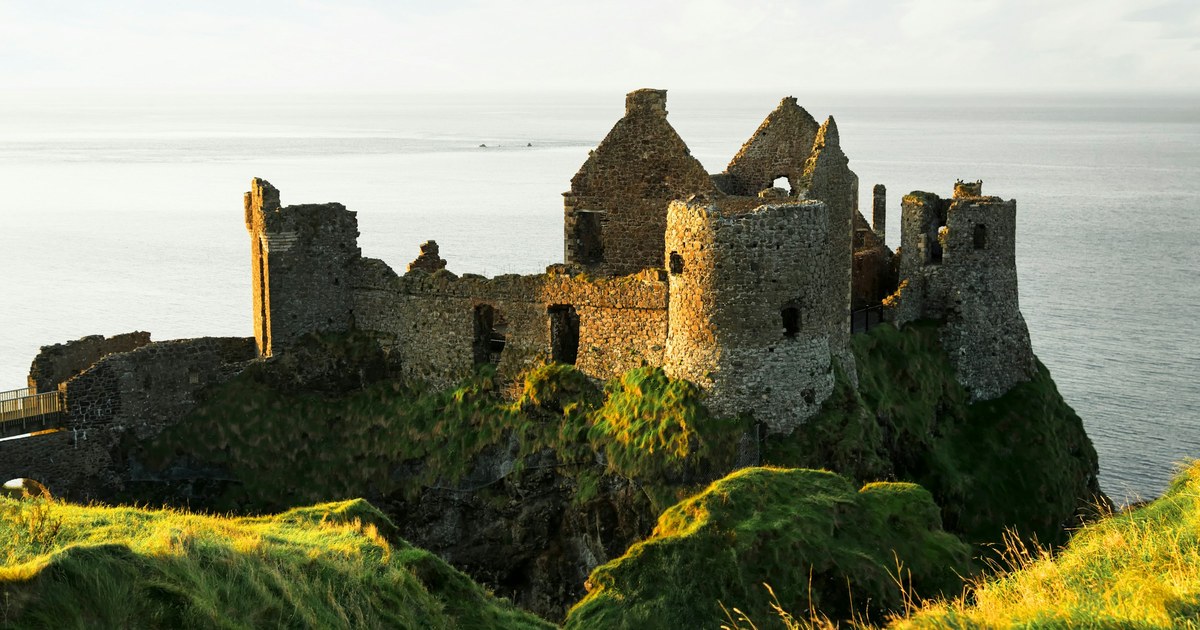
Dunluce Castle is a ruined medieval fortress on the north coast of County Antrim, in Northern Ireland. It stands on a sheer basalt outcrop about 30 metres above the Atlantic, roughly 4 km from Bushmills and 8 km from the Giant’s Causeway. It is one of the most photographed castles on the island of Ireland, and you can see most of it in about an hour.
This guide covers the history, what to look for on site, how to fit Dunluce into a day on the Causeway Coastal Route, and what else is close by. Northern Ireland is part of the United Kingdom, so remember that your phone and your money may behave differently from the Republic. Check the official visitor pages before you travel, because opening times and entry rules change.
The history of Dunluce Castle
The earliest stone buildings at Dunluce date to around 1500. The MacQuillan family held the headland then. They were Anglo-Norman in origin and had grown into powerful Gaelic lords of the area known as the Route.
Control passed to the MacDonnells, a Scottish clan from the Western Isles, in the 1560s. Sorley Boy MacDonnell took the castle during the long struggle for north Antrim, and his family then strengthened and extended it. Later owners added a more comfortable residence in the early 1600s, with large windows and a formal layout that sat oddly beside the older defences.
In October 1588, survivors of a wrecked Spanish Armada galleass came ashore at the foot of these same cliffs. Read the full Spanish Armada shipwreck story for that chapter of the castle’s history.
Why the site matters
The headland made Dunluce hard to attack. Cliffs fall away on three sides, and only one narrow approach leads to the gate. That position let the lords of the Route watch ships along the coast and control the land route between Antrim and the Scottish islands, which lie only about 20 km across the sea at the nearest point.
The legend of the falling kitchen
Local tradition says that in 1639 part of the kitchen collapsed into the sea during a storm. The story claims that the cooks fell with it and only a kitchen boy survived, because he was sitting in a corner that held. Our full account of the night the kitchen fell covers the story in more detail. Historians treat the tale with caution. The castle was in decline by the later 1600s, and the family moved to a new house inland. After that, wind, salt and weather did the rest.
- Around 1500: the MacQuillans build the first stone castle on the headland.
- 1560s: the MacDonnells take over and begin rebuilding.
- Early 1600s: new domestic buildings go up inside the walls.
- Late 1600s: the family leaves and the castle slowly falls into ruin.
What to see at Dunluce Castle
When you walk out to the castle, the first thing you notice is how little ground there is. The ruin fills the whole rock. A narrow bridge links the mainland to the gatehouse, and the drop on both sides is steep.
The gatehouse and the bridge
The twin-towered gatehouse is the most complete part of the castle. Its round towers show where defenders once stood. Take a moment on the bridge to look down at the waves and the cliff face, then turn back to see how the whole ruin rises above the water.
The Great Hall and the courtyards
Inside the walls you can trace the line of the Great Hall, the old kitchens and the ruined houses of the later period. Signs and displays explain what each space did. Imagine the noise, smoke and sea wind in a working castle and the ruin starts to make sense.
Mermaid’s Cave
A sea cave runs beneath the headland, known as the Mermaid’s Cave. Local stories link it to smugglers, shipwrecks and Maeve Roe, the lady of the castle who is said to have been seen on the rocks. Access is limited, so look at it from the viewing points rather than trying to reach it.
☘️ Enjoying this? 64,000+ Ireland lovers get stories like this every week. Subscribe free →
Planning your visit to Dunluce Castle
Dunluce sits on the A2 coast road between Portrush and Bushmills. Belfast is about 100 km away, and Dublin is roughly 250 km. Most visitors arrive by car as part of the Causeway Coastal Route. There is a car park beside the site, and a short walk takes you to the gatehouse.
- Time needed: allow about an hour, or longer if you like photography.
- Best light: late afternoon and early evening bring warm colour to the stone.
- Footwear: wear shoes with grip, because paths and steps are uneven and can be wet.
- Wind: the headland is exposed, so bring a windproof layer even on bright days.
- Opening times and entry: check the official Northern Ireland visitor listings before you set off.
Visiting in autumn and winter
November is a fine month for Dunluce. Crowds thin out, the light is low and golden, and stormy seas make the cliff setting feel dramatic. Short days mean you should plan your arrival early, and you should expect rain. The rewards are empty paths and clear photographs.
What to see near Dunluce Castle
Dunluce works well as one stop in a longer day. Several famous sights sit within a short drive.
- The Giant’s Causeway lies about 8 km east. The National Trust page for the Giant’s Causeway explains the basalt columns and gives current visitor details.
- The Old Bushmills Distillery in Bushmills is the oldest licensed distillery site in Ireland, with a licence dating to 1608. See the Bushmills website for tours.
- Carrick-a-Rede is a clifftop walk to a rope bridge about 20 km east. The National Trust Carrick-a-Rede page has the details.
- Mussenden Temple at Downhill sits on a cliff to the west. The Downhill Demesne page tells its story.
Add a stop at the famous beech tunnel and you have a full day. Our guide to the Dark Hedges and its grey lady legend covers the nearby tree avenue.
More castles to explore in Ireland
If Dunluce leaves you wanting more, try our top 10 castles in Ireland you can go inside and the complete guide to Irish castles. Our Trim Castle guide and Cahir Castle guide cover two great medieval fortresses in the Republic. To plan the rest of your trip, start with the planning hub and our 7-day Ireland road trip itinerary.
Frequently asked questions about Dunluce Castle
Where is Dunluce Castle?
Dunluce Castle stands on a basalt cliff on the north coast of County Antrim, Northern Ireland. It sits about 4 km from Bushmills and roughly 8 km from the Giant’s Causeway.
How old is Dunluce Castle?
The oldest surviving stonework dates to around 1500, when the MacQuillan family held the site. The MacDonnells took over in the 1560s and rebuilt much of it.
Is Dunluce Castle worth visiting?
Yes. The cliff setting, the sea views and the short walk from the car park make it one of the best castle stops on the Causeway Coastal Route.
How long do you need at Dunluce Castle?
Most visitors need about an hour. Add time if you want to walk the clifftop paths or photograph the ruins in the evening light.
☘️ Join 64,000+ Ireland Lovers
Every weekday morning, get Ireland’s lesser-known corners, local stories and secrets, straight to your inbox.
Subscribe free — enter your email:
Already subscribed? Download your free Ireland guide (PDF)
📲 Know someone who’d love this? Share on WhatsApp →
Free forever · Unsubscribe anytime
Tours & experiences you might love


Powered by Viator. Some links are affiliate links — we may earn a small commission at no extra cost to you.
Secure Your Dream Irish Experience Before It’s Gone!
Planning a trip to Ireland? Don’t let sold-out tours or packed attractions spoil your journey. Iconic experiences like visiting the Cliffs of Moher, exploring the Rock of Cashel, or enjoying a guided walk through Ireland’s ancient past often sell out quickly—especially during peak travel seasons.

Booking in advance guarantees your place and ensures you can fully immerse yourself in the rich culture and breathtaking scenery without stress or disappointment. You’ll also free up time to explore Ireland’s hidden gems and savour those authentic moments that make your trip truly special.
Make the most of your journey—start planning today and secure those must-do experiences before they’re gone!