

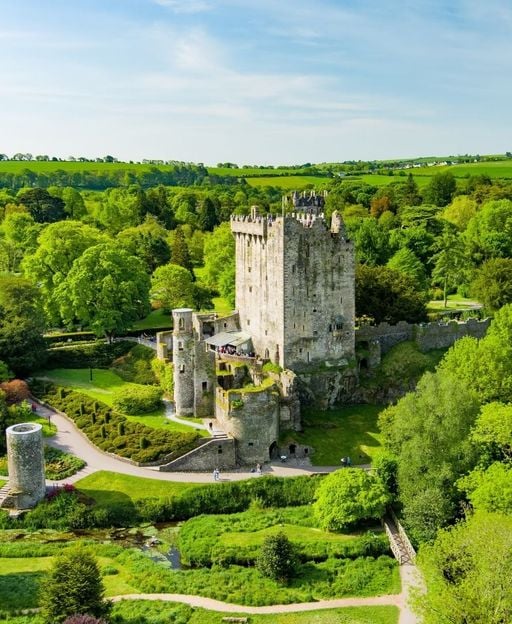
Blarney Castle stands 8 kilometres north-west of Cork city and draws visitors from every corner of the world. Built in 1446 by Cormac Laidir MacCarthy, the massive stone keep rises approximately 26 metres above its wooded grounds — and at the very top sits a limestone block that has inspired more legends, arguments, and awkward backwards leans than any other stone in Ireland. This guide covers the history, the myths, and everything you need to plan your visit.
The History of Blarney Castle
A castle has stood on this site since the early 10th century, but the structure visitors see today dates to 1446. Cormac Laidir MacCarthy built the square tower keep using local limestone. His name translates as “the strong”. The castle served as the seat of the MacCarthy Mór clan. They were one of the most powerful Gaelic families in Munster.
The castle changed hands many times after the Williamite Wars of the 1690s, when MacCarthy lands were confiscated. The estate passed through several English owners before the Colthurst family acquired it. The adjacent Blarney House — a Scottish baronial mansion completed in 1874 — became the family residence and remains in Colthurst ownership today.
The grounds were landscaped in the 18th and 19th centuries and now include formal gardens, a rock close, ancient standing stones, and a wishing well. Blarney is far more than a single famous stone — though the stone is why most people arrive.
The Blarney Stone: Myth, Legend, and Reality
The Blarney Stone sits in the battlements, 26 metres above the ground. To kiss it, you must lie on your back and grip iron bars. Then you lean backwards over a narrow gap in the parapet. Millions of people have done this since the late 18th century. They come in pursuit of eloquence and the gift of speech.
The most repeated origin story traces the word “blarney” to Queen Elizabeth I. In the late 16th century, Cormac Teige MacCarthy kept promising to submit to the Queen. But he always found a reason to delay. Each time her representatives reported back with another elaborate excuse, Elizabeth reportedly declared: “This is all Blarney.” The word entered English as a synonym for flattering, cleverly evasive talk.
Other theories claim the stone was a gift from Robert the Bruce in 1314. He sent it after the Battle of Bannockburn. According to this version, it was a fragment of the Stone of Scone — Scotland’s ancient coronation stone. Another tradition holds that it came from the biblical lands, brought to Ireland via Spain. None of these stories are verifiable, which has probably done nothing but add to the stone’s mystique.
By 1800, kissing the stone was already a fashionable tradition among travellers. Sir Walter Scott visited Blarney in 1825 and kissed the stone. Today, over 400,000 visitors make the climb each year, making it one of Ireland’s most visited heritage sites. Curious which origin story holds up best? We dug into the disputed origins of the Blarney Stone in more detail.
☘️ Planning a trip to Ireland?
Our free 7-day road trip itinerary covers the Wild Atlantic Way from Dublin to the west — day-by-day driving guide with hidden gems, practical tips, and local secrets.
What to See and Do at Blarney Castle
Most visitors focus entirely on the Blarney Stone, which is understandable but a shame. The estate covers around 60 acres and rewards those who allow a full morning or afternoon to explore.
Climbing the Castle Keep
To reach the Blarney Stone, you climb 127 steps. The staircase inside the castle is narrow and the steps are worn smooth. Wear flat shoes. Do not wear heels or sandals. Staff assist at the top with the backwards lean over the parapet. The view from the battlements stretches across County Cork’s green countryside and is worth the climb on its own terms.
The Poison Garden
Blarney’s Poison Garden contains over 70 plants. Each one can harm, intoxicate, or kill. The range runs from hemlock to mandrake to cannabis. Every plant is clearly labelled with its effects. It is modelled on the famous Poison Garden at Alnwick Castle in Northumberland, England, and is consistently one of the estate’s most-talked-about attractions. Children in particular find it both educational and alarming. For a closer look at every plant on display, see our full guide to the Poison Garden.
Rock Close and Ancient Stones
The Rock Close is a garden of massive boulders and ancient trees. People have linked it to Druidic practise for centuries. Inside you will find a Witch’s Kitchen — a hollow formed between two enormous rocks. There is also a Druidic altar stone and the Wishing Steps. The steps are cut into the living rock. Visitors descend them backwards with eyes closed while making a wish. The atmosphere here is genuinely atmospheric, particularly in early morning before the crowds arrive.
The Bog Garden and Arboretum
The grounds include a bog garden planted with moisture-loving species, a Victorian fernery, and an arboretum containing specimens planted over 200 years ago. Blarney is at its most spectacular in spring when the rhododendrons are in full bloom, but the estate rewards a visit in any season.
Blarney House
Blarney House, adjacent to the castle, opens during summer months. Completed in 1874 in the Scottish baronial style, its interior gives a clear picture of Anglo-Irish landed life in the Victorian era. The formal gardens surrounding the house are separate from the wider castle grounds and worth exploring independently.
☘️ Enjoying this? 64,000+ Ireland lovers get stories like this every week. Subscribe free →
Planning Your Visit to Blarney Castle
How to Get There from Cork
Blarney Castle sits 8 kilometres north-west of Cork city centre. From Cork, your options are:
- Bus: Bus Éireann runs regular services from Cork Bus Station at Parnell Place. The journey takes around 30 minutes. From Blarney village, the castle is a 10-minute walk.
- Car: Follow the N20 north from Cork. Parking is available at the castle. The drive takes around 15 minutes outside peak traffic.
- Tour: Several Cork-based operators run half-day excursions to Blarney, often combined with a stop at Cobh or Kinsale.
Tickets and Opening Hours
Blarney Castle opens year-round, with extended summer hours. It closes on Christmas Day. Entry fees change periodically — check the official Blarney Castle website for current admission prices. Booking tickets online in advance is strongly recommended in summer, when queues for the stone can stretch to 45 minutes or more on busy days.
How Long Should You Allow?
Allow at least 2 hours if you want to climb the castle and see the main gardens. Three hours is more comfortable if you plan to explore the Rock Close, Poison Garden, bog garden, and Blarney House. Many visitors combine Blarney with Cobh — 25 kilometres south-east — for a full day of Cork heritage.
Blarney Castle and the Wider Cork Experience
For visitors with Irish ancestry, Cork and its surroundings form one of the most historically layered parts of Ireland. The MacCarthy clan who built Blarney were among the last Gaelic lords of Munster to resist Tudor expansion. Their story — of eloquent delays, broken promises, and ultimate dispossession — mirrors the fate of Gaelic Ireland across the 16th and 17th centuries.
Many of the families who left County Cork during the Great Famine (1845–1852) or in subsequent decades did so through the port at Cobh, then known as Queenstown. The town’s Titanic connection and its Queenstown Story museum make it a natural companion to Blarney for those tracing family roots. Kinsale, 30 kilometres south of Cork city, offers some of Ireland’s finest restaurants alongside its own medieval heritage at Charles Fort.
Whether you come for the stone, the gardens, or the history of the MacCarthys, Blarney delivers something most famous tourist sites cannot — a place that exceeds expectations rather than simply meeting them.
Frequently Asked Questions About Blarney Castle
What does the Blarney Stone supposedly do?
According to legend, kissing the Blarney Stone grants the “gift of gab” — the ability to speak eloquently and persuasively. The word “blarney” itself entered the English language as a term for flattering, cleverly evasive speech, lending the legend an extra layer of self-aware irony.
Is Blarney Castle worth visiting beyond the famous stone?
Yes — Blarney Castle rewards a full half-day visit. The estate covers around 60 acres and includes the Poison Garden (70 species of harmful plants), Rock Close with ancient standing stones, a Victorian arboretum, a bog garden, and Blarney House. The Blarney Stone is the reason most people come, but the grounds are why they remember the visit.
How far is Blarney Castle from Cork city?
Blarney Castle is 8 kilometres (5 miles) north-west of Cork city centre. By car the drive takes about 15 minutes. Bus Éireann runs regular services from Cork Bus Station at Parnell Place, with a journey time of around 30 minutes followed by a short 10-minute walk from Blarney village.
When is the best time to visit Blarney Castle?
Visit on a weekday morning, ideally in May, June, or September, for the best combination of good light, manageable crowds, and grounds in good condition. Summer weekend afternoons see the longest queues for the Blarney Stone — sometimes 45 minutes or more. Book tickets online in advance during the peak summer months.
☘️ Join 64,000+ Ireland Lovers
Every weekday morning, get Ireland’s hidden gems, local secrets, and travel inspiration — the kind you won’t find in any guidebook.
Subscribe free — enter your email:
Already subscribed?
Thinking about it for retirement?
If you’ve started thinking seriously about retiring there, our complete our full Retire in Ireland guide covers the visa, healthcare, cost-of-living, and the regions worth shortlisting.
📲 Know someone who’d love this? Share on WhatsApp →
Free forever · Unsubscribe anytime
Tours & experiences you might love


Powered by Viator. Some links are affiliate links — we may earn a small commission at no extra cost to you.
Secure Your Dream Irish Experience Before It’s Gone!
Planning a trip to Ireland? Don’t let sold-out tours or packed attractions spoil your journey. Iconic experiences like visiting the Cliffs of Moher, exploring the Rock of Cashel, or enjoying a guided walk through Ireland’s ancient past often sell out quickly—especially during peak travel seasons.

Booking in advance guarantees your place and ensures you can fully immerse yourself in the rich culture and breathtaking scenery without stress or disappointment. You’ll also free up time to explore Ireland’s hidden gems and savour those authentic moments that make your trip truly special.
Make the most of your journey—start planning today and secure those must-do experiences before they’re gone!