

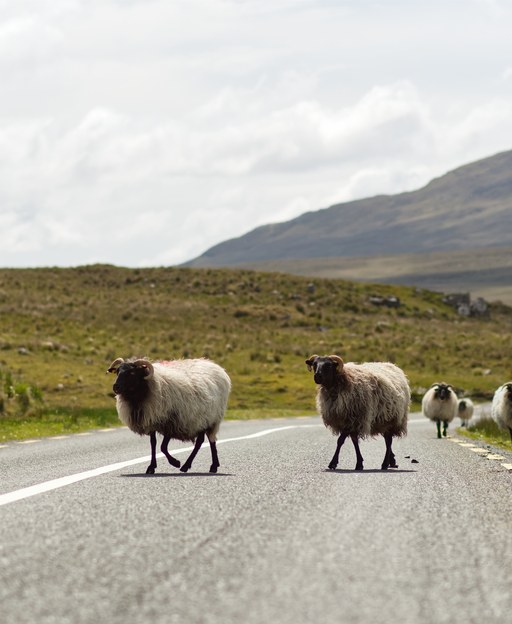
Farmers in the Connemara hills say it takes 12 to 16 weeks to rear a lamb there, while other farmers turn theirs around in eight. That slower lamb now has a protected name, Connemara Hill Lamb, or Uain Sléibhe Chonamara in Irish. This is its story, and how to cook it in a traditional Irish stew.
What’s the best Irish dish of all time? ☘️
Vote in our Best Irish Food poll — recipes nominated by the community.
What’s your Irish county’s signature dish? ☘️
Different counties claim different dishes — Your County’s Signature Food tells you which one your county is known for, with a short story behind it.
Want more real Irish kitchen recipes? ☘️
Our free guide, 10 Real Irish Recipes, starts with beef and Guinness pie: the real thing, step by step.
The lamb that takes twice as long
The words come from Connemara farmers quoted in a study hosted by Teagasc, the Irish agriculture and food development authority. One says: “It takes 12-16 weeks for us to rear our lambs in their natural environment, while other farmers turn around their lambs in eight weeks.” Another describes the ground: lakes, mountains, heathers and bogs, “a totally different landscape to the rest of Ireland”. And the diet, in the farmer’s words: “It’s the herbs and the heathers and the grasses that give the meat a darker texture.” (Connemara Hill Lamb, Teagasc FARM study)
What the protected name says
☘️ Join 64,000+ Ireland Lovers
Every weekday morning, get Ireland’s hidden gems, local secrets, and travel inspiration — the kind you won’t find in any guidebook.
Subscribe free — enter your email:
Free forever · Unsubscribe anytime
Connemara Hill Lamb is a protected geographical indication (PGI). The name “Connemara Hill Lamb or Uain Sléibhe Chonamara (PGI)” was registered by Commission Regulation (EC) No 148/2007 of 15 February 2007 (legislation.gov.uk), and the EU register lists it as registered (EU geographical indications register). Its specification was later changed by Commission Implementing Regulation (EU) 2017/966 of 1 June 2017, which approved non-minor amendments (legislation.gov.uk). Dates differ from site to site, so we give only the dates in the regulations.
The published product description says the lambs are reared in mountainous terrain where they graze on mountain grass, heathers and herbs (Official Journal, 3 February 2017). That matches what the farmers say in their own words.
Why Irish stew suits it
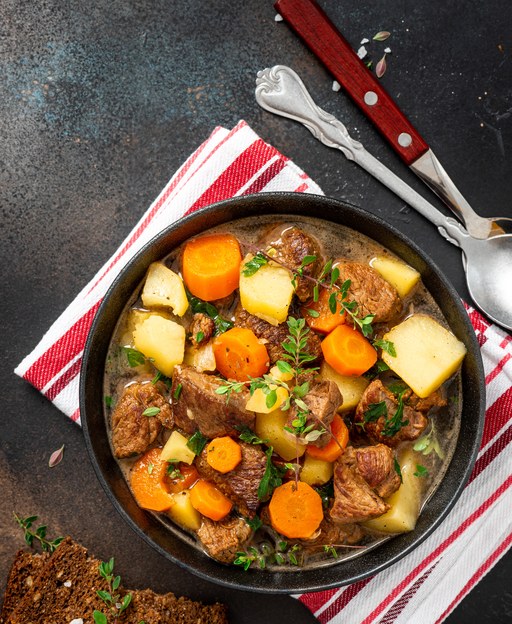
Irish stew is the dish where lamb is the whole point: meat, potatoes, onions and not much else, cooked slowly in one pot. We have the story of the dish in the story inside every bowl of Irish stew. If you can find lamb with the Connemara Hill Lamb name, this is a good place to use it, but the recipe works with any good lamb shoulder or neck.
How to make traditional Irish stew (serves 6)
This is our own tested recipe. Prep takes about 25 minutes and the stew cooks for about 2 hours.
Ingredients
- 1 kg boneless lamb shoulder or neck, cut into 4 to 5 cm chunks (or 1.35 kg bone-in gigot or neck chops)
- 1 tbsp rapeseed or vegetable oil (or a little of the trimmed lamb fat)
- 2 medium onions, cut into chunks
- 3 medium carrots, cut into large chunks
- 1 medium parsnip, cut into chunks (optional)
- 1 litre lamb or chicken stock (or water)
- 4 to 5 sprigs fresh thyme (or 1/2 tsp dried thyme)
- 1 kg potatoes (about 6 medium), peeled and cut into large chunks
- salt and freshly ground black pepper
- 2 tbsp fresh parsley, chopped, to serve
- 1 tbsp butter mashed with 1 tbsp plain flour, to thicken (optional)
Method
- Heat the oil in a large heavy pot over a medium-high heat. Brown the lamb in 2 or 3 batches, without crowding the pot, then lift it out onto a plate.
- Lower the heat to medium, add the onions, carrots and parsnip (if using) and cook for about 5 minutes, stirring, until they take on a little colour.
- Return the lamb and its juices to the pot. Pour in the stock so it just covers the meat, add the thyme and season with salt and pepper.
- Bring to the boil, skim off any foam, then cover and simmer very gently for 1 hour.
- Lay the potato chunks on top of the stew, season them, cover again and simmer gently for 45 minutes to 1 hour more, until the lamb is very tender and the potatoes are cooked through. Some potatoes will break down and thicken the broth; that is how it should be.
- Remove the thyme stalks. For a thicker broth, mash the butter and flour together and stir it in a little at a time, simmering for 2 to 3 minutes, or crush a few potato chunks against the side of the pot.
- Taste for seasoning, scatter with parsley and serve in warm bowls with soda bread.
More Irish lamb from our kitchen: a white lamb stew and Connemara lamb cutlets with mint sauce.
Want more real Irish kitchen recipes? ☘️
Get our free Irish cooking recipes, 10 real recipes for home cooks, wherever you live.
Would you wait the extra weeks for a lamb raised on heather?
Sources
- Connemara Hill Lamb, FARM: Re-Viewing Local Food Knowledge, Teagasc
- Commission Regulation (EC) No 148/2007, legislation.gov.uk
- Commission Implementing Regulation (EU) 2017/966, legislation.gov.uk
- Connemara Hill Lamb entry, EU geographical indications register (eAmbrosia)
- Official Journal of the European Union, C 35, 3 February 2017
Checked November 2026.
Tours & experiences you might love


Powered by Viator. Some links are affiliate links — we may earn a small commission at no extra cost to you.
Secure Your Dream Irish Experience Before It’s Gone!
Planning a trip to Ireland? Don’t let sold-out tours or packed attractions spoil your journey. Iconic experiences like visiting the Cliffs of Moher, exploring the Rock of Cashel, or enjoying a guided walk through Ireland’s ancient past often sell out quickly—especially during peak travel seasons.

Booking in advance guarantees your place and ensures you can fully immerse yourself in the rich culture and breathtaking scenery without stress or disappointment. You’ll also free up time to explore Ireland’s hidden gems and savour those authentic moments that make your trip truly special.
Make the most of your journey—start planning today and secure those must-do experiences before they’re gone!