

Armagh is the smallest of Northern Ireland’s six counties, and yet it carries a weight out of all proportion to its size. This is where Saint Patrick founded his principal church. Where the Red Branch Knights rode out from Navan Fort. Where two cathedrals bearing the same saint’s name face each other across opposing hills, one Catholic, one Church of Ireland, both claiming primacy over all of Christian Ireland. And between the mythology and the theology, six thousand acres of apple orchards bloom every spring, filling the air with blossom and giving the county the only name that ever stuck: the Orchard County.
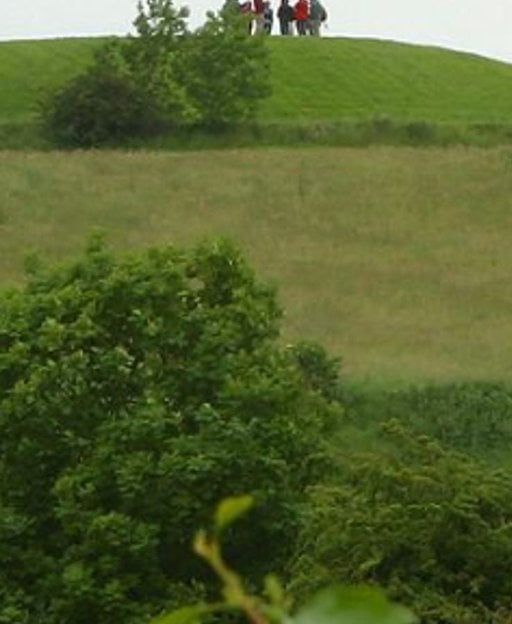
Navan Fort: Where the Ulster Kings Held Court
Two miles west of Armagh city, a grass-covered mound rises from a gentle hillside. It does not look like much — until you understand what it was. Navan Fort, known in Irish as Emain Macha, was the royal capital of Ulster for over a thousand years. This is where King Conchobar mac Nessa held his court. Where the Red Branch Knights trained and feasted. Where Cú Chulainn, Ireland’s greatest mythological warrior, learned to fight.
The site has been occupied since at least 3500 BCE, but around 95 BCE something extraordinary happened. A massive timber temple, 45 metres across, was constructed — then deliberately burned and buried under a mound of earth in a single ritual act. The purpose remains a mystery. The mound still stands.
The Navan Centre and Fort visitor centre brings the archaeology and mythology to life with interactive exhibitions. Nearby lie Haughey’s Fort (a Bronze Age hilltop enclosure) and the King’s Stables, a man-made ritual pool where Iron Age artefacts including a famous bronze trumpet were recovered from the water. Navan Fort is part of the Royal Sites of Ireland group being considered for UNESCO World Heritage status.
Armagh City: Two Cathedrals, One Saint, Fifteen Centuries
Armagh city is the ecclesiastical capital of the entire island of Ireland — not just Northern Ireland, but the Republic too. In 445 AD, Saint Patrick was granted the hill of Druim Saileach by the local chieftain Daire, and he built his principal church there. That decision shaped the next fifteen centuries. Both the Catholic and Church of Ireland archbishops of Armagh hold the title “Primate of All Ireland,” and both cathedrals are dedicated to Saint Patrick.
The Church of Ireland cathedral sits on Patrick’s original site, a medieval building with a crypt containing ancient stone carvings and the reputed burial place of Brian Boru, the High King who visited in 1004 to recognise Armagh’s primacy. Across the valley, the Roman Catholic cathedral was built between 1840 and 1904 — its construction delayed by the Great Famine — with twin spires and elaborate interior mosaics that reward a slow, upward gaze.
Between the cathedrals, the city reveals its Georgian character: warm limestone terraces, the Armagh Robinson Library (which holds a first edition of Gulliver’s Travels annotated by Jonathan Swift himself), and the Palace Demesne — 300 acres of parkland in the heart of the city.
☘️ Enjoying this? 64,000 Ireland lovers get stories like this every week. Subscribe free →
Slieve Gullion and the Ring of Gullion
South Armagh’s landscape changes abruptly. The gentle orchards give way to the Ring of Gullion, an Area of Outstanding Natural Beauty and the finest ring dyke in the British Isles — a circle of hills formed by volcanic activity during the opening of the Atlantic Ocean. At its centre stands Slieve Gullion, 573 metres high, an extinct volcano with a lake at its summit.
On the summit cairn sits the highest surviving passage tomb in Britain or Ireland, over 5,000 years old. The mythology runs deep here: this is the territory of the Cailleach (the divine hag of Irish tradition), of Fionn mac Cumhaill, of Cú Chulainn. The Clontygora Court Tomb, known locally as “The King’s Ring,” and the Ballykeel Portal Tomb are scattered across the landscape — evidence that people have lived in this volcanic ring for over six thousand years.
Around twenty thousand walkers climb Slieve Gullion each year. The Ring of Gullion sits at the heart of the Mourne Gullion Strangford UNESCO Global Geopark, which has raised its international profile considerably in recent years.
The Orchard County: Cider, Apples, and PGI Pride
Armagh’s nickname is earned, not inherited. Some six thousand acres of apple trees blanket the county, and in spring the blossom is a sight that rivals anything in Kent or Normandy. The Armagh Bramley apple was awarded Protected Geographical Indication (PGI) status by the EU in 2012 — the same level of protection given to Champagne. Only Bramleys grown, picked, and packed within the Armagh area may carry the name.
A cider revival has followed the apples. Armagh Cider Company, Long Meadow Farm (a third-generation family operation beside the Upper Bann River), and Mac Ivors Cider (fifth-generation MacNeice family, blending Armagh Bramleys with bittersweet varieties like Dabinett and Harry Master’s Jersey) have built a cider trail that runs through the heart of the orchards. Traditional apple varieties with names like Bloody Butcher, Coccagee, and Strawberry Cheeks still grow here.
The Armagh Food and Cider Festival, typically held in September, brings the harvest to life with orchard events, tasting sessions, and an energy that reflects the county’s growing confidence in its food identity.
Lough Neagh and the Quiet North
Armagh’s northern edge touches Lough Neagh, the largest lake in the British Isles. Legend says Fionn mac Cumhaill scooped up a chunk of land and hurled it at a Scottish rival — the hole filled with water to become Lough Neagh, and the land he threw became the Isle of Man. Oxford Island, on the Armagh shore, hosts the Lough Neagh Discovery Centre with four miles of walks and five loughside bird hides overlooking waters that supply over 40 per cent of Northern Ireland’s drinking water.
Elsewhere in the county, The Argory is a Greek Revival villa set on a 315-acre National Trust estate overlooking the River Blackwater — still lit by one of the most complete surviving acetylene gas systems in the British Isles. Gosford Forest Park outside Markethill houses a Norman-style castle with 197 rooms, set in 240 hectares of woodland that became Northern Ireland’s first conservation forest in 1986.
How to Get There
Armagh city is roughly 40 miles south-west of Belfast and 60 miles north of Dublin. The M1 motorway from Belfast runs to Portadown and Lurgan, from where the A3 takes you to Armagh in under 20 minutes. From Dublin, the M1/A1 route through Newry and then the A28 takes about 90 minutes. There is no direct rail service to Armagh city, but trains run to Portadown on the Belfast–Dublin Enterprise line. The Ring of Gullion is best explored by car, and the cider trail deserves a designated driver.
Join 64,000+ Ireland Lovers
Every Tuesday morning, get Ireland’s hidden stories, secret places, and living traditions — the kind you won’t find in any guidebook.
Free forever · · Unsubscribe anytime
☘️ You Might Also Love
☘️ Want More Hidden Ireland?
Join 64,000+ subscribers who discover Ireland’s best-kept secrets every week.
Subscribe Free — Join the Community →
Free forever · Unsubscribe anytime · No spam
📥 Free Download: Ireland Travel Planning Guide
Our most popular resource — itineraries, insider tips, and the 50 places you must not miss.
Tours & experiences you might love


Powered by Viator. Some links are affiliate links — we may earn a small commission at no extra cost to you.
Secure Your Dream Irish Experience Before It’s Gone!
Planning a trip to Ireland? Don’t let sold-out tours or packed attractions spoil your journey. Iconic experiences like visiting the Cliffs of Moher, exploring the Rock of Cashel, or enjoying a guided walk through Ireland’s ancient past often sell out quickly—especially during peak travel seasons.

Booking in advance guarantees your place and ensures you can fully immerse yourself in the rich culture and breathtaking scenery without stress or disappointment. You’ll also free up time to explore Ireland’s hidden gems and savour those authentic moments that make your trip truly special.
Make the most of your journey—start planning today and secure those must-do experiences before they’re gone!