

There is a county in Ireland where the land and water have never quite agreed on a border. County Fermanagh, tucked into the south-west corner of Northern Ireland, is one-third lake. Upper and Lower Lough Erne stretch across forty miles of the county, connected by a labyrinth of channels, islands and inlets that have shaped every chapter of Fermanagh’s story — from the monks who built their monasteries on its islands to the Allied pilots who launched flying boats from its waters during the Second World War.
This is not the Ireland of dramatic sea cliffs or rolling Atlantic surf. Fermanagh is quieter than that. Its beauty creeps up on you — the still reflection of a ruined tower on glass-calm water, the echo of your footsteps in a cave three hundred million years in the making, the precise click of a Belleek potter shaping china the same way it has been shaped here since 1849.
The Lakelands — Where a County Becomes an Archipelago
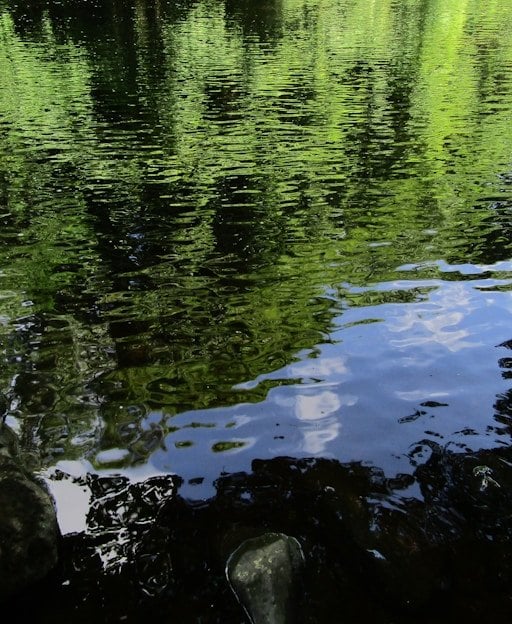
Lough Erne is not one lake but two, and together they contain more islands than most people could visit in a lifetime. Lower Lough Erne alone has over a hundred. Some hold the ruins of medieval churches. Others are little more than a tuft of grass and a few wind-bent trees. The shoreline is so convoluted that the lake seems to dissolve the land around it, turning fields into peninsulas and hills into islands.
The county’s name comes from the Fir Manach, an ancient people who settled these lakelands and gave their name to both Fermanagh and neighbouring Monaghan. They chose well. The waterways provided transport, protection and food. Centuries later, the monks followed their logic exactly.
☘️ Love stories like this? Join 64,000+ readers who get the best of Ireland delivered free every weekday morning. Subscribe to Love Ireland — it only takes a second.
Devenish Island — Scholars on the Water
In the sixth century, Saint Molaise founded a monastery on Devenish Island in Lower Lough Erne. At its peak, fifteen hundred scholars lived and studied here — one of the great centres of early Christian learning in Ireland. Vikings raided it in 837. Fire swept through it in 1157 and again in 1360. But the round tower survived it all.
Standing eighty-one feet tall with four small windows at the cardinal points — each topped by a carved stone head — the Devenish round tower is one of the finest in Ireland. You can only reach the island by boat from Trory Point near Enniskillen, and there is something fitting about that. The monks chose islands precisely because they were hard to reach. The journey across the water was part of the point.
Enniskillen — The Castle Between the Waters
Enniskillen sits on an island between Upper and Lower Lough Erne, and its castle has guarded the crossing since 1428. Hugh Maguire — known as Hugh the Hospitable — built it to control one of the few passes into Ulster. The English besieged it three times in the 1590s. After the Flight of the Earls in 1607, the last Maguire lord departed, and the castle passed into plantation hands.
☘️ Enjoying this? 64,000+ Ireland lovers get stories like this every week. Subscribe free →
Today, Enniskillen Castle houses two museums and sits at the heart of a town that has learned to live between the waters. The Buttermarket — a cluster of restored Georgian buildings — now holds craft workshops. The town has produced two of Ireland’s most celebrated literary figures: Samuel Beckett was schooled at Portora Royal School here, and Oscar Wilde attended the same school a generation earlier.
Three Hundred Million Years Underground
The Marble Arch Caves sit beneath the hills south of Enniskillen, where rivers have been dissolving limestone for three hundred and forty million years. The guided tour begins on a boat, drifting along a subterranean river past stalactites that have taken millennia to form. Then you walk — through chambers of flowstone and stalagmites, past formations that the darkness has been building since before the first fish crawled onto land.
In 2008, the caves became the heart of a UNESCO Global Geopark — the first in the world to cross an international border, spanning from Fermanagh into County Cavan in the Republic. The cross-border designation was deliberate: the geology does not recognise political boundaries.
The Stairway to Heaven
Above the caves, the Cuilcagh Boardwalk climbs the same mountain from which the underground rivers flow. The trail stretches four miles across blanket bog — a delicate ecosystem that the boardwalk was built to protect. The final section is four hundred and fifty steps straight up the mountainside, and whoever named it the Stairway to Heaven was not exaggerating. At the top, on a clear day, you can see halfway across Ireland.
Grand Houses and an Ancient Yew
Eight miles south-west of Enniskillen, Florence Court stands amid woodland and parkland. The Georgian house was built in the 1750s and devastated by fire in 1955, then meticulously restored. Its grounds hold something remarkable — the mother tree of every Irish Yew in the world. A two-hundred-and-fifty-year-old Taxus baccata ‘Fastigiata’ stands here, the single genetic ancestor of a tree now found in gardens and cemeteries across every continent.
A few miles away, Castle Coole is its more refined neighbour — a neoclassical mansion completed in 1798 that sits in parkland grazed by the oldest flock of greylag geese in Ireland. Both properties are managed by the National Trust and are open to visitors year-round.
Belleek — Pottery Born from Famine
In 1849, with the Famine still devastating Ireland, a Fermanagh landlord named John Caldwell Bloomfield decided to do something unusual. He commissioned a geological survey of his estate and discovered the minerals needed to make fine pottery. Rather than evict his tenants, he built a factory. He even had a railway line constructed to deliver coal to the kilns.
By 1865, Belleek Pottery had royal patronage — Queen Victoria and the Prince of Wales among its customers. One hundred and seventy-seven years later, it is still producing fine Parian china in the same village on the banks of the River Erne. It remains Ireland’s oldest working pottery, and visitors can watch the craftspeople at work, shaping each piece by hand exactly as their predecessors did.
The Secret Corridor
During the Second World War, Lough Erne became one of the most strategically important bodies of water in Europe. RAF Castle Archdale operated as the westernmost flying-boat base in the United Kingdom, launching Catalina and Sunderland aircraft to patrol the North Atlantic and hunt German U-boats. Nine confirmed kills and many more damaged submarines are attributed to crews based here. A Catalina from Lough Erne helped locate the Bismarck.
But there was a problem. Ireland was neutral, and Fermanagh is landlocked by Donegal to the west. To reach the open Atlantic, aircraft had to fly over Irish territory. The solution was the Donegal Corridor — a secret agreement that allowed Allied planes to fly a narrow four-mile strip from Belleek to Ballyshannon without officially violating Irish neutrality. Three hundred and twenty airmen lost their lives on missions from Lough Erne.
Why Fermanagh Stays with You
Fermanagh does not shout. It does not have the name recognition of Kerry or the dramatic coastline of Donegal. What it has is depth — layer upon layer of history, geology and natural beauty woven around and between its waterways. The monks who chose Devenish knew what they were doing. The waters that carved the Marble Arch Caves are the same waters that reflect Enniskillen Castle at sunset. And the boardwalk that climbs Cuilcagh leads you above it all, to a place where the county spreads out beneath you in every shade of green and silver.
One-third water, all Ireland. That is Fermanagh.
Never Miss a Story from Ireland
Every week, over 64,000 readers open their inbox to find the best of Ireland — hidden places, untold stories, real culture, and stunning photography. No spam. No clickbait. Just Ireland, done right.
☘️ Subscribe free to Love Ireland →
☘️ You Might Also Love
☘️ Want More Hidden Ireland?
Join 64,000+ subscribers who discover Ireland’s best-kept secrets every week.
Subscribe Free — Join the Community →
Free forever · Unsubscribe anytime · No spam
📥 Free Download: Ireland Travel Planning Guide
Our most popular resource — itineraries, insider tips, and the 50 places you must not miss.
Tours & experiences you might love


Powered by Viator. Some links are affiliate links — we may earn a small commission at no extra cost to you.
Secure Your Dream Irish Experience Before It’s Gone!
Planning a trip to Ireland? Don’t let sold-out tours or packed attractions spoil your journey. Iconic experiences like visiting the Cliffs of Moher, exploring the Rock of Cashel, or enjoying a guided walk through Ireland’s ancient past often sell out quickly—especially during peak travel seasons.

Booking in advance guarantees your place and ensures you can fully immerse yourself in the rich culture and breathtaking scenery without stress or disappointment. You’ll also free up time to explore Ireland’s hidden gems and savour those authentic moments that make your trip truly special.
Make the most of your journey—start planning today and secure those must-do experiences before they’re gone!