

There is a place in the north of Ireland where you can walk a circuit of city walls that have stood unbroken for four centuries, then drive twenty minutes to stand on a windswept beach beneath a clifftop temple that looks as though it belongs on the coast of Greece. County Derry — from the Irish Doire, meaning oak grove — holds within its borders one of Europe’s finest walled cities, a coastline that rivals anything on the Wild Atlantic Way, a Nobel laureate’s homeland, and a mountain range that most visitors never think to explore.
This is a county of contrasts. The city of Derry~Londonderry pulses with music, murals, and a creative energy born of a complicated past. Beyond it, the landscape opens into long golden beaches, deep wooded glens, and the rolling heather of the Sperrin Mountains. It is compact enough to explore in a few days, yet rich enough to draw you back again and again.
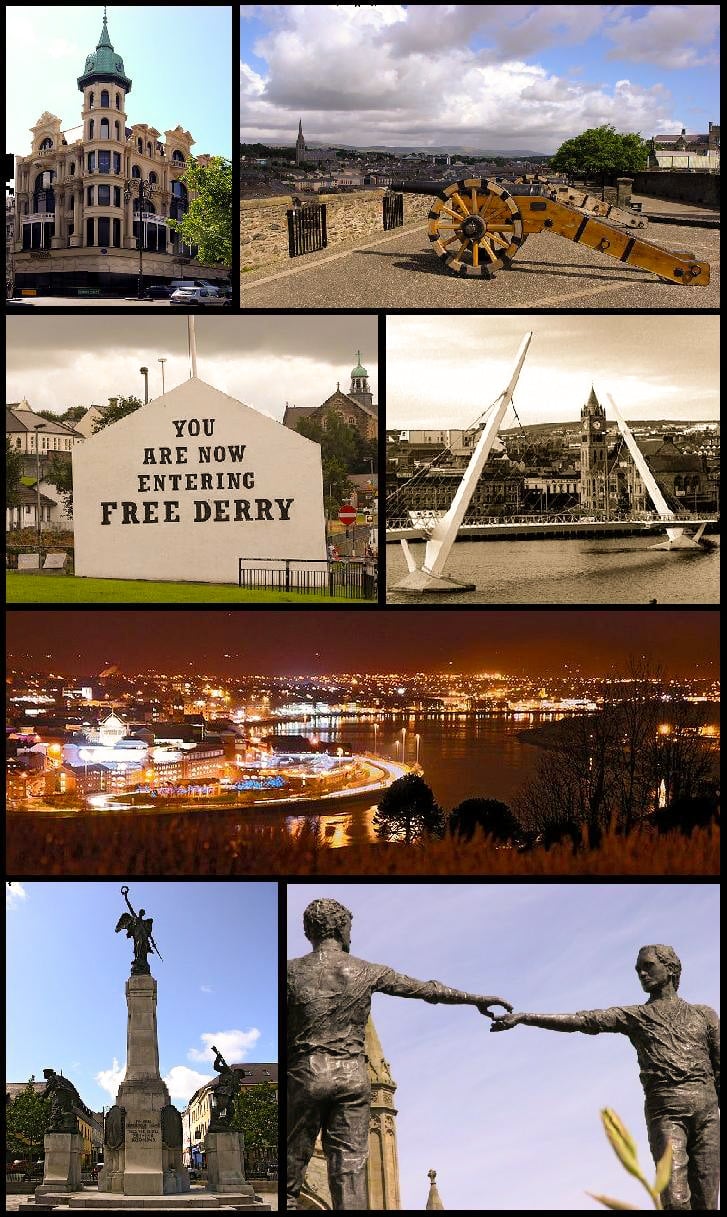
The Walled City — Four Centuries Standing
Derry’s city walls are the most complete set of fortifications anywhere in Ireland and among the finest in Europe. Built between 1613 and 1619 during the Plantation of Ulster, they form an unbroken circuit of roughly one mile — a walk that takes about thirty minutes and offers views down into the old city on one side and out across the River Foyle on the other.
The walls were never breached, not even during the famous Siege of Derry in 1689, when the city held out for 105 days against the forces of King James II. That siege remains one of the most storied episodes in Irish history, and walking the walls today you can still see the cannons and the watchpoints that played a part in it.
Within the walls stands St Columb’s Cathedral, built in 1633 and the first post-Reformation cathedral erected anywhere in the British Isles. Its chapter house museum holds relics of the siege, including the original padlocks from the city gates. The cathedral’s stonework is warm and pale against the sky, and its quiet interior offers a welcome pause from the bustle of the streets outside.
At the foot of the walls, the Tower Museum tells the story of Derry from its monastic origins through the Plantation, the Great Famine, and into the modern era. It also houses a remarkable exhibition on the wreck of La Trinidad Valencera, part of the Spanish Armada, lost off the Donegal coast in 1588.
The Causeway Coast — Beaches, Temples, and Boundless Sky
The northern coast of County Derry is one of the most visually striking stretches of shoreline in Ireland. It begins at Magilligan Point, a vast sandy spit that marks the entrance to Lough Foyle, and sweeps westward through a series of beaches and headlands that belong on any list of Ireland’s finest coastal scenery.
Benone Strand is seven miles of golden sand backed by dunes, with views across to Donegal and out to the open Atlantic. On a clear day, you can see the mountains of Inishowen rising across the water. The beach is Blue Flag certified and rarely crowded — even in summer, you can walk for half an hour and meet only a handful of other souls.
Just along the coast sits Downhill Beach, perhaps best known for the extraordinary building perched on the cliff above it. Mussenden Temple is a small, circular library built in 1785 by the eccentric Bishop of Derry, Frederick Augustus Hervey. Modelled on the Temple of Vesta at Tivoli, it clings to the edge of a 120-foot cliff with the Atlantic crashing below. The temple was originally set back from the cliff edge, but centuries of erosion have brought it to the very brink, adding to its drama. The walk down from the temple through the Downhill Demesne to the beach is one of the most rewarding short hikes in Northern Ireland.
At Magilligan Point itself, a Martello tower built during the Napoleonic Wars guards the narrow strait between Lough Foyle and the open sea. A small ferry crosses to Greencastle in Donegal — a five-minute voyage that connects two worlds.
Seamus Heaney HomePlace — The Poet’s Country
In the village of Bellaghy, about thirty miles south of Derry city, a beautifully designed arts centre celebrates the life and work of Seamus Heaney, who was born on a farm just outside the village in 1939 and went on to win the Nobel Prize in Literature in 1995.
The Seamus Heaney HomePlace is not simply a museum. It is a living literary space — part exhibition, part performance venue, part place of pilgrimage for anyone who loves the written word. The permanent exhibition traces Heaney’s journey from his childhood among the fields and bogs of south Derry to the global stage, using his own voice (through audio recordings) and the landscapes that shaped his poetry.
Heaney wrote about digging, about blackberry picking, about the act of putting pen to paper as a form of excavation. Walking the lanes around Bellaghy after visiting the centre, you begin to see the countryside through his eyes — the dark gleam of bogland, the particular green of an Irish field after rain, the weight of history beneath the soil.
The centre also hosts readings, workshops, and events throughout the year, drawing writers and poets from across the world. It is a place that reminds you why literature matters, and why place matters to literature.
Want more Ireland stories like this?
Join 64,000+ readers who get our free newsletter — the best of Ireland, delivered weekly.
The Sperrin Mountains — Hidden Highlands
The Sperrins stretch across the south of County Derry and into neighbouring Tyrone, forming the largest mountain range in Northern Ireland. They are not dramatic in the way of the Mournes or the Twelve Bens — their beauty is gentler, subtler, a rolling expanse of heather-clad hills, blanket bog, and quiet valleys that reward those who slow down.
Banagher Glen, near Dungiven, is one of the finest woodland walks in the north. An ancient oak forest follows a river through a deep, mossy gorge — the kind of place where the light filters green through the canopy and the only sound is water over stone. The glen has been designated a Nature Reserve and is home to red squirrels, dippers, and a wealth of native wildflowers.
Nearby, Ness Country Park offers something more dramatic: a waterfall that drops into a wooded gorge, with walking trails looping through the surrounding forest. The main waterfall is the highest in Northern Ireland, and after heavy rain it becomes a thundering spectacle.
For hillwalkers, the Sperrins offer miles of open moorland and ridge walks with panoramic views. Sawel Mountain, at 678 metres, is the highest point and can be reached by a straightforward (if boggy) climb from the Sperrins Heritage Centre. On a clear day, the summit views stretch from the Donegal highlands to the shores of Lough Neagh.
Music, Culture, and the Spirit of a City
Derry was named the first UK City of Culture in 2013, and the legacy of that year is still felt in every corner. The city has long punched above its weight in the arts — it gave the world the Undertones, Phil Coulter, and the backdrop for the beloved television series Derry Girls — but the City of Culture year accelerated a creative transformation that continues today.
The Guildhall, a neo-Gothic masterpiece on the banks of the Foyle, is the city’s civic heart. Its stained-glass windows tell the story of Derry in vivid colour, and its main hall hosts concerts, exhibitions, and community events throughout the year. Admission is free, and it is worth visiting simply to stand beneath those windows.
The Peace Bridge, a graceful footbridge that arcs across the Foyle, has become one of the city’s most recognisable landmarks since it opened in 2011. It connects the largely nationalist west bank with the largely unionist Waterside, and on a summer evening the walk across it — with the sun setting behind the city — is one of the great simple pleasures of the north.
Derry’s murals are famous, particularly those in the Bogside area. The People’s Gallery, a series of twelve large-scale murals painted by the Bogside Artists, depicts scenes from the Troubles and the civil rights movement. They are powerful, moving, and deeply rooted in this particular place. A walking tour of the murals, led by local guides, is one of the most memorable experiences you can have in Ireland.
The music scene is thriving. Pubs like Peadar O’Donnell’s and the Gweedore Bar host live traditional sessions most nights of the week, and the city’s festival calendar — from the Halloween celebrations (regularly named the best in the world) to the Walled City Music Festival — keeps the streets alive with sound and colour year-round.
Food and Drink — A City Finding Its Flavour
Derry’s food scene has blossomed in recent years, driven by a new generation of chefs and producers who draw on the county’s natural larder — Atlantic seafood, Sperrin lamb, Lough Foyle oysters, and the rich dairy tradition of the surrounding farmland.
The Walled City Brewery, housed in a restored building within the old city, brews its own craft beers and serves a menu built around local ingredients. It has become a gathering place for locals and visitors alike, and its position within the walls gives it a sense of history that no amount of interior design could replicate.
Pyke ‘n’ Pommes, a street food stall turned restaurant on the quay, is famous for its Derry-style tacos and its commitment to using local, seasonal produce. What started as a food truck has become one of the city’s most talked-about dining spots, embodying the creative, unpretentious spirit of Derry itself.
The craft food movement extends beyond the city. The Dart Mountain Cheese company in the Sperrins produces artisan cheeses using traditional methods and milk from local herds. Farmers’ markets in Derry, Limavady, and Maghera showcase the best of the county’s produce, from organic vegetables to smoked fish and handmade preserves.
Lough Foyle — Where the River Meets the Sea
Lough Foyle is the vast tidal inlet that forms County Derry’s northern and western boundary, separating it from Donegal across the water. It is one of the most important bird habitats in Ireland, with thousands of migratory waders, geese, and swans arriving each autumn from Iceland, Greenland, and the Arctic.
Birdwatchers come from across Europe to see the light-bellied brent geese that winter here — Lough Foyle hosts one of the largest flocks in the world. Bar-tailed godwits, curlews, and whooper swans are regular visitors, and the mudflats and salt marshes along the shore provide rich feeding grounds.
The lough is also famous for its oysters. Lough Foyle oysters have been harvested for centuries and are prized for their clean, briny flavour — a taste of the Atlantic filtered through one of Ireland’s great estuaries.
On the eastern shore, the small town of Greencastle (not to be confused with its Donegal namesake across the water) offers quiet charm, coastal walks, and views across the lough to the hills of Inishowen. It is a place to pause, breathe in the salt air, and watch the light change over the water.
A County That Stays With You
County Derry is not a place that shouts for attention. It does not need to. The walls speak for themselves, standing as they have for four hundred years. The coastline needs no introduction — one look at Mussenden Temple perched above the Atlantic is enough. Heaney’s poetry carries the landscape within it, and the Sperrins wait in patient silence for those who seek them out.
But it is the city itself that lingers longest in the memory. Derry has a warmth, a wit, and a resilience that you feel the moment you arrive. The locals will talk to you — really talk to you — in pubs, on the walls, in the queue for coffee. There is a pride here that is hard-won and genuine, a sense that this city has come through its hardest days and is building something worth celebrating.
Come for the walls. Stay for the people. Leave knowing you will return.
Download our free Ireland Travel Guide (PDF)
Love Ireland?
Get the best of Ireland delivered to your inbox every week — free.
Join 64,000+ readers. No spam, unsubscribe anytime.
☘️ Join 64,000+ Ireland Lovers
Every weekday morning, get Ireland’s hidden gems, local secrets, and travel inspiration — the kind you won’t find in any guidebook.
Subscribe free — enter your email:
📲 Know someone who’d love this? Share on WhatsApp →
Free forever · Unsubscribe anytime
Tours & experiences you might love


Powered by Viator. Some links are affiliate links — we may earn a small commission at no extra cost to you.
Secure Your Dream Irish Experience Before It’s Gone!
Planning a trip to Ireland? Don’t let sold-out tours or packed attractions spoil your journey. Iconic experiences like visiting the Cliffs of Moher, exploring the Rock of Cashel, or enjoying a guided walk through Ireland’s ancient past often sell out quickly—especially during peak travel seasons.

Booking in advance guarantees your place and ensures you can fully immerse yourself in the rich culture and breathtaking scenery without stress or disappointment. You’ll also free up time to explore Ireland’s hidden gems and savour those authentic moments that make your trip truly special.
Make the most of your journey—start planning today and secure those must-do experiences before they’re gone!