

There are counties in Ireland that announce themselves with towering sea cliffs or sweeping Atlantic coastlines. County Monaghan is not one of them. This quiet, landlocked county in southern Ulster reveals itself slowly — through gentle hills that roll like waves frozen in green, through centuries-old lace that once dressed queens, and through the words of a farmer’s son from Inniskeen who became one of Ireland’s greatest poets. The name itself tells you everything: Muineachán, from the Irish meaning “the land of little hills”.
Monaghan sits between Dublin and Belfast, yet it feels a world apart from both. This is a border county in every sense — one of three Ulster counties that remained in the Republic after partition, a place where two traditions meet and mingle in a landscape shaped by glaciers ten thousand years ago. It is a county of quiet lakes and ancient woodlands, of round towers and high crosses, of lace so fine it adorned the wedding dresses of Princess Diana and Catherine Middleton. It is, above all, a county that rewards those who slow down long enough to notice.
Castle Leslie — A Thousand Acres of Living History
In the village of Glaslough, eleven kilometres northeast of Monaghan Town, stands one of the last great Irish castle estates still in the hands of its founding family. Castle Leslie has been home to the Leslie family since the 1660s, and the estate stretches across a thousand acres of rolling parkland, ancient woodland, and three glittering lakes. The castle itself, redesigned in Scottish baronial style in 1870, sits among ancestral portraits and Italian Renaissance drawing rooms that whisper of a family whose roots stretch from Hungary to Scotland to this quiet corner of Ulster.
The Leslies have never been ordinary. Sir Shane Leslie was a first cousin of Winston Churchill and an important literary figure in his own right. The estate made international headlines in 2002 when Paul McCartney married Heather Mills in the grounds. Today, Castle Leslie operates as a luxury four-star hotel, and its Snaffles Restaurant holds two AA Rosettes for food that draws on the estate’s own produce — including their Fighting Bishop Gin, distilled on the grounds. The equestrian centre, the spa, and the walking trails through ancient oaks make this a place where you could lose an entire week and count none of it wasted.
The Drumlin Landscape — Ireland’s Basket of Eggs
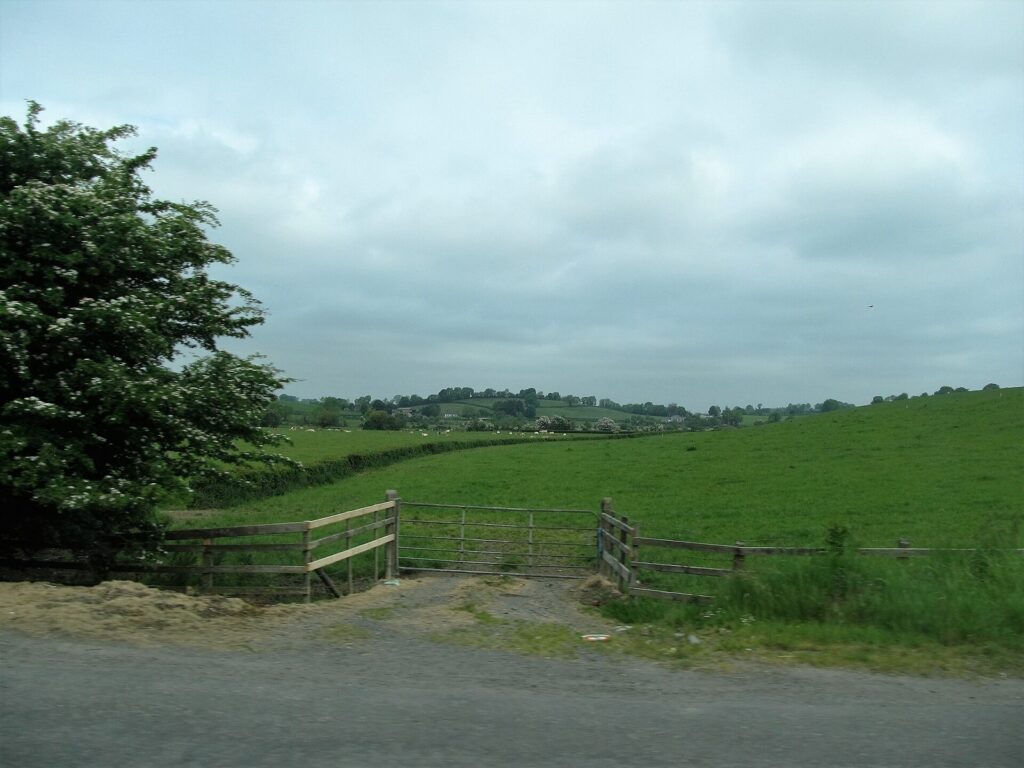
Monaghan sits at the heart of Ireland’s drumlin belt, and the landscape is unlike anything else on the island. These smooth, rounded hills — geographers call the pattern a “basket of eggs” topography — were formed by unevenly spread glacial deposits at the end of the last Ice Age. The result is a county of constant gentle undulation, where every rise reveals another green valley, another still lake, another hedgerow threading between fields that seem to glow in the soft midlands light.
Rossmore Forest Park, just outside Monaghan Town, is the perfect introduction. Its sprawling woodlands hold five fishing lakes, a giant sculpture trail, and forest walks that wind past towering yews and the atmospheric crypt of the Rossmore family. Further north, Sliabh Beagh rises to nearly four hundred metres on the Monaghan-Fermanagh-Tyrone border, offering looping walks through bogland and open meadows where the rare hen harrier still hunts. Lough Muckno, the county’s largest lake, spreads across nine hundred wooded acres near Castleblayney, with sailing, kayaking, and fishing for those who want to be on the water rather than simply gazing at it.
This is the landscape that shaped Patrick Kavanagh’s poetry — the stony grey soil, the triangular fields, the blackthorn hedges. To walk through Monaghan’s drumlins is to walk through the world he made immortal.
Carrickmacross and Clones — Two Lace Traditions, One Remarkable County
Monaghan is the only county in Ireland — perhaps the only county anywhere — with two internationally recognised lace-making traditions. In Carrickmacross, the art of appliqué lace arrived in 1820, brought from Italy by a local gentlewoman named Mrs Grey Porter. During the Great Famine, a lace school was established to provide starving tenants with a means of survival, and the craft became a lifeline. Today, Carrickmacross lace is on Ireland’s National Inventory of Intangible Cultural Heritage. Its most famous moment came when delicate Carrickmacross lace adorned the wedding dresses of both Princess Diana and Catherine Middleton.
Forty kilometres north in Clones, a different tradition took root. Clones lace is Irish crochet, introduced during the Famine by Cassandra Hand as another form of relief work. The Clones Lace Museum, housed in the Ulster Canal Stores Visitor Centre, preserves this remarkable heritage. Both traditions survive today through dedicated co-operatives and craftswomen who keep alive skills that have been passed down through nearly two centuries of Monaghan hands.
Want more Ireland stories like this?
Join 64,000+ readers who get our free newsletter — the best of Ireland, delivered weekly.
Inniskeen — Walking in Kavanagh’s Country
Patrick Kavanagh was born in 1904 in the townland of Mucker, just outside Inniskeen. The fourth of ten children, son of a cobbler who was also a small farmer, he left school at twelve and educated himself through a passion for books that burned as fiercely as any turf fire. His long poem The Great Hunger is widely regarded as one of the most important works in the Irish language tradition of the twentieth century. Many critics consider him the finest Irish poet since Yeats.
The Patrick Kavanagh Centre, set in a beautifully restored eighteenth-century church in Inniskeen, houses twelve commissioned paintings illustrating The Great Hunger, the poet’s death mask, and a collection of memorabilia that brings his world vividly to life. Outside, the six-kilometre Kavanagh Trail follows country lanes and triangular fields to the places he made famous — Shancoduff, Billy Brennan’s barn, the hedgerows where he watched the world go by with the eyes of a prophet disguised as a ploughman.
Each September, the Patrick Kavanagh Weekend draws writers and readers from across the world for three days of readings, lectures, and walks through the landscape that made the poetry possible. The annual Patrick Kavanagh Poetry Award, presented for an unpublished collection, remains one of the most prestigious prizes in Irish letters.
Clones — Round Towers, High Crosses, and Ancient Monastic Heritage
Clones is a town where layers of history lie one upon another like the pages of a very old book. St Tighernach founded a monastery here around 500 AD, and its traces are still visible: a tenth-century round tower rises from St Tighearnach’s Cemetery alongside the stone sarcophagus of the saint himself, dating to the early thirteenth century. In the Diamond — the town’s central square — the Cross Moyle High Cross stands five metres tall, its sandstone shaft carved with interlacing beads and biblical imagery dating from the ninth century.
Food and Drink — A County That Quietly Punches Above Its Weight
Monaghan’s food scene has been gathering quiet momentum. The Courthouse Restaurant in Carrickmacross holds a coveted Michelin Bib Gourmand, while Snaffles at Castle Leslie serves two-AA-Rosette dining in a setting that would make most country house restaurants weep with envy. The Squealing Pig in Monaghan Town has been the beating heart of local social life for over thirty years, serving craft beers and hearty pub classics alongside Porky’s seasonal menu.
The real surprises, though, are the artisan producers. Brehon Brewhouse in Inniskeen is an award-winning micro-brewery set on a working dairy farm, where tours weave brewing science with local folklore in the ancestral home of its proprietor. Dinkin’s Bakery, a World Bread Award winner, has four locations across the county serving sourdough that has become something of a local obsession. Every Friday, Monaghan Town’s farmers’ market fills Church Square with food trucks and artisan stalls, while the Monaghan Taste Club runs pop-up dining events at venues across the county that sell out before most people even hear about them.
A County That Gets Under Your Skin
Monaghan will never compete with the Wild Atlantic Way for dramatic scenery or with Dublin for urban energy. It doesn’t try. What it offers is something rarer and, for many travellers, something more valuable: an Ireland that has not yet learned to perform for an audience. The drumlins roll as they have rolled since the glaciers retreated. The lace is still made by hand. The poetry is still read aloud in the pubs of Inniskeen. The high crosses still stand in the squares of towns where everyone knows your name before you’ve finished your first pint.
Patrick Kavanagh once wrote that the truly great are those who can find the universal in the parochial. Monaghan is his proof. Come for the little hills. Stay for the stories they hold. Leave knowing that Ireland’s best-kept secrets are always the ones worth keeping.
Download our free Ireland Travel Guide (PDF)
Love Ireland?
Get the best of Ireland delivered to your inbox every week — free.
Join 64,000+ readers. No spam, unsubscribe anytime.
Tours & experiences you might love


Powered by Viator. Some links are affiliate links — we may earn a small commission at no extra cost to you.
Secure Your Dream Irish Experience Before It’s Gone!
Planning a trip to Ireland? Don’t let sold-out tours or packed attractions spoil your journey. Iconic experiences like visiting the Cliffs of Moher, exploring the Rock of Cashel, or enjoying a guided walk through Ireland’s ancient past often sell out quickly—especially during peak travel seasons.

Booking in advance guarantees your place and ensures you can fully immerse yourself in the rich culture and breathtaking scenery without stress or disappointment. You’ll also free up time to explore Ireland’s hidden gems and savour those authentic moments that make your trip truly special.
Make the most of your journey—start planning today and secure those must-do experiences before they’re gone!