

Hook Lighthouse stands at the very tip of the Hook Peninsula in County Wexford, on the south-east coast of Ireland. It has been guiding ships safely past these rocky shores for over 800 years. That makes it one of the oldest working lighthouses in the world — and one of the most remarkable places to visit in Ireland.
This is not a polished heritage attraction built around a story. It is the real thing: a medieval tower, still flashing its light out to sea every three seconds, still doing the job it was built to do centuries ago. There are few places in Ireland where history and function come together so vividly.
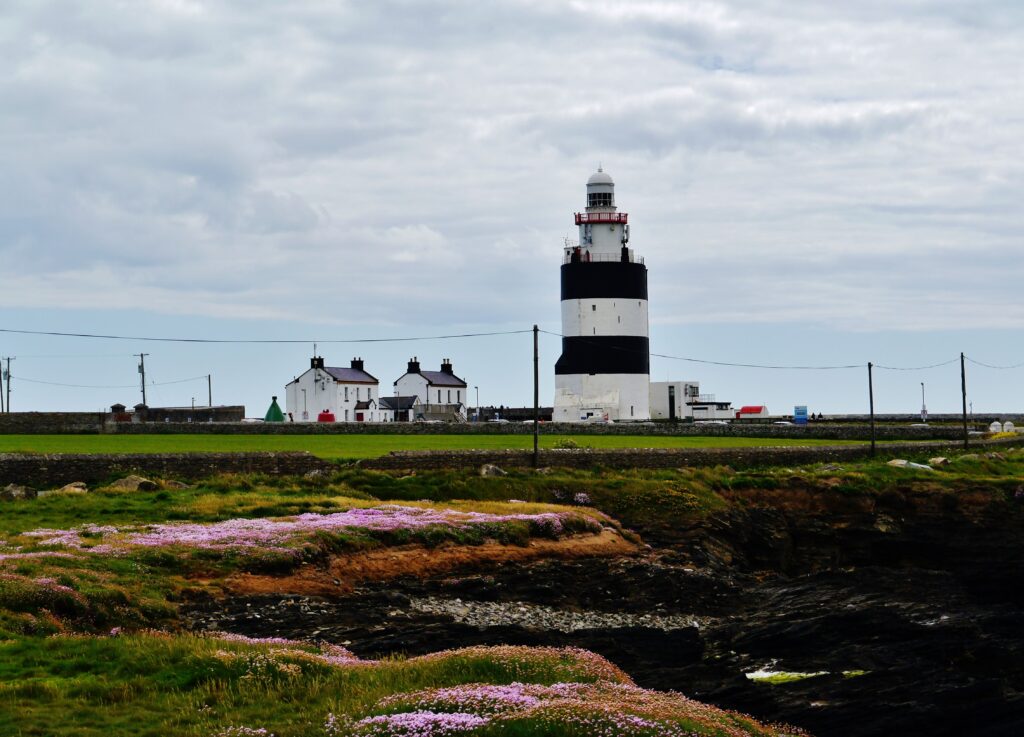
A Lighthouse Over 800 Years Old
The current stone tower at Hook Head dates to the early 13th century — most likely between 1201 and 1240 — when William Marshal, Earl of Pembroke, ordered its construction to help ships navigate the treacherous waters at the mouth of Waterford Harbour. Marshal was one of the most powerful men in medieval Europe, and he recognised that safe passage into Waterford — then one of Ireland’s busiest ports — required a reliable, permanent light.
But the story of Hook Head as a place of light goes back even further. Before the stone tower was built, a community of monks from the 5th century maintained a fire beacon on this headland. St Dubhán — whose name means “little dark one” — is said to have established a monastery here and kept flames burning to warn passing sailors. The monks’ fire became a guiding light for centuries before William Marshal ever arrived.
The tower Marshal built has survived intact. It is 35 metres tall, with walls up to four metres thick at the base. Those walls have withstood Atlantic storms, the upheaval of centuries of Irish history, and the steady march of technological change. The lighthouse was converted to oil in the 19th century, then electrified, and finally automated in 1996. Today it is managed by Irish Lights and remains fully operational.
The Famous Black and White Stripes
The distinctive broad black and white bands that stripe the tower were painted on to make the lighthouse easier to identify in daylight — a practice called a “daymark”. Sailors approaching the Wexford coast needed to know exactly which lighthouse they were looking at, and Hook’s bold pattern left no room for doubt.
From a distance, the lighthouse looks almost graphic in its simplicity. Up close, the scale of the structure becomes clear. The base of the tower is enormous, and the medieval stonework is remarkably well preserved. Climbing the 115 steps to the lantern room rewards visitors with views across the Celtic Sea, back towards the Waterford Estuary, and down the length of the Hook Peninsula itself.
The light itself — a rotating optic — flashes white every three seconds and has a range of 23 nautical miles on a clear night. Ships still use it as a navigational reference point today.
Love stories like this one? Get the best of Ireland — history, travel tips, hidden places and more — delivered straight to your inbox every week. Subscribe to the Love Ireland newsletter →
Planning Your Visit to Hook Lighthouse
Hook Lighthouse is open to visitors throughout the year, though hours vary by season. The visitor centre at the base of the tower provides context on the history of the lighthouse and the peninsula, and guided tours take you inside the tower and up to the lantern room.
Tours run regularly throughout the day during peak season (roughly March to October), with reduced frequency in winter. It is worth checking the Hook Lighthouse website before you travel to confirm tour times, particularly in the off-season. Admission costs €10 for adults (€9 concession, €6 for children aged 5–18, under-5s free); the tour is what makes the visit worthwhile — the internal spaces of the tower are extraordinary, and the view from the top is excellent.
The grounds around the lighthouse are freely accessible and make for a fine walk. The headland itself is striking: exposed rock, short grass cropped by the wind, wildflowers in spring and summer, and the constant presence of the sea on three sides. Bring a jacket regardless of the time of year — it is a headland on the south coast of Ireland, and the weather is its own thing.
There is a café and gift shop on site, which makes for a welcome stop after a tour. Car parking is available at the lighthouse.
The Hook Peninsula: More Than Just a Lighthouse
Most visitors treat Hook Lighthouse as the destination and the Hook Peninsula as the road to reach it. That is understandable — the lighthouse is the draw — but the peninsula itself is worth taking time over.
The drive out from New Ross or Waterford takes you through quiet farmland and small villages, past sea inlets and tidal flats. Arthurstown and Ballyhack sit on the western shore of the peninsula, looking across the Waterford Estuary towards County Waterford. A passenger and car ferry crosses between Ballyhack and Passage East, cutting out the long drive around the top of the estuary — useful if you are continuing westward.
Duncannon Fort, a few kilometres north of the lighthouse on the western shore, is another significant historic site. The star-shaped fort was built in 1587 in response to the threat of the Spanish Armada and later played a role in the 1798 Rebellion. It is open to visitors in summer and offers its own distinctive views across the water.
The beaches on the peninsula — Booley Bay, Baginbun, Dollar Bay — are quiet and largely undiscovered by visitors who stick to better-known Wexford beaches further along the coast. If you are visiting in summer and want to swim, these are worth exploring.
Planning a trip to Wexford? Our weekly newsletter covers the best places to visit across Ireland, with practical tips and local knowledge you won’t find in a guidebook. Join the Love Ireland newsletter →
Getting There
Hook Lighthouse is at the southernmost tip of the Hook Peninsula, in the south-east of County Wexford. The nearest town of any size is New Ross, about 35 kilometres to the north. Waterford city is approximately 30 kilometres away via the Passage East ferry, or around 50 kilometres by road.
By car, the R733 runs the length of the peninsula from Fethard-on-Sea to the lighthouse. There is no public transport to Hook Head, so a car is effectively essential. The drive from Wexford town takes about 45 minutes; from Waterford, allow a little over an hour (or less if you use the Ballyhack ferry).
Hook Lighthouse is easily combined with a visit to Wexford town, the Irish National Heritage Park at Ferrycarrig, or the John F. Kennedy Arboretum near New Ross. The broader New Ross and Wexford area rewards a couple of days’ exploration.
What to Expect on the Day
The guided tour takes roughly 45 minutes and covers the history of the lighthouse, the mechanics of the light itself, and the lives of the lighthouse keepers who lived here before automation. Keepers and their families were stationed at Hook for extended periods — the lighthouse complex includes former keeper cottages, which give a sense of what that isolated life looked like.
The tower climb involves 115 steps on a tight spiral staircase. It is manageable for most people, though not suitable for anyone with mobility difficulties or a fear of confined spaces. Children generally love it. The view from the top — the Celtic Sea stretching out to the south, the Waterford Estuary to the north-west — is genuinely impressive, and on a clear day you can see the Saltee Islands to the east.
Weather at Hook Head can change quickly. The headland is fully exposed, and what starts as a mild morning can turn breezy and cool by midday. Layers are the sensible approach, and sturdy shoes are preferable to anything that might slip on wet rock.
Why Hook Lighthouse Deserves Your Time
There is something grounding about standing at the base of a tower that has been doing the same job since the 12th century. Hook Lighthouse is not preserved behind glass — it is still working, still blinking out its three-second pattern across the water every night, still earning its place on the charts of every ship that rounds the headland.
County Wexford is often described as Ireland’s “Sunny South-East” for its relatively mild climate and longer sunshine hours compared to the west. The south coast has a gentler feel than the dramatic Atlantic seaboard — the scenery is quieter, the crowds are thinner, and the sense of history is just as deep. Hook Head is one of those places that rewards the journey out to it.
If you have never visited County Wexford, Hook Lighthouse is an excellent reason to start. If you have visited before and skipped the peninsula, now is a good time to go back.
More to explore across Ireland? Every week, the Love Ireland newsletter brings you travel ideas, history, local food and drink, and the kind of detail that makes a trip worth taking. Sign up free today →
Thinking about it for retirement?
If you’ve started thinking seriously about retiring there, our complete our full Retire in Ireland guide covers the visa, healthcare, cost-of-living, and the regions worth shortlisting.
Tours & experiences you might love


Powered by Viator. Some links are affiliate links — we may earn a small commission at no extra cost to you.
Secure Your Dream Irish Experience Before It’s Gone!
Planning a trip to Ireland? Don’t let sold-out tours or packed attractions spoil your journey. Iconic experiences like visiting the Cliffs of Moher, exploring the Rock of Cashel, or enjoying a guided walk through Ireland’s ancient past often sell out quickly—especially during peak travel seasons.

Booking in advance guarantees your place and ensures you can fully immerse yourself in the rich culture and breathtaking scenery without stress or disappointment. You’ll also free up time to explore Ireland’s hidden gems and savour those authentic moments that make your trip truly special.
Make the most of your journey—start planning today and secure those must-do experiences before they’re gone!