

Some travel memories fade within a few weeks. Others stay with you for decades. You can be sitting at your desk years later, and something — a piece of music, a particular quality of grey light, a smell — brings it flooding back. That feeling is what people mean when they talk about a travel experience that still gives them chills.
Ireland produces these moments with unusual frequency. It is not the biggest country, nor the most exotic, but something about the combination of landscape, history and people seems to cut through in a way that surprises visitors — including those who thought they knew exactly what they were coming for.
Here are some of the experiences that travellers return to again and again in their memory — and what makes each one hit the way it does.
Standing at the Edge of Dún Aonghasa, Inis Mór
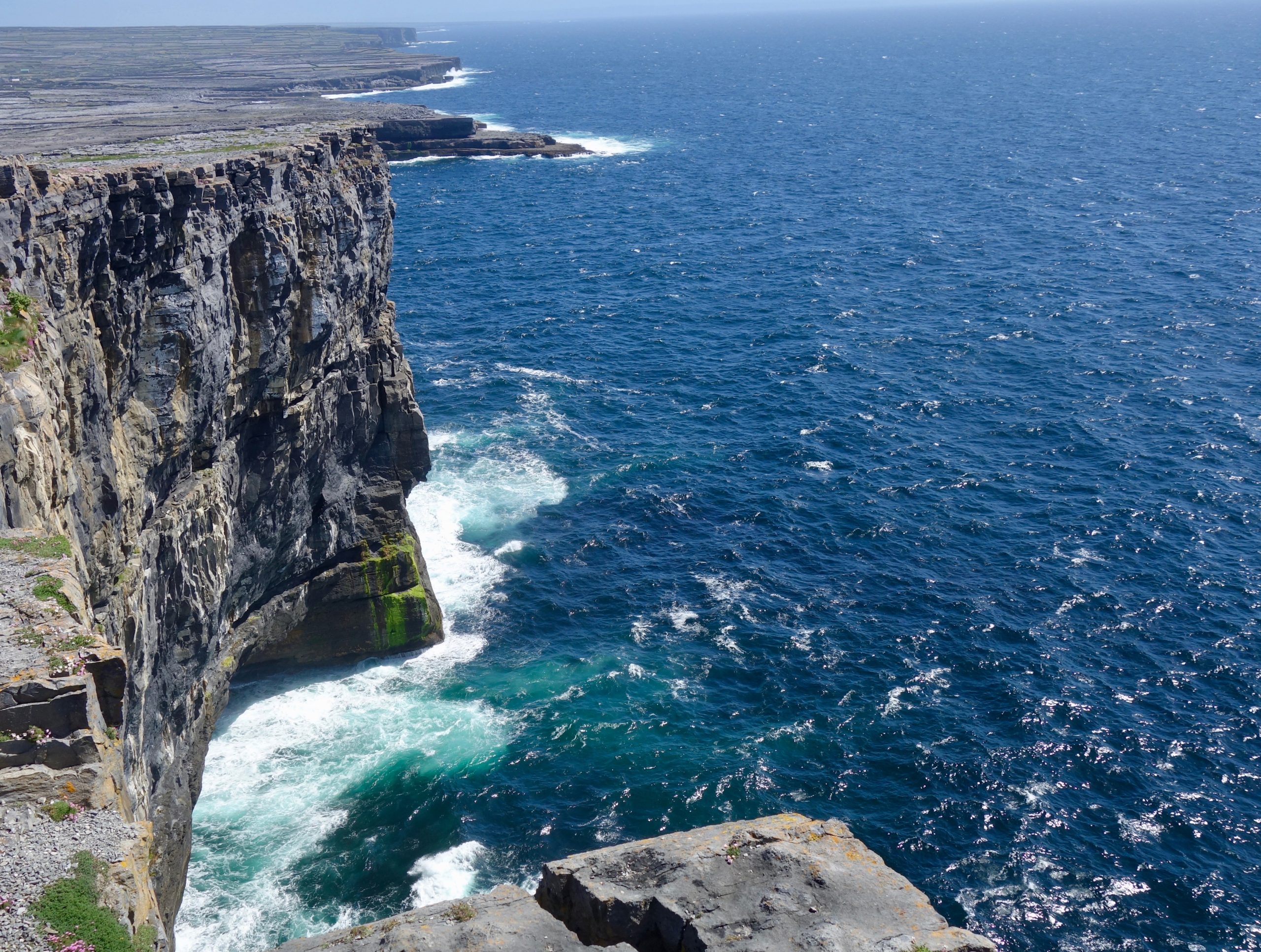
Dún Aonghasa is a prehistoric stone fort on the Aran Islands, built right at the edge of a 100-metre sheer cliff above the Atlantic. There are no railings. The fort itself dates back more than 3,000 years, and nobody knows exactly what it was built for — defence, ceremony, or something else entirely.
To reach it, you cycle or walk from Kilronan, the main village on Inis Mór, up a steep path across the limestone plateau. When you pass through the outer stone walls and walk across the inner enclosure to the cliff edge, the drop is sudden and absolute. The Atlantic stretches to the horizon. On a clear day you can see the Cliffs of Moher across the water.
The combination of extreme age, complete silence (once the other tourists have moved away), and a sheer physical edge produces something that is difficult to describe but easy to remember. Many people who visit report the same thing: they lie on their stomachs and crawl to the edge and peer over, heart hammering, and feel very small and very alive at the same time.
Getting there: Ferries run from Rossaveel in County Galway and from Doolin in County Clare to Inis Mór. The crossing takes roughly 40 minutes from Rossaveel. Bikes can be hired at the pier for a few euros.
Get Ireland in your inbox every week. Stories, places, and heritage — for people who love Ireland wherever they are. Subscribe free here →
Walking Into Newgrange at the Winter Solstice
☘️ Join 64,000+ Ireland Lovers
Every weekday morning, get Ireland’s hidden gems, local secrets, and travel inspiration — the kind you won’t find in any guidebook.
Subscribe free — enter your email:
Already subscribed? Download your free Ireland guide (PDF)
📲 Know someone who’d love this? Share on WhatsApp →
Free forever · Unsubscribe anytime
Newgrange is a passage tomb in County Meath built around 3,200 BC — older than Stonehenge, older than the Egyptian pyramids. It was constructed by Neolithic farmers who aligned the entrance precisely so that, on the winter solstice, a shaft of sunlight travels down the 19-metre passage and lights up the inner chamber for about 17 minutes.
Each year, a public lottery decides who gets into the chamber for the sunrise event, held across five mornings from 19 to 23 December. Thousands of people enter for a few dozen places, and each winner may bring one guest. If you are not one of the lucky ones, the visitor centre runs a simulated re-creation of the light event during normal opening hours throughout the year.
Even the simulation, inside the actual chamber, is genuinely moving. You stand in complete darkness in a space that has not changed in over 5,000 years, and then the artificial light creeps across the carved stone floor. The scale of planning and effort required by people who had no metal tools — who dragged these stones from quarries up to 80 kilometres away — is something you feel physically rather than just understand intellectually.
Those who win the real lottery consistently describe it as one of the most powerful experiences of their lives.
Getting there: Newgrange is in the Boyne Valley, about 50 kilometres north of Dublin. Access is only via the Brú na Bóinne visitor centre, where buses run to the site. Book tickets in advance — it sells out.
A Late-Night Session in a West of Ireland Pub
Traditional Irish music is different in person from anything you will hear on a recording. A session — an informal gathering of musicians playing together, usually in a pub — is not a performance. There is no stage. The musicians sit in a circle or at a corner table, and the music comes and goes, speeds up, slows down, passes from one instrument to another.
In the west of Ireland — in Clare, Galway, Kerry and Donegal in particular — sessions happen regularly in ordinary local pubs. In Doolin in Clare, in Miltown Malbay, in Westport in Mayo, in Dingle, you can walk in on a Tuesday evening and find something that has been going on, in various forms, for centuries.
What produces the chills is usually the moment when it all clicks together — when the bodhrán and fiddle and flute hit the same phrase at the same time, when the speed builds past what seems physically possible, when a singer drops into a sean-nós song in Irish and the room goes completely silent. It feels like being let into something very old and very private.
Love stories like these? Our weekly newsletter is read by tens of thousands of people who feel connected to Ireland. Join them — it’s free →
Finding Your Family’s Name in a Churchyard
This one is specific to the Irish diaspora — and there are tens of millions of people around the world with Irish ancestry. Standing in a rural churchyard in County Cork or Roscommon or Donegal, looking at a gravestone that carries your family name and a date from the 1840s or 1850s, is an experience that people describe in terms that go well beyond ordinary tourism.
The Famine years of 1845 to 1852 drove more than a million people to emigrate. Many of their descendants have lived in the United States, Canada, Australia and Britain for five or six generations without ever setting foot in Ireland. Coming back — particularly to a specific parish, a specific village, a specific field where a great-great-grandparent was born — tends to produce a reaction that surprises people. Grown adults who consider themselves entirely unsentimental find themselves unable to speak.
It is worth doing the research before you travel. The General Register Office and Irish Genealogy database (www.irishgenealogy.ie) hold civil records from 1864 and many Church of Ireland records from earlier. The National Library of Ireland holds Catholic parish registers on microfilm. County heritage centres across Ireland offer paid research services if you want expert help — and understanding the origins of your family name can be a useful starting point.
The most useful thing you can do before visiting is to establish the specific townland — the smallest administrative unit in Ireland — where your ancestors lived. Once you have that, a local historian or heritage centre can often fill in the rest.
The Wild Atlantic Way in a Storm
The Wild Atlantic Way is a 2,500-kilometre coastal driving route running from Donegal in the north to Cork in the south. On a sunny day it is beautiful. In a storm, it is something else entirely.
The Atlantic coast of Ireland is one of the most exposed coastlines in Europe. The waves that hit it have crossed more than 3,000 kilometres of open ocean since leaving North America. When the wind is coming in from the west and a proper Atlantic swell is running, the cliffs at Slieve League in Donegal, the Cliffs of Moher in Clare, or Mizen Head in Cork produce waves and spray and noise on a scale that feels genuinely elemental.
Slieve League, at 601 metres, is among the highest sea cliffs in Europe. It receives far fewer visitors than the Cliffs of Moher and involves a steeper walk, but the payoff in conditions — and in solitude — is significant. On a stormy day, standing at the top looking down at waves you can hear but barely see through the spray, the ordinary scale of things loses its grip for a moment.
Getting there: Slieve League is signposted from Carrick in south Donegal. There is a car park at Bunglass from which the cliff-top walk begins. Allow two to three hours for the full circuit and check weather conditions beforehand — in very high winds the path becomes dangerous.
Why Ireland Produces These Moments
There are practical reasons why Ireland tends to leave a strong impression. The country is small enough that you can reach very remote places without great effort. The population is thinly spread, so you can stand at a 5,000-year-old monument with no other person in sight. The history is layered and often tragic in ways that are still visible — in the ruined cottages scattered across the west, in the missing generations that emigrated, in the Irish language that still clings on in the Gaeltacht regions of Galway, Donegal and Kerry.
But there is also something less easy to quantify — a quality of directness in the way people speak to you, a willingness to actually talk, that is not something every travel destination offers. The woman behind the counter at a post office in Roscommon who asks where you are from and ends up spending 20 minutes tracing a possible shared history between your family and hers. The farmer who waves you through a gate across a right-of-way and then stands talking for an hour in the rain.
These encounters are not manufactured. They are the ordinary texture of Irish daily life, and they catch people off guard in a way that an impressive view rarely does.
Planning Your Visit
Ireland is a year-round destination, but the shoulder seasons — April to early June and September to October — offer the best combination of reasonable weather, manageable crowds and lower prices. July and August are busier and warmer but the west can be wet at any time of year regardless.
If you are travelling for genealogy specifically, book a session with a local heritage centre or genealogist before you go — they can save you weeks of searching and often know local details that no database captures. Many county-level genealogy centres offer half-day consultations that are well worth the cost.
For music, avoid tourist-facing shows and ask locally where the actual sessions happen. In most Irish towns there will be a pub that hosts regular traditional music nights — the bar staff will tell you which one it is and when it starts. It usually does not start until after nine in the evening.
Planning a trip to Ireland? Every week we share practical guides, heritage stories and local knowledge with our community. Subscribe free and never miss an issue →
The experiences that stay with you tend not to be the ones you planned for. They happen when you pull over somewhere on a minor road because the light is doing something odd over a lough, or when a conversation in a shop goes in an unexpected direction, or when you round a bend and find yourself looking at something that has been standing for 4,000 years and has no interpretation board. Ireland has a lot of those moments. The country is good at producing them.
Tours & experiences you might love


Powered by Viator. Some links are affiliate links — we may earn a small commission at no extra cost to you.
Secure Your Dream Irish Experience Before It’s Gone!
Planning a trip to Ireland? Don’t let sold-out tours or packed attractions spoil your journey. Iconic experiences like visiting the Cliffs of Moher, exploring the Rock of Cashel, or enjoying a guided walk through Ireland’s ancient past often sell out quickly—especially during peak travel seasons.

Booking in advance guarantees your place and ensures you can fully immerse yourself in the rich culture and breathtaking scenery without stress or disappointment. You’ll also free up time to explore Ireland’s hidden gems and savour those authentic moments that make your trip truly special.
Make the most of your journey—start planning today and secure those must-do experiences before they’re gone!