

Ask any Irish person about the country’s greatest traditional dish and brace yourself. You will not get a quick answer. You’ll get a story — probably about a grandmother, a farmhouse kitchen, and a pot that never seemed to come off the hob. Irish food is not just fuel; it’s identity, memory, and belonging wrapped up in a bowl.
We’ve ranked Ireland’s ten most iconic traditional dishes, and we’re under no illusions: you’re going to disagree with us. Good. That’s the whole point. Tell us in the comments where we’ve gone wrong, what we’ve unfairly overlooked, and — most importantly — which dish sits at the very top of your own list.
10. Barmbrack
Barmbrack is Ireland’s most theatrical loaf. A yeasted tea bread studded with raisins and sultanas, it’s eaten year-round but reaches its peak on Hallowe’en, when tradition demands that small objects — a ring, a coin, a piece of rag — are baked inside. Finding the ring means marriage is coming. The coin promises wealth. The rag suggests a leaner year ahead. No other bread in the world makes people nervous to eat it. The crust cracks with a faint sweetness; the crumb is dense, rich, and deeply comforting alongside a strong cup of tea.
9. Brown Bread and Smoked Salmon
This pairing is so simple it barely feels like a dish — and yet it appears on the menus of the finest restaurants in Dublin and the humblest harbour cafés in Donegal alike. Thick-cut Irish smoked salmon, its flesh the colour of a winter sunset, laid over dense slices of brown wheaten bread spread with cold, salted butter. A squeeze of lemon. Perhaps a curl of cream cheese. That’s it. The ocean and the land on a single plate, and nothing superfluous between them.
8. Black Pudding
Black pudding is perhaps Ireland’s most misunderstood delicacy. Mention the ingredients to the uninitiated and they’ll recoil. Serve it to them — sliced thick, fried until the edges crisp and the inside stays just slightly soft — and they’ll ask for more. Clonakilty black pudding from County Cork has its own near-mythical reputation, and travelling through West Cork without sampling it is the kind of omission you don’t make twice. It belongs on a plate alongside rashers and eggs, but it’s increasingly appearing on restaurant menus as a standalone starter with apple and chutney, and rightly so.
7. Champ
Champ is proof that the Irish have always understood that the greatest cooking is honest cooking. Mashed potatoes beaten with butter — truly alarming quantities of butter — and stirred through with finely chopped spring onions, then finished with a pool of more melted butter in the centre that you work your way through as you eat. It is the kind of dish that inspired folk songs — because when something is made with this much care and this much butter, it deserves commemorating.
6. Dublin Coddle
Coddle is Dublin’s own dish, and Dubliners are fiercely defensive of it. Sausages, bacon rashers, onions, and potatoes slow-cooked together in a broth until everything has surrendered to the pot — this was traditionally made on Fridays from whatever leftovers the week had produced, because nothing was ever wasted. Jonathan Swift was a fan. So was Seán O’Casey. The broth is pale and quietly smoky; the potatoes absorb everything around them. It’s not a glamorous dish. It tastes exactly like someone’s kitchen at the end of a long, cold day.
5. Full Irish Breakfast
The Full Irish — or “the full” as it’s simply called — is less a meal than a commitment. Bacon rashers, sausages, black and white pudding, fried eggs, grilled tomatoes, mushrooms, and a pile of soda bread or toast to hold it all together. It arrives with a pot of tea large enough to fill a small reservoir. Order one in a roadside café on the road to Galway on a damp September morning and you’ll understand why the Irish have never seen much point in continental breakfast. This is sustenance. This is armour against the day.
☘️ Enjoying this? 64,000+ Ireland lovers get stories like this every week. Subscribe free to the Love Ireland newsletter
Thinking about it seriously?
If you’ve started actually planning a move, our complete the full Move to Ireland guide walks through every step, every cost, and the paperwork that catches most people out.
Subscribe free →
4. Boxty
The children of Ireland grew up learning the rhyme: “Boxty on the griddle, boxty on the pan; if you can’t make boxty, you’ll never get a man.” Whether that particular social pressure ever proved effective is debatable, but boxty itself is extraordinary — a pancake made from a mixture of raw grated potato and mashed potato, bound with flour and fried until the outside is golden and the inside is still tender and slightly starchy. County Leitrim and County Cavan claim it as their own, though you’ll find it across the north midlands. Order it stuffed with smoked salmon and sour cream in a restaurant, or eat it plain with butter at someone’s kitchen table. Both versions are correct.
3. Colcannon
Colcannon is mashed potato’s most glorious evolution. Silky mashed potato folded through with softened kale or cabbage, enriched with butter and cream, often topped with crispy fried bacon. Like champ, it belongs to the Hallowe’en table — coins were traditionally hidden inside, wrapped in paper, to bring fortune to whoever found them. A good colcannon is a precise thing: the potato must be floury, the greens must retain a little texture, and the butter must be excessive. There is no such thing as a colcannon made with too much butter. Our readers have spoken on the great Irish food debate — and potato dishes feature prominently.
2. Soda Bread
No dish better captures the ingenuity of Irish cooking than soda bread. In a country where yeast was expensive and time was scarce, bakers discovered that bicarbonate of soda reacted with buttermilk to create a rise — giving a loaf with a tight, hearty crumb, a floury crust, and a slightly tangy flavour that no other bread in the world quite replicates. Every Irish family has its own version, its own proportions, its own argument about whether to add treacle or caraway seeds or wholemeal flour. The tradition extends to scones and griddle cakes. The smell of soda bread baking is, for many Irish people, the smell of home — regardless of which country that home is in.
1. Irish Stew
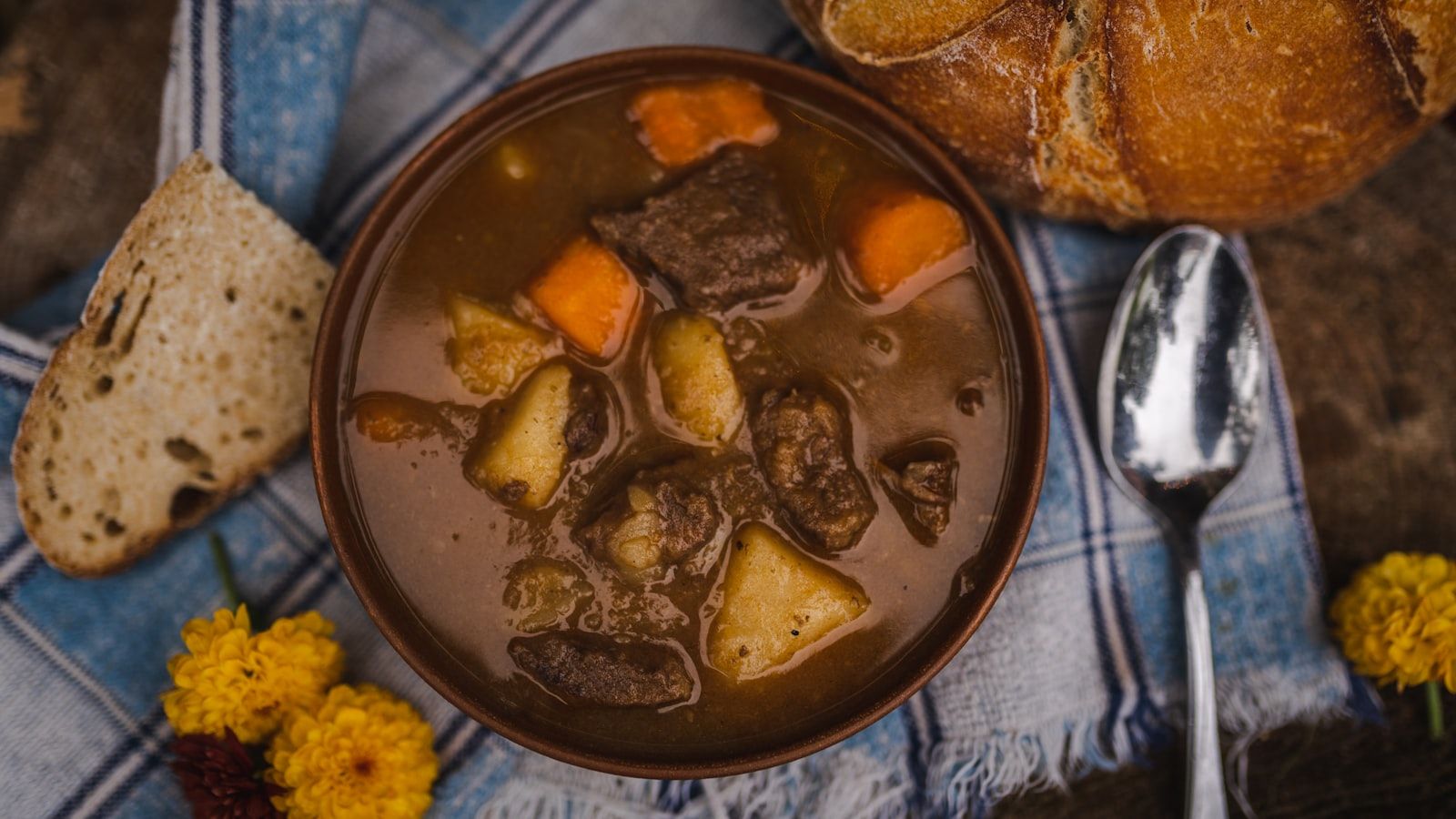
At the top of the list, there could only ever be one dish. Irish stew is the country in a pot. Originally made with lamb — always lamb, never beef, though the argument rages still — the recipe is almost insultingly simple: meat on the bone, potatoes, onions, water, time. Hours of slow cooking until the broth deepens to something earthy and rich, the potato thickens the liquid into silk, and the lamb falls from the bone at the lightest touch. There are no herbs fighting for attention. There are no complicated techniques. There is only patience, and the understanding that something exceptional can come from the most ordinary of ingredients. Eat it in a pub in Connemara while rain hammers the window. You’ll never want to leave.
Honourable Mentions
No top-10 list can fit everything, and two dishes in particular kept coming up as we compiled ours. Irish Seafood Chowder — a thick, creamy harbour-pub staple built on smoked fish, prawns and a splash of cream — is arguably as iconic along the west coast as anything on this list, and a bowl with brown bread is the definitive wet-weather lunch in towns like Kinsale, Galway and Dingle. And Shepherd’s Pie — minced lamb (or its beef cousin, Cottage Pie) under a blanket of golden mashed potato — is the dish most Irish households actually cook on a weeknight, even if it doesn’t carry the same festival-day ceremony as coddle or colcannon. Both deserve a place at the table, even if they didn’t crack our final ten.
Now It’s Your Turn
We’ve made our call — but the beauty of Irish food is that everyone has a different number one. Is it your mother’s coddle? The boxty you ate in a County Leitrim farmhouse? The soda bread still warm from the oven of a Connemara B&B?
Tell us your number one traditional Irish dish in the comments below. And if we’ve committed the unforgivable sin of leaving your favourite off the list entirely, let us know — we can take it.
For more stories about the food, culture, and hidden corners of Ireland, subscribe to our free weekly newsletter — join over 64,000 readers who love Ireland as much as you do.
☘️ Join 64,000+ Ireland Lovers
Every weekday morning, get Ireland’s hidden gems, local secrets, and travel inspiration — the kind you won’t find in any guidebook.
Subscribe free — enter your email:
📲 Know someone who’d love this? Share on WhatsApp →
Free forever · Unsubscribe anytime
Tours & experiences you might love


Powered by Viator. Some links are affiliate links — we may earn a small commission at no extra cost to you.
Secure Your Dream Irish Experience Before It’s Gone!
Planning a trip to Ireland? Don’t let sold-out tours or packed attractions spoil your journey. Iconic experiences like visiting the Cliffs of Moher, exploring the Rock of Cashel, or enjoying a guided walk through Ireland’s ancient past often sell out quickly—especially during peak travel seasons.

Booking in advance guarantees your place and ensures you can fully immerse yourself in the rich culture and breathtaking scenery without stress or disappointment. You’ll also free up time to explore Ireland’s hidden gems and savour those authentic moments that make your trip truly special.
Make the most of your journey—start planning today and secure those must-do experiences before they’re gone!
Subscribe Free