

Manannán mac Lir is the most powerful sea deity in Irish mythology — a shape-shifting god of the ocean, the Otherworld, and the afterlife who ruled over every wave that struck Ireland’s roughly 3,171-kilometre coastline. His name means “son of the sea” (mac Lir translates directly as “son of the sea”), and for thousands of years, Irish fishermen, sailors, and islanders invoked his name before venturing onto the water. He wasn’t a distant Olympian figure. He was the sea itself.
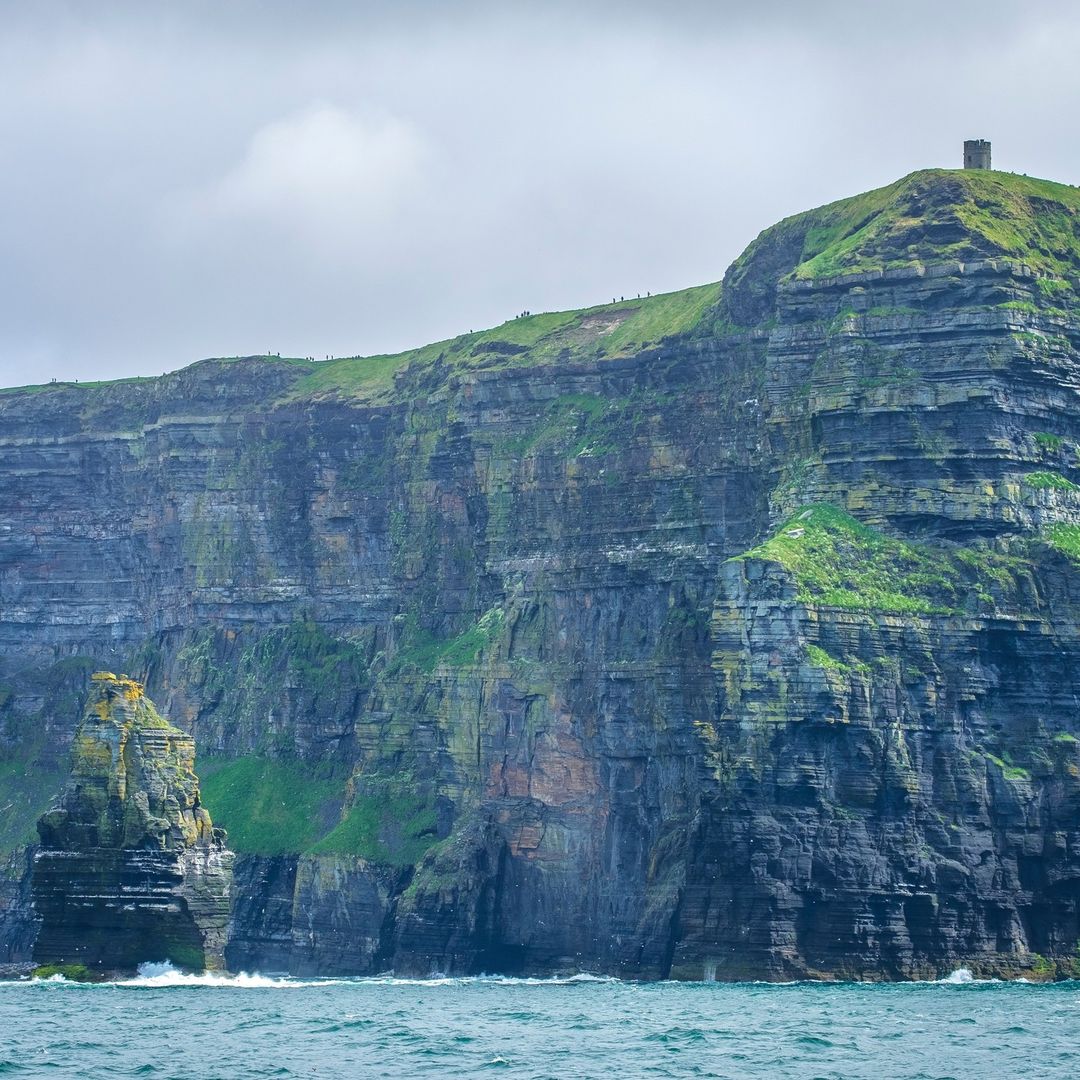
Unlike many mythological figures, Manannán never really disappeared. His name still appears in place names, his feast day is still observed in parts of Ireland and the Isle of Man, and his cloak — the famous Féth Fíada, or mist of invisibility — appears again and again in Irish folk tales right up to the nineteenth century. If you’ve ever stood on a Wild Atlantic Way headland and watched the ocean fog roll in from nowhere, you’ve witnessed what ancient Irish people called Manannán pulling his cloak across the water.
Who Was Manannán mac Lir?
Manannán mac Lir belongs to the Tuatha Dé Danann — the supernatural race of beings who inhabited Ireland before the Gaels arrived. He occupies a unique position even within that pantheon. While the Dagda ruled the land, the Morrigan presided over battle, and other gods commanded the harvest, Manannán alone claimed the sea and everything that lay beneath and beyond it.
His father was Lir, the primordial ocean deity (not to be confused with the Lir of the Children of Lir story, though the names share the same root). Manannán’s home was Tír Tairngire — the “Land of Promise” — sometimes called Mag Mell, the “Plain of Delight.” This was not a place of punishment but of eternal joy, abundance, and beauty. It lay beyond the western horizon, accessible only by sea, and the Atlantic Ocean was essentially its gateway.
Medieval Irish texts picture him as tall, golden-haired, and dressed in a cloak that changed colour like the sea itself — now green, now grey, now deepest blue-black. He rode a horse called Aonbharr (“Splendid Mane”) that could travel as fast across water as across land. He carried a sword called Fragarach (“The Answerer”) that cut through any armour, and a bag made of crane skin that held all the treasures of the sea. His chariot crossed the waves, leaving foam in its wake — what people now call the white crests of breaking waves.
Manannán and the Isle of Man
The Isle of Man — Ellan Vannin in Manx — takes its English name directly from Manannán mac Lir. In Manx tradition, he served as the island’s first ruler and lawgiver, and his influence on local culture persisted for centuries after Christianisation. The Manx annual Midsummer festival, Tynwald Day (held every 5th of July, which is Old Midsummer’s Day), involves carrying rushes to the ancient assembly mound — a tradition scholars connect to offerings that the Manx people once made to Manannán.
Irish sources explained Manannán’s connection to Man in practical terms: the island sat at the centre of the Irish Sea, which the ancient Irish called Muir Meann — “Manannán’s Sea.” From any point in Ireland, on a clear day, you could sometimes see the Isle of Man on the horizon. It marked the threshold between the known world and the Otherworld, the last land before the open Atlantic and the paradise beyond.
The medieval text Cath Maige Tuired — “The Battle of Mag Tuired,” one of the four great mythological texts of early Ireland — records Manannán as the keeper of the sacred weapons of the gods. Lugh Lámhfhada later inherited his sword Fragarach, which compelled anyone it pointed at to speak only the truth. In Irish legal tradition, swearing on a sword ranked among the most binding oaths possible — and scholars trace that tradition directly back to Fragarach.
The Féth Fíada: Manannán’s Cloak of Invisibility
The most famous of Manannán’s possessions was not a weapon but a garment — the Féth Fíada, or “mist of concealment.” This magical cloak could render anyone wearing it or sheltered beneath it invisible to ordinary human sight. In the mythological texts, Manannán deployed it when the Gaels defeated the Tuatha Dé Danann and drove them underground into the fairy mounds (sídhe) beneath the Irish landscape.
The Féth Fíada appears repeatedly throughout Irish mythology and early Christian hagiography. Early texts describe Saint Patrick himself using a version of it — a prayer-mist that concealed his monks from pursuing warriors. The Hymn of Saint Patrick, traditionally known as “The Deer’s Cry” or the Lorica of Saint Patrick, transformed the entire band of monks into deer so that soldiers saw only animals on the road. The Féth Fíada tradition had moved directly into Christian miracle-working.
In folk tradition, the Féth Fíada became associated with sea mist and coastal fog. When the haar rolled in off the Atlantic — the thick, impenetrable kind that can reduce visibility to near zero within minutes — Irish coastal communities understood it as Manannán drawing his cloak around his domain. County Donegal fishermen still use the phrase “Manannán’s blanket” for heavy sea fog in some areas.
The Mist in Practise: Where to See It
The coastal fogs associated with Manannán are most dramatic along Ireland’s west coast, particularly:
- The Aran Islands, County Galway — Inis Mór in particular, where sea mist can descend and lift several times in a single morning. People have lived on the island for over 4,000 years, and early Irish texts identify it as a threshold to the Otherworld.
- Malin Head, County Donegal — Ireland’s most northerly point, where the Atlantic rolls in unimpeded from thousands of kilometres away. Nineteenth-century folklore collectors found that local people attributed the headland’s dramatic sea mists directly to Manannán.
- The Slieve League cliffs, County Donegal — At 601 metres, the highest sea cliffs in Ireland. The views are extraordinary when clear, but fog rolls in from the Atlantic without warning, transforming the landscape entirely within minutes.
- The Blasket Islands, County Kerry — The last inhabited landfall before North America. Kerry tradition held them to be the closest physical point to Tír na nÓg. The last residents left in 1953, but the mythology endures.
☘️ Enjoying this? 64,000+ Ireland lovers get stories like this every week. Subscribe free →
Manannán’s Role as Guardian of the Otherworld
In Irish mythology, the Otherworld was no place of damnation. It was a realm of abundance, beauty, and timelessness — and Manannán chose who could enter. He moves through several of the great mythological narratives as a ferryman and guide, leading heroes, kings, and occasionally ordinary mortals to Tír Tairngire.
The most famous of these is the Voyage of Bran (Immram Brain), composed around the eighth century and one of the oldest pieces of Irish literature. In this tale, Bran mac Febail hears beautiful otherworldly music and follows it until he falls asleep. He wakes to find a silver branch covered in white apple blossoms on his pillow — a gift from a woman of the Otherworld. She describes Tír Mór — the Great Land — in fifty quatrains, depicting it as a place without death, without sin, without sorrow. Bran and three groups of nine companions set out across the western sea and encounter Manannán himself, sailing toward them in a chariot across the waves:
“Bran deems it a marvellous beauty in his coracle across the clear sea; while to me in my chariot from afar it is a flowery plain on which he drives about.”
— Immram Brain, c. 8th century (trans. Kuno Meyer)
Manannán tells Bran that what appears to be ocean to humans is actually a plain of flowers. What Bran sees as waves are the meadows of Tír Tairngire. The entire poem is a meditation on the limits of human perception — the idea that the world as we see it is only one layer of a much richer reality.
The Imrama: Ireland’s Great Voyage Tradition
The Immram Brain is one of several imrama — “voyage tales” — in early Irish literature, all of which follow a similar pattern: an Irish hero sails west, encounters Manannán or his emissaries, and either enters the Otherworld or returns transformed. The genre includes:
- Immram Maíle Dúin — The richest of the voyage tales, featuring thirty-one islands of wonders. It directly influenced the Voyage of Saint Brendan, which was copied and translated into numerous European languages across the medieval period and read widely throughout Christian Europe.
- Immram Snédgusa agus Maic Riagla — Two monks encounter islands with miraculous birds, speaking salmon, and a figure identified as the Angel of God — but whose description mirrors Manannán precisely.
- Immram Ua Corra — A later tale of three brothers seeking penance who sail west and encounter a Manannán-like figure described simply as “the Lord of the Western Sea.”
Manannán’s Connections to Real Irish Places
Unlike many mythological figures who inhabit purely imaginary geographies, Manannán mac Lir connects to specific, visitable places in Ireland. These are not casual associations — texts written over a thousand years ago record them in detail.
Knocknarea, County Sligo
Most visitors know Knocknarea as the probable burial site of Queen Medb (Maeve), but some traditions also link the great cairn at its summit — Miosgán Meadhbha, standing 10 metres high and roughly 55 metres in diameter — to a council of the gods over which Manannán presided. Archaeologists have never excavated the site. It dates to approximately 3000 BCE, placing it in the same era as Newgrange.
The Aran Islands, County Galway
Inis Mór, the largest of the three Aran Islands, sits at the mouth of Galway Bay where the Atlantic begins. The island’s principal prehistoric fort, Dún Aonghasa, perches on the very edge of a 100-metre cliff above the Atlantic — a structure so dramatically positioned that archaeologists still debate whether its builders designed it for defence, ceremony, or both. Early Irish tradition sometimes identified the Aran Islands as the eastern threshold of Tír na nÓg, with Manannán watching over every crossing.
Emain Ablach: The Island of Apple Trees
Manannán’s own home — Emain Ablach, the “Isle of Apples” — appears in several texts somewhere off the Irish coast, to the north-west. Some scholars propose it as an early Irish name for the Isle of Arran in Scotland, or for a now-submerged coastal headland. The apple tree connection matters: apple orchards appear again and again in Celtic Otherworld mythology across Britain and Ireland, and Glastonbury in Somerset carried the Celtic name Avalon — meaning precisely “place of apples.” A single widespread Atlantic-facing mythology may tie all these traditions together.
Manannán mac Lir in Irish Genealogy and Family Tradition
If your Irish ancestors came from coastal counties — particularly Donegal, Sligo, Mayo, Galway, Clare, Kerry, or any part of Ulster bordering the sea — Manannán mac Lir was part of the mythological world they inhabited. The sea was not simply geography; it was alive with divine presence. This shaped everything from fishing customs and boat-naming practices to the way death and the afterlife were understood.
Several Irish clan names carry traces of the sea-god tradition. “Mac Lir” was never itself a widespread hereditary surname, but some modern Irish families with names meaning “of the sea” or tied to coastal territories may trace genealogical roots to communities that particularly venerated Manannán. The O’Donnells of Donegal, the Flaithbheartachs (Flahertys) of Connemara, and the Uí Briúin clans of Connacht all held territories the sea god claimed as his domain.
Coastal Irish families also preserved specific customs that appear to have roots in the Manannán tradition:
- Never whistling at sea — Whistling was said to summon Manannán’s attention, and summoning the sea god’s attention when you didn’t mean to was dangerous. This prohibition survived as a sailor’s superstition into the twentieth century.
- Offering the first catch — Throwing the first fish of a new season back into the sea was a widespread practise in Irish coastal communities, understood as returning a gift to the lord of the sea.
- Blessing a new boat with seawater — Not fresh water, but seawater specifically, taken from the open sea rather than a harbour — understood as taking the blessing of the sea itself.
- Not counting the catch on the water — Counting amounted to claiming ownership, and claiming ownership of the sea god’s fish was an act of arrogance that could cost the next catch.
Manannán in Early Christian Ireland
Christianity arrived in Ireland in the fifth century, and it did not erase Manannán mac Lir. It absorbed him. The process was gradual and sometimes startlingly direct. Early Irish monks took deep interest in the mythological tradition, and Christian scribes in monasteries wrote many of the texts that preserve Manannán’s stories today — men who clearly admired and wished to keep the older material alive, even as they framed it within a Christian worldview.
The most striking example is the voyage tradition. The Navigatio Sancti Brendani — the Voyage of Saint Brendan — follows almost exactly the same structure as the pagan imrama. Brendan and his monks set out from the Kerry coast in a currach (a traditional Irish boat of hide stretched over a wooden frame), sail west for seven years, and discover an extraordinary series of islands — some paradisiacal, some terrifying. A crystal column rises from the sea (possibly an iceberg), a floating island reveals itself as a sleeping sea creature (the tale’s most famous episode), and eventually the party reaches the “Island of Delight” — the Christian equivalent of Tír na nÓg.
Scribes wrote the text around 900 CE, though it claims to describe voyages made in the sixth century. It went on to become one of the most widely copied documents of the entire medieval period. Scholars believe it preserves genuine knowledge of Atlantic navigation that Irish seafarers accumulated over centuries — knowledge that an earlier era would have attributed directly to Manannán mac Lir’s guidance.
Manannán’s Feast Day and Living Traditions
Manannán mac Lir has no single universally agreed feast day in Ireland, but in the Isle of Man, Midsummer (5th July in the Old Calendar) traditionally carried tribute to him. On Midsummer’s Day in Manx custom, people strewed rushes on the roads leading to Tynwald Hill as an offering to Manannán.
In Ireland, the nearest equivalent is the feast of Lughnasadh (1st August). Communities held ceremonies at coastal sites — great assemblies at Lúnasa on river banks and headlands that included tribute to Manannán as lord of the sea and its bounty. The mackerel run in August ranked among the most important harvests in the Irish coastal economy, and beginning it with ceremony made both practical and spiritual sense.
Contemporary Irish neopagan and polytheist communities have revived Manannán as a central figure in modern Irish spirituality. There are now regular ceremonies at Inis Mór, at Malin Head, and at the Slieve League cliffs in which offerings are made to the sea — rushes, grains, biodegradable items — in the traditional manner. In a typical year, the Tynwald ceremony on the Isle of Man draws several thousand participants, demonstrating that interest in Manannán mac Lir remains genuinely alive rather than merely academic.
FAQ: Manannán mac Lir
What is Manannán mac Lir the god of?
Manannán mac Lir is the Irish god of the sea, the Otherworld, and magic. He presides over the ocean, sea mist, and the passage between the living world and the realm of the dead and the supernatural. He is also associated with abundance, hospitality, and the afterlife — in Irish mythology, the Otherworld he rules is a place of joy, not punishment. He appears in texts going back to at least the eighth century CE, though the oral traditions are certainly older.
Where does the name Manannán mac Lir come from?
The name breaks into two parts: Manannán (which appears to derive from the same Celtic root as “Manx” and “Man,” referring to the Isle of Man) and mac Lir, meaning “son of the sea” (Lir being an ancient Celtic word for sea). His name therefore means roughly “the Manxman, son of the sea” — or more poetically, “son of the ocean who rules the middle sea.” The Proto-Celtic root *mori for “sea” appears across the ancient Celtic world, from the Marne river in France to the Irish word for sea, muir.
Is Manannán mac Lir still worshipped today?
In a formal religious sense, practitioners of Celtic reconstructionist polytheism and Irish neopaganism honour Manannán mac Lir, particularly within the tradition known as Gaelic Polytheism. Communities hold annual ceremonies at his associated sites in Ireland and the Isle of Man. More broadly, he remains a living figure in Irish and Manx cultural identity — Manx folk tradition links him to the three-legged triskelion on the Isle of Man’s coat of arms, his name marks roads and townlands across Ireland, and Irish-language schools teach his stories. He never stopped drawing veneration; the form changed, but the continuity never fully broke.
How is Manannán mac Lir different from the Dagda?
The Dagda is the “Good God” of Irish mythology — the all-father figure who commands the land, fertility, wisdom, and the earth’s abundance. Manannán mac Lir commands the sea and the Otherworld. Where the Dagda’s cauldron never runs empty of food (representing earthly abundance), Manannán’s bag of crane skin holds the treasures of the sea (representing oceanic abundance and hidden mystery). The two figures complement rather than rival each other — the land god and the sea god — and both rank among the most powerful of the Tuatha Dé Danann.
Where can I visit places connected to Manannán mac Lir in Ireland?
The best places to experience the landscapes associated with Manannán are on Ireland’s western coastline. Inis Mór on the Aran Islands is the single most evocative site — accessible by ferry from Rossaveel (approximately 45 minutes, with ferries running year-round) or by an 8–10 minute direct flight from Connemara Airport — one of the shortest scheduled flights in Europe. The Slieve League cliffs in County Donegal (free access, car park at Bunglass Point, approximately 3 hours from Dublin) are among the most dramatic in Europe. Malin Head in County Donegal — Ireland’s most northerly point and the end of the Wild Atlantic Way’s northern route — requires about 4.5 hours’ drive from Dublin but is one of the most atmospheric headlands in Ireland.
October is Family History Month — if you’re searching for your own Irish roots from coastal counties where Manannán’s traditions ran deepest, our free Irish Ancestry Guide at the link below can help you trace your family to a specific townland or parish.
☘️ Join 64,000+ Ireland Lovers
Every weekday morning, get Ireland’s hidden gems, local secrets, and travel inspiration — the kind you won’t find in any guidebook.
Subscribe free — enter your email:
Already subscribed? Download your free Ireland guide (PDF)
📲 Know someone who’d love this? Share on WhatsApp →
Free forever · Unsubscribe anytime
Tours & experiences you might love


Powered by Viator. Some links are affiliate links — we may earn a small commission at no extra cost to you.
Secure Your Dream Irish Experience Before It’s Gone!
Planning a trip to Ireland? Don’t let sold-out tours or packed attractions spoil your journey. Iconic experiences like visiting the Cliffs of Moher, exploring the Rock of Cashel, or enjoying a guided walk through Ireland’s ancient past often sell out quickly—especially during peak travel seasons.

Booking in advance guarantees your place and ensures you can fully immerse yourself in the rich culture and breathtaking scenery without stress or disappointment. You’ll also free up time to explore Ireland’s hidden gems and savour those authentic moments that make your trip truly special.
Make the most of your journey—start planning today and secure those must-do experiences before they’re gone!