

Newgrange Winter Solstice: How a 5,000-Year-Old Tomb Captures Sunrise for Exactly 17 Minutes
Every December, thirty thousand people enter a lottery for thirty-eight spots inside a tomb
Once a year, for five mornings in December, a beam of sunlight enters a small rectangular opening above a stone doorway in County Meath and travels nineteen metres down a narrow passage until it strikes the floor of a chamber that sits in complete darkness every other day of the year. The beam lasts seventeen minutes. Then it retreats, and the chamber goes dark again.
Roughly thirty thousand people from around the world apply each year for the chance to be standing inside when that happens. Thirty-eight of them get in. The rest watch from a field outside.
What they are applying to witness is not a curiosity or an accident of landscape. It is the product of an engineering calculation made around 3200 BC, by people who had not yet discovered metal, in a monument so precisely constructed that its chamber roof — a self-supporting stone vault built without mortar — has not admitted a single drop of water in five thousand years.
The Great Pyramid of Giza would not be built for another five hundred years. Stonehenge’s main stone phase was still a thousand years away. Newgrange, a passage tomb in the Boyne Valley, is the oldest precisely aligned building on the surface of the earth.
What they built, and how big it actually is
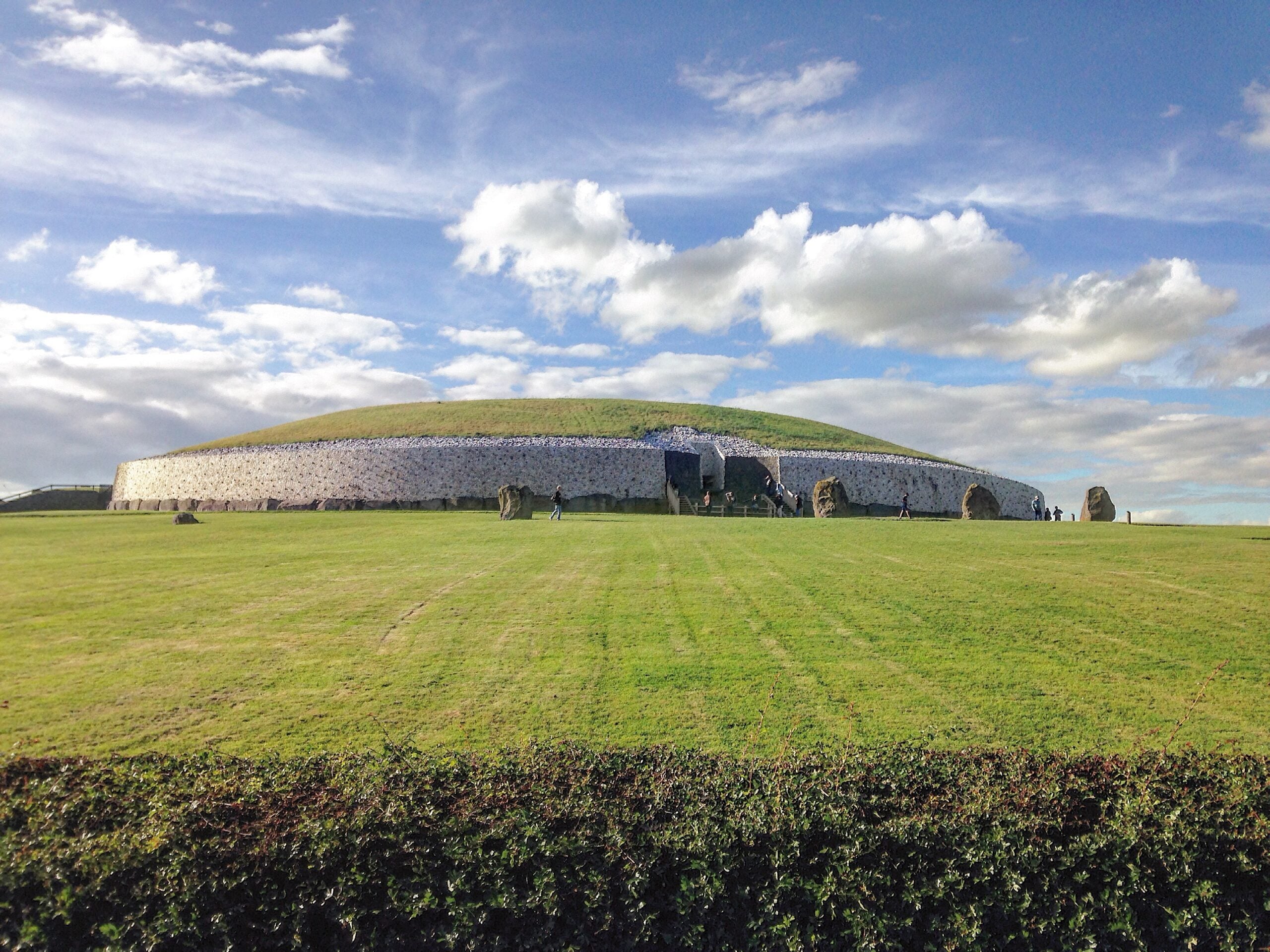
The mound at Newgrange sits about an hour’s drive north of Dublin, in a wide bend of the River Boyne. From a distance it looks like a low hill — which is partly why it went unrecognised as a structure for so long. Up close, it is enormous: eighty-five metres across and twelve metres high, sheathed in a reconstructed wall of white quartz that would have blazed in the winter landscape. The surrounding base is defined by ninety-seven kerbstones, not one of which weighs less than a tonne, and some considerably more.
The total mass of the monument — passage, chamber, corbelled vault, kerbstones, and the 200,000 tonnes of cairn material packed around and above it — came from quarries and riverbeds scattered across eastern Ireland. The white quartz was carried from the Wicklow Mountains, roughly fifty kilometres (thirty-one miles) to the south. The 547 greywacke slabs that form the passage, chamber, and kerbstones came from far closer to home — local sources and the beach at Clogherhead, County Louth, barely twenty kilometres away. The great rounded granite stones that face the mound were water-rolled by Ice Age glaciers and carried from the Mourne Mountains, about fifty kilometres (thirty-one miles) to the north. None of this was carried by wheeled vehicles, because wheels had not been invented. The builders used log rollers, rope, and what we can only assume was an extraordinary degree of collective organisation — some estimates put the construction timeline at thirty years or more, requiring the coordinated labour of hundreds of people over multiple generations.
There was no written language. There was no metal. There was, apparently, someone with a very precise idea of where the sun would be on the shortest morning of the year.
The opening above the door
Here is the piece of engineering that makes Newgrange genuinely strange.
The entrance passage runs nineteen metres from the outside world to the interior chamber. The passage slopes upward slightly as it goes in — the chamber floor sits higher than the entrance — which is significant, because it means the rising winter sun, low on the horizon, can project its light all the way to the back of the tomb without being blocked by the sloping ground between the entrance and the chamber.
But the entrance itself is not the opening that matters. There is a second, smaller opening, positioned directly above the doorway. It measures roughly ninety centimetres high, a metre wide, and about 1.2 metres deep — a stone-framed slot sitting between two roof slabs, too small to crawl through, angled precisely to face the rising sun at the winter solstice. Archaeologists now call this feature a roof box, a term coined by the man who excavated Newgrange in the 1960s.
The mechanics are not complicated, but the precision is. For sunlight from the solstice sunrise to travel the full length of the passage and reach the chamber floor, the builders needed to hold the azimuth — the compass direction of the opening — within a range of roughly 133 to 138 degrees, and the elevation of the distant horizon had to sit within a specific arc above flat. They had no surveying instruments we know of. They got it right.
When the sun clears the ridge to the southeast at 8:58 on a clear solstice morning, a thin blade of orange light enters the roof box and begins to travel the passage. It takes a few minutes to reach the chamber. When it does, it widens into a broad band, illuminates the floor, the walls, the side recesses, and the corbelled ceiling six metres above. After seventeen minutes, the sun has moved enough that the light withdraws. The chamber returns to darkness for another year.
A roof that has not leaked in five thousand years
The chamber vault is, by any measure, a feat of engineering. The builders used a corbelling technique: each successive course of stone slabs slightly overhangs the course below it, the diameter narrowing inward with each layer until a single capstone closes the top. Every stone was laid with a slight outward tilt. Grooves were carved into the upper surfaces of the passage roof stones to channel rainwater away from the joints. The outer ends of the corbels are buried in the cairn material and angled fractionally downward, so water percolating through the mound runs away from the chamber rather than into it.
The result is a room that has stayed completely dry since it was sealed. When O’Kelly’s excavation team cleared the chamber in the 1960s, not a drop of moisture had penetrated the vault. The corbelled roof at Newgrange has outperformed the waterproofing on every flat-roofed building most of us have ever lived in, and it did so without sealant, without concrete, and without modern understanding of material engineering.
The stone outside the door
Before you enter the passage, you pass a flat boulder lying across the entrance. It is roughly three metres wide and covered in a dense spiral carving — three interlocking whorls executed with a confidence and depth that suggests not a first attempt but a tradition. The spirals rotate clockwise toward the centre, then anticlockwise moving away from it. Archaeologists call it Kerbstone 1, or K1. It is among the best-known examples of Neolithic art in Europe.
Nobody knows what it means. The three spirals may represent the sun, moon, and earth. They may mark the threshold between the living world and whatever the builders believed lay on the other side. They may be cosmological notation or they may be something we have no category for. What is not in doubt is that whoever made them was working at a level of skill and intentionality that implies a long cultural tradition — this was not experimental mark-making. These were people who had been carving spirals for a long time.
Michael O’Kelly, standing alone in the dark
For most of recorded history, nobody knew the roof box was there. The mound fell out of use around the third century BC when Celtic cultures arrived in Ireland. By the seventeenth century AD, it was recorded simply as a large hill, its entrance blocked by debris. An excavation in 1699 found the entrance passage but did not connect it to any astronomical purpose. The roof box — sitting just above the door, covered in accumulated earth — was invisible.
In 1962, Michael J. O’Kelly, a professor of archaeology at University College Cork, began what would become a thirteen-year excavation of the site. O’Kelly was unusual in his field: he had trained as an engineer and surveyor alongside his studies in archaeology, which gave him a different way of looking at the monument’s physical structure. He had held the position of head of the archaeology department at UCC for thirty-six years. He was, by the mid-1960s, Ireland’s most eminent archaeologist.
In 1963, while his team was clearing and restoring the collapsed front section of the entrance passage, they uncovered a strange structure above the doorway: a deliberate stone-framed opening, lined and ornamented, positioned at an angle that seemed to point toward the southeast horizon. O’Kelly noted the orientation and put it aside. He had a lot of monument to excavate.
By September 1966, restoration of the roof box was complete. O’Kelly looked at it again, thought about the direction it was pointing, and formed a hypothesis: perhaps the opening aligned with the rising sun at the winter solstice. He had heard local tradition — told to visitors over many generations — that sunrise would light up the triple spiral at the chamber’s back on certain mornings of the year. He had been sceptical. Standing in front of the restored roof box in autumn, he became less so.
He drove from Cork to County Meath on the evening of December 20, 1967. The sky was clear.
He entered the chamber before dawn on December 21 and waited in the dark.
“I was there entirely alone,” he later wrote. “Not a soul stood even on the road below.”
“When I came into the tomb I knew there was a possibility of seeing the sunrise because the sky had been clear during the morning.”
The light, when it came, entered as a thin pencil and widened to a band of about six inches. O’Kelly later described being “literally astounded.” The chamber grew bright enough that he could walk around without a lamp and see the roof twenty feet above him. He expected, he wrote afterwards, to hear a voice — or perhaps feel a cold hand on his shoulder. Instead there was silence, and light, and then none.
He returned to Newgrange on the winter solstice every year for the rest of his life. He died in 1982.
The discovery was not widely publicised until June 1971, when it was mentioned in a report by the Office of Public Works. The academic community received it carefully — the association of ancient monuments with astronomical alignment had attracted a lot of fringe theorising, and O’Kelly, a meticulous excavator, was cautious about the company his findings might keep. The evidence, however, was not easily dismissed. Dr. Frank Prendergast, who has studied the monument’s astronomical properties in depth, has put it simply: “No other passage tomb, in Ireland or Northwest Europe, can demonstrate such emphatic evidence of celestial alignment intentionality.”
What thirty thousand applicants are actually hoping for
Newgrange draws more than two hundred thousand visitors a year through the Brú na Bóinne Visitor Centre. You can walk the passage in any month. You can stand in the chamber, look at the corbelled roof, run your fingers (if they let you) near the triple spiral on K1 — a smaller echo of the same art that covers an even larger share of the carved stones at the neighbouring passage tomb at Knowth. What you cannot do, unless the lottery goes your way, is be inside on a solstice morning.
Each autumn — the draw happens in late September, with winners notified in October — applications pour in from across Ireland and from the diaspora worldwide. Around thirty thousand people enter, according to the official lottery, for thirty-eight available places inside the chamber over the five mornings of December 19 through 23. Each winner may bring one guest. The places are strictly non-transferable.
The mathematics are unforgiving: if thirty thousand people apply for thirty-eight spots, your odds in any given year are slightly better than one in eight hundred. People apply for years without success. Some people who have been inside describe it as the most significant experience of their lives. Others, on overcast mornings, stand in the dark chamber and see nothing at all — the entire phenomenon depends on cloud cover, and the clouds over the Boyne Valley in December do not consult the lottery calendar.
This is, in a way, the most straightforward thing about Newgrange. Its builders did not engineer a guarantee. They engineered an opportunity: a seventeen-minute window, once a year, when the geometry of the earth’s tilt and the precise placement of a stone slot conspire to push a beam of light nineteen metres into the dark. Whether the light arrives on any given morning is still, as it was five thousand years ago, a matter of weather.
The people who built this knew the sun would be at a specific azimuth on the shortest day of the year. They knew the horizon sat at a specific elevation to the southeast. They knew how to build a passage at the precise angle to channel that light, and they knew how to vault a chamber above it that would stand for millennia. What they built has outlasted every culture that came after them in this landscape — the Bronze Age farmers, the Iron Age Celts, the medieval church, the English plantations. It is still doing exactly what it was built to do.
The entrance stone outside, with its double loops of spirals rotating in opposite directions, has been lying in place since before the Egyptian state existed. Every December 21, just after nine in the morning, the sun lines up with it like a key in a lock.
Whether anyone is inside to see it is another question entirely — but the mechanism keeps running, indifferent and perfect, whether we show up or not.
If you find yourself in the Boyne Valley in December, even outside the lottery, the valley at dawn on a solstice morning is worth standing in. The mound is there. The quartz face catches the early light. You can see the roof box from the path. You know what is happening inside, and why, and who first stood there alone to find out. That is not nothing. For more on how the monument was built and what else the excavation uncovered, see our companion piece on Newgrange’s construction.
Tours & experiences you might love


Powered by Viator. Some links are affiliate links — we may earn a small commission at no extra cost to you.
Secure Your Dream Irish Experience Before It’s Gone!
Planning a trip to Ireland? Don’t let sold-out tours or packed attractions spoil your journey. Iconic experiences like visiting the Cliffs of Moher, exploring the Rock of Cashel, or enjoying a guided walk through Ireland’s ancient past often sell out quickly—especially during peak travel seasons.

Booking in advance guarantees your place and ensures you can fully immerse yourself in the rich culture and breathtaking scenery without stress or disappointment. You’ll also free up time to explore Ireland’s hidden gems and savour those authentic moments that make your trip truly special.
Make the most of your journey—start planning today and secure those must-do experiences before they’re gone!