

Why Are Dublin's Oldest Pubs Called The Bleeding Horse, The Gravediggers, and The Brazen Head?
Most pub signs in Ireland were never meant to be decorative. Before widespread literacy, a painted image above a door was functional communication — a recognizable symbol that told travelers where they were and what to expect inside. A white horse meant a coaching stop. A stag meant a certain class of clientele. A brass head mounted above a doorway on a narrow Dublin street meant something considerably more unsettling.
The name above the door was a compressed story. And behind a surprising number of Ireland’s most iconic pub names, the story involves something darker, stranger, or more specifically human than you might expect from a place where you’ve just ordered a pint.
The Brazen Head, Dublin — The Prophet That Shattered
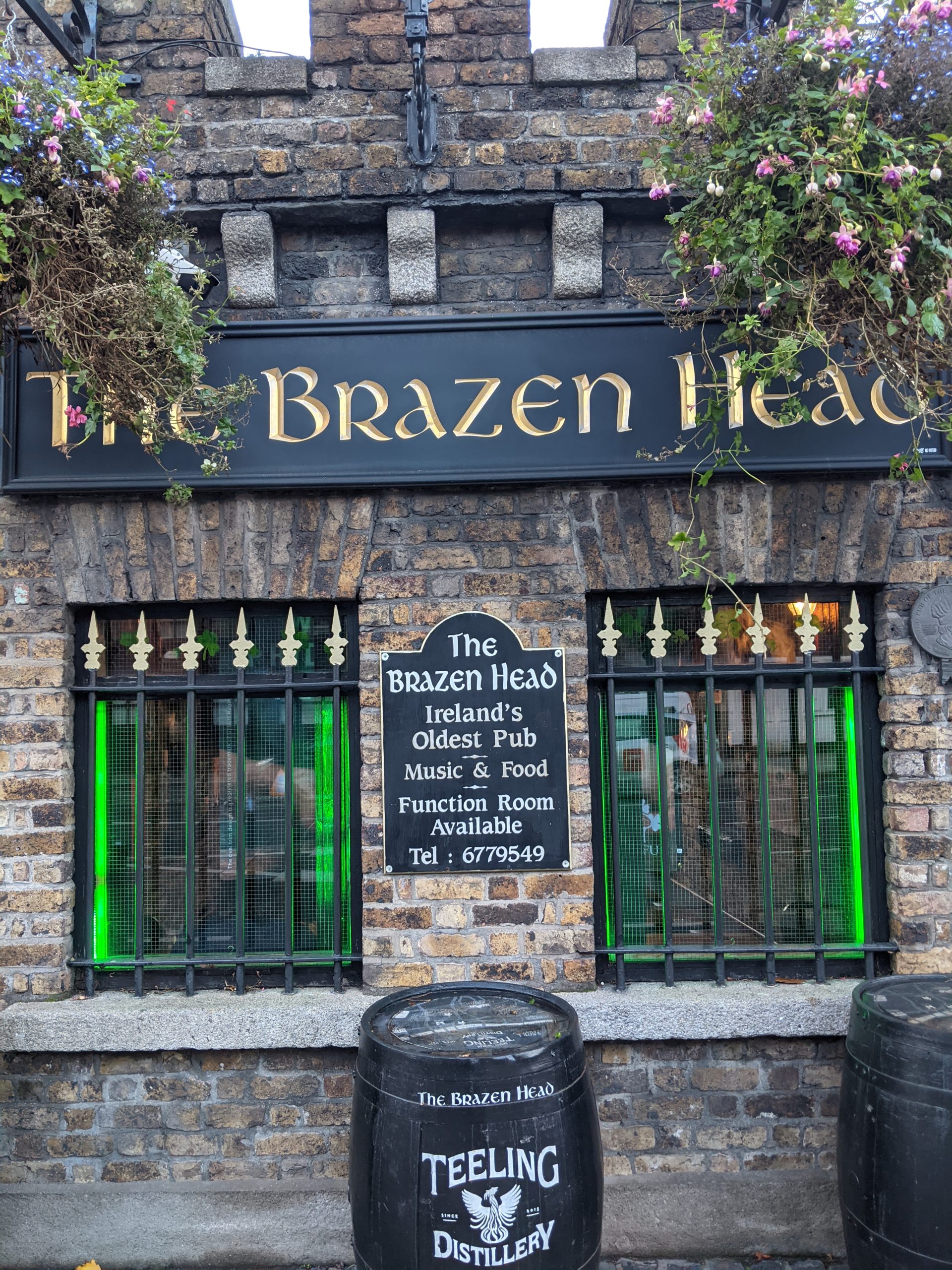
There has been a pub of some kind at 20 Lower Bridge Street in Dublin since, by the house’s own reckoning, 1198. The current building dates to 1754, when it was rebuilt as a Georgian coaching inn. Whether the license truly stretches back eight centuries is something historians have debated politely for years — the name first appears in documented records from 1653, and the site’s earliest written record as an inn dates to 1668. But the name itself is older than the building, and stranger than it first appears.
A “brazen head” — brazen meaning brass or bronze — referred to a medieval legend: an automaton, a brass replica of a human head, said to be capable of answering any question about the future. The most famous version attached itself to the reputation of Roger Bacon, the thirteenth-century English friar and philosopher whose experimental interests in optics and natural science gave later storytellers enough material to cast him as a kind of wizard. In the legend, Bacon labored for years to build his brazen head, believing that with its knowledge he could ring England in a wall of brass. His assistant, keeping watch while Bacon slept, heard the head speak three times: “Time is.” Then, later: “Time was.” Then: “Time is past” — and the head shattered.
The tale circulated widely in England and Ireland through the sixteenth and seventeenth centuries, appearing in ballads, plays, and popular romances. A pub sign using the image would have been immediately legible to anyone who knew the legend: here is a place of uncanny knowledge, or a certain kind of eerie power. What is documented is that the name was in use on Bridge Street by 1653.
The pub’s history deepened considerably over the following century and a half. Robert Emmet, who led a failed uprising against British rule in 1803, is documented as having used the Brazen Head as a base of operations, meeting with co-conspirators in an upstairs room. He was captured, tried for treason, and executed on nearby Thomas Street the same year. He was twenty-five years old. The Brazen Head’s rooms, by this point, had hosted enough sedition that the pub’s role in Irish revolutionary planning was an open secret — earlier patrons included members of the United Irishmen, who planned their insurrection of the 1790s there, among them Wolfe Tone.
The building survived two near-destructions during the Four Courts bombardments of the 1922 Civil War, both times by the proximity of fire from across the Liffey. The medieval automaton’s three pronouncements have a certain retrospective quality about the place: time is, time was, time is past.
The Bleeding Horse, Camden Street, Dublin — The Sign That Needed No Explanation
The pub on Camden Street known as the Bleeding Horse has occupied this corner of Dublin’s southside since at least the seventeenth century, positioned at the fork of two major roads heading out of the city. The building visible today was constructed in 1871. There are two competing explanations for the name, and both are uncomfortable.
The first is veterinary. Before modern medicine, horses suffering from a condition known as “the staggers” — a neurological collapse — were routinely bled by farriers as treatment. The inn, positioned on two busy exit roads from Dublin, served as a natural stopping point for working horses, and a farrier’s practice at the premises would have made for a distinctive, if gory, roadside landmark. The second theory connects the name to the Battle of Rathmines, fought in 1649, when a horse wounded in the fighting fled the battlefield and ended up in the area nearby. That battle ended in the defeat of the Royalist forces besieging Dublin, clearing the way for Cromwell’s broader campaign — the same campaign that would result in mass displacement, land confiscation, and a transformation of Irish ownership so comprehensive that its effects appear in property records to this day. A wounded horse stumbling away from that particular field carries a certain amount of historical weight.
Neither origin has been definitively proven. What is documented is the sign. Sheridan Le Fanu, writing his 1845 novel Cock and Anchor — set in early eighteenth-century Dublin — described the Bleeding Horse as “a small, old-fashioned building, something between an ale-house and an inn” and its painted sign as showing “a white horse, out of whose neck there spouted a crimson cascade.” Le Fanu was not inventing the image. He was recording what anyone walking down Camden Street would have seen hanging above the door.
James Joyce, less poetically, placed the pub in Ulysses by name and moved on. By his time it was a fixture so embedded in the city’s geography that it needed no introduction. It did, however, later need a name change: for most of the 1960s, under new ownership, the pub traded as “The Falcon.” The original name was restored in the 1970s. The crimson cascade returned.
John Kavanagh’s, Glasnevin — The Gravediggers’ Pub
A man named John O’Neill converted a house on Prospect Square into a pub in 1833, the year after Glasnevin Cemetery opened. Two years later he passed the business to his son-in-law, John Kavanagh, and it has stayed in the Kavanagh family ever since. The timing of that first opening was not coincidental. Daniel O’Connell had campaigned for the cemetery specifically as a place where Irish Catholics — who had for decades been barred from conducting religious ceremonies at their burials under the Penal Laws — could inter their loved ones with a proper funeral Mass. The cemetery’s opening was a significant moment, and the grief that followed was steady. Mourners needed somewhere to go. The pub at the end of Prospect Square, sharing its boundary wall with the cemetery, was conveniently placed.
What gave it its enduring nickname, though, were not the mourners but the workers. Glasnevin’s gravediggers developed a practice — documented in writing by Shane MacThomáis, a former Glasnevin Cemetery historian, and visible in film footage from 1974 — of knocking on the pub’s back wall between burials. The wall separating Kavanagh’s from the cemetery had, at one point in its history, iron railings through which a pint could be passed. The gravediggers would knock, the Kavanaghs would bring the drinks out, and the transaction would take place through the bars. Eugene Kavanagh, a late owner of the pub, remembered doing this himself as a boy.
Seven generations of the Kavanagh family have run the pub since 1835. There is no television inside, no radio, and no singing — a policy enforced with notable firmness. When Luke Kelly, one of the founding members of the Dubliners, died in 1984, musicians who came to the funeral wanting to play him off are said to have been turned away when they tried to bring the music inside. The Gravediggers maintained its rules. The cemetery, next door, kept its silence.
The Hole in the Wall, Blackhorse Avenue, Dublin — The Drinks That Went Through the Barrier
The pub on Blackhorse Avenue started life in 1651 under the name “Ye Signe of Ye Blackhorse Inn,” a coaching house at the edge of what would become the Phoenix Park. The name by which everyone knows it today came later, and was earned through a precise arrangement involving the British Army and a wall.
The Phoenix Park is ringed by approximately eleven kilometres of limestone wall, built when the parkland was established as a royal hunting ground. Along Blackhorse Avenue, that wall runs directly past the front door of the old coaching inn. When McKee Barracks was established inside the park in 1891, British Army soldiers stationed there were not permitted to leave the park’s grounds without authorization. The pub was, technically, on the other side of a wall they were forbidden to cross.
The solution was architectural. The pub’s owner at the time, Levinus Doyle, cut an opening in the wall. Soldiers would approach from the park side; Doyle would serve them through the gap. The arrangement appears to have been understood by all parties as an open secret — a captive market on one side of a wall, a willing publican on the other. The hole in the wall remained in active use until the barracks changed hands after Irish independence in 1922.
The pub today runs for just over one hundred metres from end to end, the result of centuries of gradual expansion along the park wall, making it one of the longest pub bars in Europe. The original limestone wall is still there. The hole has been filled in.
Sean’s Bar, Athlone — The Innkeeper Who Named a Town
The oldest documented pub in Ireland by the reckoning of Guinness World Records — which issued its certification in 2004 — is a building on the banks of the Shannon in Athlone. The establishment claims a founding date of 900 AD, a figure that archaeologists and historians have treated with appropriate caution: the building’s architecture points to the seventeenth or eighteenth century, and most of what can be said with confidence about the structure dates from that era. The wattle-and-wicker walls discovered during renovations in the 1970s — interwoven hazel sticks bound with horsehair and clay, now preserved behind glass for visitors to see — are genuinely ancient, even if the exact date remains harder to establish than the marketing suggests.
What is more durable is the story attached to the site. An inn is said to have operated at this ford of the River Shannon from the early medieval period, run by a man named Luain Mac Luighdeach. The crossing point became known as Áth Luain — the Ford of Luain. The settlement that grew around it took the name along with it, and Áth Luain became, in its anglicised form, Athlone. A town of roughly twenty thousand people today carries the name of a medieval innkeeper in its etymology, whether anyone ordering a round there currently knows it or not.
The pub has gone by several names over the centuries, one of them “The Three Blackamoor Heads,” a heraldic sign type once common in British inns that most establishments quietly retired long ago. The current name dates only to 1968, when a man named Sean Fitzsimons took ownership and renamed the place after himself. In a building with a thousand years of claimed history, the final name belongs to the most recent owner.
The Hairy Lemon, Lower Stephen Street, Dublin — The Man Who Looked Like One
Not every pub name in Ireland belongs to a myth, a battle, or a buried political conspiracy. Some belong to the city’s cast of vanished human characters — people so vividly themselves that they outlasted their own lifetimes in the collective memory of those who remembered them.
The pub on Lower Stephen Street known as The Hairy Lemon takes its name from a Dublin dog catcher who worked the city’s streets in the 1940s. His actual name appears to have been lost; what survived was his appearance. His face was described as lemon-shaped, his skin with a complexion that matched, and his stubble resembling — in the vivid recollection of those who passed him regularly — the fine hairs on the skin of a gooseberry. He caught stray dogs for the city authorities and was a sufficiently regular presence on Dublin’s streets that he became one of those unofficial municipal characters: the kind of person who never appears in any official record but whom enough people remembered that his description survived him by decades.
When the pub took his likeness as its name and sign, it was memorializing not a military event or a medieval legend but a specific kind of Dublin street life — irreplaceable, slightly absurd, and entirely human. Alan Parker’s 1991 film of Roddy Doyle’s The Commitments shot scenes at the Hairy Lemon. The pub still stands on Lower Stephen Street. The dog catcher has been gone for the better part of a century.
There is something in the range of these names — from the prophesying bronze automaton of the Brazen Head to the stubbly face of a man who rounded up strays for the city — that tells you something true about how Irish public history actually works. The important events get written down in the official record. Everything else gets written above the door. For more on how Ireland’s pub signs got their names, see our full guide to Irish pub names.
Tours & experiences you might love


Powered by Viator. Some links are affiliate links — we may earn a small commission at no extra cost to you.
Secure Your Dream Irish Experience Before It’s Gone!
Planning a trip to Ireland? Don’t let sold-out tours or packed attractions spoil your journey. Iconic experiences like visiting the Cliffs of Moher, exploring the Rock of Cashel, or enjoying a guided walk through Ireland’s ancient past often sell out quickly—especially during peak travel seasons.

Booking in advance guarantees your place and ensures you can fully immerse yourself in the rich culture and breathtaking scenery without stress or disappointment. You’ll also free up time to explore Ireland’s hidden gems and savour those authentic moments that make your trip truly special.
Make the most of your journey—start planning today and secure those must-do experiences before they’re gone!