

Long before Dublin rose to prominence, before the Anglo-Normans built their castles and the English drew their boundaries, there was Meath. The Royal County. The seat of the High Kings of Ireland. A place where history is not measured in centuries but in millennia.
County Meath sits in Ireland’s Ancient East, a gentle landscape of rolling farmland and river valleys that conceals some of the most extraordinary archaeological sites on the planet. This is where Ireland’s story truly begins.
How many of Ireland’s 32 counties can you name? ☘️
Counties of Ireland — the geography-quiz tool. Place all 32 on the map and see if you can beat the average.
Newgrange — Older Than the Pyramids
Newgrange is not merely old. It is staggeringly, almost incomprehensibly ancient. Built around 3200 BC, this passage tomb in the Boyne Valley predates the Great Pyramid of Giza by roughly 500 years and Stonehenge by a thousand. Yet it was constructed with a precision that modern engineers still marvel at.
Every year on the winter solstice, a narrow beam of sunlight penetrates the roof box above the entrance and travels the full length of the passage to illuminate the inner chamber. For approximately seventeen minutes, the darkness that has held for 364 days gives way to light. The Neolithic farmers who built this monument 5,000 years ago understood the movements of the sun well enough to engineer this moment deliberately.
Newgrange sits within the Brú na Bóinne UNESCO World Heritage Site alongside its sister monuments Knowth and Dowth. Together they represent one of the most significant concentrations of prehistoric megalithic art in Europe.
The Hill of Tara — Seat of the High Kings
The Hill of Tara rises modestly from the Meath countryside — barely 150 metres above sea level. Yet from its summit you can see across twenty of Ireland’s thirty-two counties on a clear day. It was this commanding view, this sense of dominion over the landscape, that made Tara the most symbolically powerful site in ancient Ireland.
For over two thousand years, Tara served as the ceremonial capital of the High Kings of Ireland. The Lia Fáil — the Stone of Destiny — still stands on the hilltop, said to cry out when touched by the rightful king. The Mound of the Hostages, a passage tomb dating to around 3000 BC, predates even the kingship traditions.
Walking Tara today is a profoundly quiet experience. There are no grand ruins, no towering walls. Just gentle mounds in the grass, sheep grazing, and a view that stretches to the horizon in every direction. The power of the place is felt, not seen.
☘️ Enjoying this journey through Meath?
Join 64,000+ readers who get stories like this delivered free every morning.
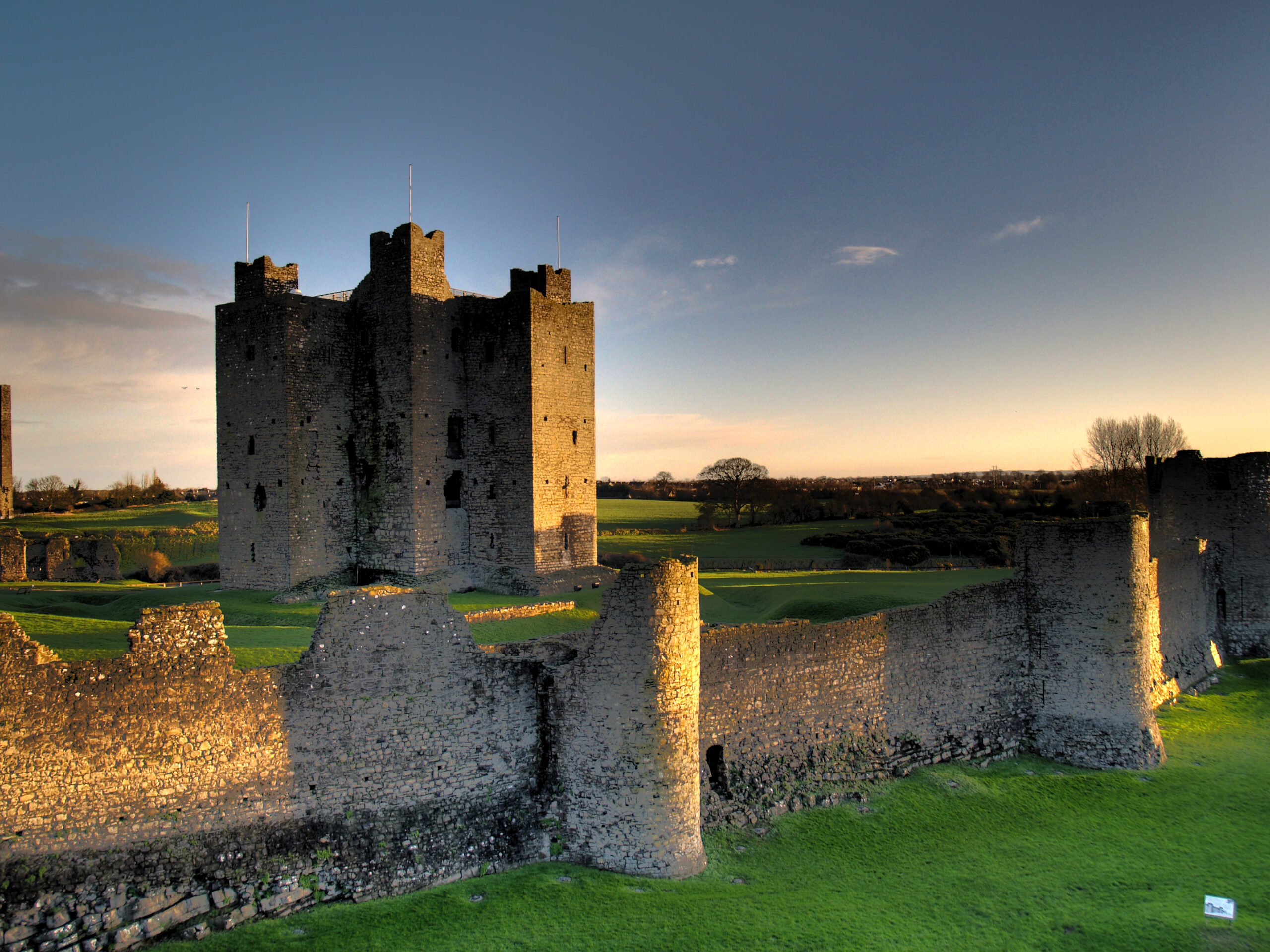
Trim Castle — Ireland’s Largest Norman Castle
Trim Castle is a fortress that means business. Built by Hugh de Lacy in 1176, it is the largest Anglo-Norman castle in Ireland, with massive curtain walls enclosing three acres and a central keep that towers twenty metres above the surrounding town.
☘️ Enjoying this? 64,000+ Ireland lovers get stories like this every week. Subscribe free →
If the castle looks familiar, there is good reason. Mel Gibson chose Trim as the location for the 1995 film Braveheart, with the castle standing in for the city of York. Walk through the gate and you are stepping into the same courtyard where extras once donned medieval armour.
The town of Trim itself is a delight — a small, walkable heritage town with a cluster of medieval ruins that few visitors expect. The Yellow Steeple, the remains of Trim Priory, and the Sheep Gate are all within a short stroll of the castle.
The Boyne Valley — A Landscape of Layers
The River Boyne flows through Meath like a thread connecting five thousand years of history. From the Neolithic passage tombs at Brú na Bóinne to the medieval monastery at Bective Abbey, from the Williamite battlefield at Oldbridge to the elegant Slane Castle, this river valley is arguably the most historically dense corridor in Ireland.
The Battle of the Boyne in 1690, fought between the forces of William of Orange and the deposed King James II, remains one of the most significant military engagements in Irish and British history. The Oldbridge Estate now houses an excellent interpretive centre where the battle is brought to life without political bias — a considerable achievement given the event’s continued resonance.
Kells and the Book of Illumination
The town of Kells gives its name to perhaps the most famous manuscript in the world. The Book of Kells, now housed in Trinity College Dublin, was created by Columban monks — and Kells was one of the monasteries where it may have been produced or kept.
The town retains an extraordinary collection of early Christian heritage. Five ninth-century high crosses survive, including the Market Cross in the town centre and the magnificent South Cross. St Columba’s Church houses a facsimile of the Book and provides context that Trinity’s exhibition cannot.
Loughcrew Cairns — The Other Passage Tombs
While Newgrange draws hundreds of thousands of visitors annually, the Loughcrew Cairns in western Meath remain wonderfully uncrowded. Scattered across the Slieve na Calliagh hills, these thirty-odd cairns date to around 3300 BC — making them contemporaries of Brú na Bóinne.
The main chamber of Cairn T is covered in Neolithic art — concentric circles, zigzags, and sun symbols carved into the stone with extraordinary care. At the spring and autumn equinoxes, sunlight illuminates the carvings on the backstone, just as it does at Newgrange during the winter solstice. But at Loughcrew, you can often experience this alone.
Slane — Music, Monks, and Whiskey
Slane occupies a unique position in Irish culture. The Hill of Slane is where, in 433 AD, St Patrick is said to have lit the Paschal Fire in defiance of the High King at Tara — effectively announcing the arrival of Christianity in Ireland.
In the modern era, Slane is best known for the legendary rock concerts held in the natural amphitheatre at Slane Castle. U2, The Rolling Stones, Bruce Springsteen, and Oasis have all played here. The castle now also houses Slane Whiskey, blending the Brown family’s 250-year distilling heritage with a thoroughly contemporary visitor experience.
Why Meath Matters
Meath does not compete for attention in the way that Kerry or Galway does. It does not have dramatic sea cliffs or wild Atlantic coastline. What it has is depth — layer upon layer of history compressed into a landscape that looks, at first glance, like ordinary farmland.
But nothing about Meath is ordinary. This is where Ireland’s civilisation began, where its kings were crowned, where monks illuminated manuscripts by candlelight, where armies clashed over crowns and creeds. Every field, every hill, every bend in the Boyne has a story that reaches back centuries or millennia.
The Royal County asks for patience. It rewards those who slow down, who read the interpretive panels, who stand on the Hill of Tara and let the view speak for itself. In a country full of spectacular places, Meath is the one that makes you think.
☘️ Love learning about Ireland’s counties?
Join 64,000+ readers exploring Ireland — one story at a time. Free every morning.
This is part 12 of our 32 Counties series — a journey through every county in Ireland. Previously: Kilkenny | Tipperary | Limerick | Waterford | Wexford | Wicklow | Donegal | Clare | Galway | Cork | Kerry
☘️ You Might Also Love
☘️ Want More Hidden Ireland?
Join 64,000+ subscribers who discover Ireland’s best-kept secrets every week.
Subscribe Free — Join the Community →
Free forever · Unsubscribe anytime · No spam
📥 Free Download: Ireland Travel Planning Guide
Our most popular resource — itineraries, insider tips, and the 50 places you must not miss.
Tours & experiences you might love


Powered by Viator. Some links are affiliate links — we may earn a small commission at no extra cost to you.
Secure Your Dream Irish Experience Before It’s Gone!
Planning a trip to Ireland? Don’t let sold-out tours or packed attractions spoil your journey. Iconic experiences like visiting the Cliffs of Moher, exploring the Rock of Cashel, or enjoying a guided walk through Ireland’s ancient past often sell out quickly—especially during peak travel seasons.

Booking in advance guarantees your place and ensures you can fully immerse yourself in the rich culture and breathtaking scenery without stress or disappointment. You’ll also free up time to explore Ireland’s hidden gems and savour those authentic moments that make your trip truly special.
Make the most of your journey—start planning today and secure those must-do experiences before they’re gone!