

County Galway gives you something rare in Ireland. You get city energy and wild countryside in the same county. Galway City hums with students, musicians, and artists seven days a week. Twenty minutes west, Connemara opens out into one of Europe’s most dramatic Atlantic landscapes. If you are weighing up where to put down roots in Ireland, County Galway belongs at the top of your list.
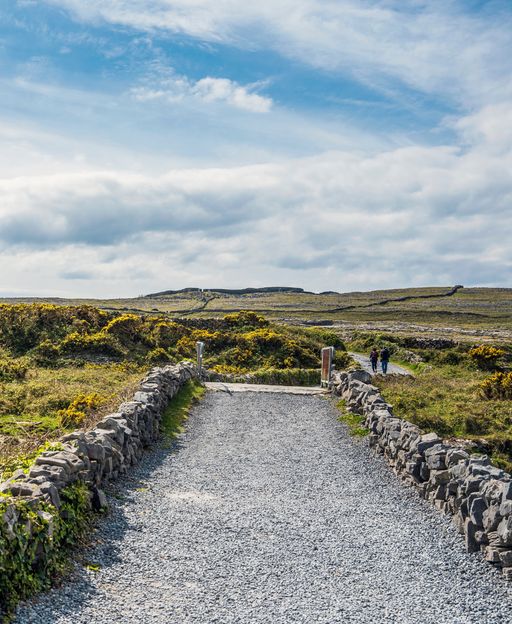
Why So Many People Are Moving to County Galway
Galway has specific qualities that keep drawing people back. The city has Ireland’s most vibrant trad music scene outside Dublin. Every week, dozens of pubs host live sessions. These are not shows for tourists. They are real community gatherings — pull up a chair and join in.
The Claddagh, just west of the city centre, is one of the oldest communities in Ireland. Local tradition traces its fishing-village roots back well over a thousand years, though the full span is folklore rather than firm record. The famous Claddagh ring — two hands holding a crowned heart — was first made here in the 17th century.
Beyond the city, Connemara stands apart. Bog, mountain, and Atlantic ocean meet in a way found nowhere else in Europe. J.M. Synge set his most powerful plays on the Aran Islands, off the Galway coast. Tim Robinson spent thirty years mapping and writing about Connemara alone.
There is also the community. Galway people are warm and direct. You will not stay a stranger for long. The county has a deserved reputation for welcoming those who arrive from elsewhere and make the effort to belong.
- Galway City: Ireland’s cultural capital of the west, with a university, arts festivals, and the best trad scene outside Dublin
- Connemara: Remote, extraordinarily beautiful, and one of the last places in Europe where Irish Gaelic is spoken daily
- The Aran Islands: Three limestone islands in Galway Bay, each with a permanent community and thousands of years of history
- East Galway: Market towns, lough-side villages, and lower property prices with easy access to the city
The Best Places to Live in County Galway
☘️ Planning a trip to Ireland?
Our free 7-day road trip itinerary covers the Wild Atlantic Way from Dublin to the west — day-by-day driving guide with hidden gems, practical tips, and local secrets.
Get the Free 7-Day Itinerary →Galway City
Galway City has a population of around 85,000. It is the cultural heart of the west of Ireland. The Latin Quarter runs through its centre — a compact web of medieval streets, independent shops, and traditional pubs. Eyre Square sits at the city’s core. It fills with people on any dry afternoon.
Salthill is the seaside suburb 3 km west of the city. It is one of the most sought-after addresses in Connacht. The Salthill promenade stretches nearly 3 km along Galway Bay. On a clear evening, you can see the Burren in County Clare across the water. The local tradition of kicking the wall at the end of the prom on an evening walk is still very much alive.
The city has two universities and a major teaching hospital. This makes it a practical choice for families and remote workers alike.
Connemara
Connemara is what drew many people to Ireland — and what keeps them. The Twelve Bens rise to 729 metres and are visible from much of the region on clear days. Clifden, the small market town at Connemara’s heart, sits at the head of a sea inlet surrounded by bog and mountain.
Life here is slower. The nearest large supermarket may be 30 km away. But the community is close-knit. The landscape changes daily with the Atlantic light. Many who arrive intending to stay a year end up staying for life.
The Aran Islands
The three Aran Islands — Inis Mór, Inis Meáin, and Inis Oírr — sit in Galway Bay about 40 km from the mainland. Inis Mór is the largest, at around 14 km in length. All three islands use Irish as a daily spoken language.
Dún Aonghasa is an ancient stone hillfort on the edge of a 100-metre cliff. Its oldest enclosures date to the Late Bronze Age, around 1100 BC. Around 2,500 people lived on the islands in 1900. The current permanent population across all three is around 1,300 (1,347 at the 2022 census). For anyone wanting full immersion in Irish language and culture, the islands offer something found nowhere else.
East Galway — Tuam and Lough Corrib
East Galway gets overlooked by most visitors heading straight for the Atlantic coast. The market town of Tuam has a cathedral whose 12th-century chancel arch — one of the finest examples of Hiberno-Romanesque carving in Ireland — dates to around 1130. It has a strong sense of its own identity. Headford sits on the southern shore of Lough Corrib — Ireland’s second-largest lake at 176 km². It is a base for fishing, walking, and water sports.
Property prices in east Galway run significantly lower than in Galway City or coastal Connemara. Families wanting space, good schools, and a 30-minute drive to the city find east Galway consistently good value.
☘️ Enjoying this? 64,000+ Ireland lovers get stories like this every week. Subscribe free →
What Daily Life Feels Like in County Galway
Music and Culture
Music in Galway is not background. It is central to daily life. The Galway International Arts Festival has run every July since 1978. It brings world-class theatre, music, and visual art to the city’s streets and venues for two weeks each summer. The Galway Film Fleadh, started in 1989, is one of Europe’s most respected independent film festivals.
Trad sessions happen in pubs across the county all year round. Not just in tourist season. In the city, venues like Monroe’s Tavern and Taaffe’s Bar have been running weekly sessions for decades.
Food and Community
Galway has one of Ireland’s strongest food cultures. The Saturday market at St Nicholas’ Churchyard has run for decades. It now has over 100 stalls — smoked salmon, artisan cheese, handmade crafts, and fresh vegetables. Galway Bay oysters are world-famous. Thousands arrive each September for the Galway International Oyster Festival.
The fishing village of Kinvara on the south Galway coast supplies restaurants across the region. Ballinasloe holds one of the oldest horse fairs in Europe each October. Local tradition claims far older roots, and documented references go back to at least the 1750s.
Galway operates like a large town rather than a small city. People know each other across neighbourhoods. New arrivals who join a club, attend a session, or shop at the Saturday market often find themselves woven into the local fabric within months.
The Weather — Honest
Galway’s weather needs a straight answer. The county is wet. Clifden receives around 1,400 mm of rainfall per year. That is almost twice Dublin’s annual average. Atlantic fronts move through quickly. You can have all four seasons in a single day. The local saying: “If you can see the mountains, it’s going to rain. If you can’t see them, it’s already raining.”
That said, the light when it breaks through is extraordinary. Summer can bring long dry stretches. Evenings stay bright until 10 pm in June and July. Autumn across Connemara brings colours that rival New England. Many people who move here find the weather becomes part of what they love about the place.
Finding Your Roots in County Galway
For many Irish-Americans and diaspora members, County Galway is not just a beautiful place to live. It is where family stories began.
The fourteen Tribes of Galway were merchant families who ran the city from the 13th century. They carried surnames still common in the Irish diaspora today: Lynch, Blake, Ffrench, Kirwan, Browne, D’Arcy, and Joyce. If your family carries one of these names, your roots may lie in Galway specifically.
The genealogical records for County Galway are some of the richest in Ireland. Catholic parish registers for many Galway parishes begin in the 1820s. Griffith’s Valuation from the 1850s documents every landholder in the county, townland by townland. The 1926 Irish Census was released to the public in 2026. It names every person in every household across the county. It is one of the most powerful tools for family researchers alive right now.
- Griffith’s Valuation (1847–1864): Lists every householder in County Galway by townland, free on AskAboutIreland.ie
- Catholic parish registers: Many Galway parishes have records from the 1820s on IrishGenealogy.ie
- 1926 Irish Census: Released in 2026 — covers every household in County Galway
- Landed Estates Court records: 1850s documents cover every major estate in Connacht
Many people who move to County Galway for its landscape discover that their family left from a specific townland just a few kilometres away. It is not uncommon.
Is County Galway the Right Place for You?
County Galway suits people who want cultural depth alongside natural beauty. The city has everything a modern European city offers — universities, hospitals, arts venues, and a lively restaurant scene. Forty minutes west, a walk across the Connemara bog can feel like the edge of the world.
It suits people who value community over anonymity. It suits people who like music played by neighbours in the pub on a Tuesday night. It suits people drawn to the old country — whether through family roots or simply a quiet sense that something here feels like home.
For a broader day-to-day look at settling in the county, see our guide to living in County Galway.
If you are thinking seriously about making the move, our full Move to Ireland guide covers the practical side in detail — from which regions suit which lifestyles to what daily life in both rural and urban Ireland actually looks like.
Many visitors to County Galway are retracing family roots. If that describes you, our free Irish Ancestry Guide can help you narrow a county down to a specific townland. It covers every record database and DNA tool for tracing Irish family history.
What is it like to live in County Galway, Ireland?
Living in County Galway means choosing between city life in a vibrant 85,000-person university city, coastal village life in Connemara, or quieter inland communities in east Galway. The county is known for its trad music culture, close communities, and some of Europe’s most dramatic Atlantic scenery. The trade-off is a wet climate and limited public transport outside the city.
Which part of County Galway is best to live in?
The right area depends on what you want. Galway City and Salthill suit those who want urban amenities with easy access to the countryside. Connemara suits those who want remote beauty, a slower pace, and a living Irish-language culture. East Galway, around Tuam and Lough Corrib, suits families who want space and lower property prices within a 30-minute drive of the city.
Is County Galway expensive to live in compared to the rest of Ireland?
Galway City sits below Dublin for property prices but above most rural Irish counties. Rentals in the city have risen sharply since 2020. Connemara and east Galway offer much lower property prices than the city or the popular tourist coastline. For remote workers or those willing to commute, value outside the city centre is considerably better than headline figures suggest.
☘️ Researching your Galway roots this Family History Month?
October is Family History Month. County Galway has some of the richest genealogical records in Ireland — from 1820s parish registers to the newly released 1926 Census. Our free Irish Ancestry Guide walks you through every record, database, and DNA tool step by step.
☘️ Join 64,000+ Ireland Lovers
Every weekday morning, get Ireland’s hidden gems, local secrets, and travel inspiration — the kind you won’t find in any guidebook.
Subscribe free — enter your email:
Already subscribed? Download your free Ireland guide (PDF)
📲 Know someone who’d love this? Share on WhatsApp →
Love more? Join 43,000 Scotland lovers → · Join 29,000 Italy lovers → · Join 7,000 France lovers →
Free forever · Unsubscribe anytime
Tours & experiences you might love


Powered by Viator. Some links are affiliate links — we may earn a small commission at no extra cost to you.
Secure Your Dream Irish Experience Before It’s Gone!
Planning a trip to Ireland? Don’t let sold-out tours or packed attractions spoil your journey. Iconic experiences like visiting the Cliffs of Moher, exploring the Rock of Cashel, or enjoying a guided walk through Ireland’s ancient past often sell out quickly—especially during peak travel seasons.

Booking in advance guarantees your place and ensures you can fully immerse yourself in the rich culture and breathtaking scenery without stress or disappointment. You’ll also free up time to explore Ireland’s hidden gems and savour those authentic moments that make your trip truly special.
Make the most of your journey—start planning today and secure those must-do experiences before they’re gone!