

There is an island off the coast of County Sligo where the wind comes off the Atlantic in long, cold waves and the silence feels older than memory. Six kilometres from shore, close enough to see but hard enough to reach that most people never try. The last permanent residents left in 1948. But the island was never truly abandoned.
Because somewhere inside the ancient cashel walls of Inishmurray — one of Ireland’s oldest monastic sites — there are stones. Flat, smooth, worn by a thousand years of turning. They are called the Clocha Breaca. And for centuries, people crossed that open water carrying a grievance too serious for any ordinary court to settle.
The Stones That Could Ruin a Man
The Clocha Breaca — the Speckled Stones — sit in a shallow stone hollow inside the cashel enclosure. They look unremarkable: smooth grey river stones, the sort you could find on any Irish beach. Their power came entirely from intention.
To curse an enemy, you came to the stones with your grievance formed clearly in your mind. You spoke the name of the person who had wronged you. Then you began to turn the stones, one by one, tuathal — anti-clockwise, against the movement of the sun. This was the direction of undoing, of calling something dark into being.
To bless someone, you turned them deiseal — clockwise, following the sun. But the island’s reputation was built on the curses.
Justice When No Court Would Listen
The ritual was not undertaken lightly. Community consensus mattered deeply. If your grievance was seen as petty, dishonest, or unjust, the curse was believed to turn back on the one who placed it — to rebound and destroy the curser instead.
What sent people across the water was serious: a false oath sworn to steal land; a neighbour who took cattle and denied it; a betrayal so deep that even the Brehon Laws of ancient Ireland offered no adequate remedy. When all else failed, someone hired a boat and sailed to Inishmurray.
It was, in its way, a community safety valve — a last resort for wrongs that could not be made right by any ordinary human means.
The Island Saint Molaise Built
The man who first made Inishmurray sacred was Molaise — also known as Saint Laserian of Leighlin — who founded a monastic community here in the early sixth century. He chose his site well, if not comfortably. The island is exposed to the full force of the North Atlantic, and the winters offer no mercy.
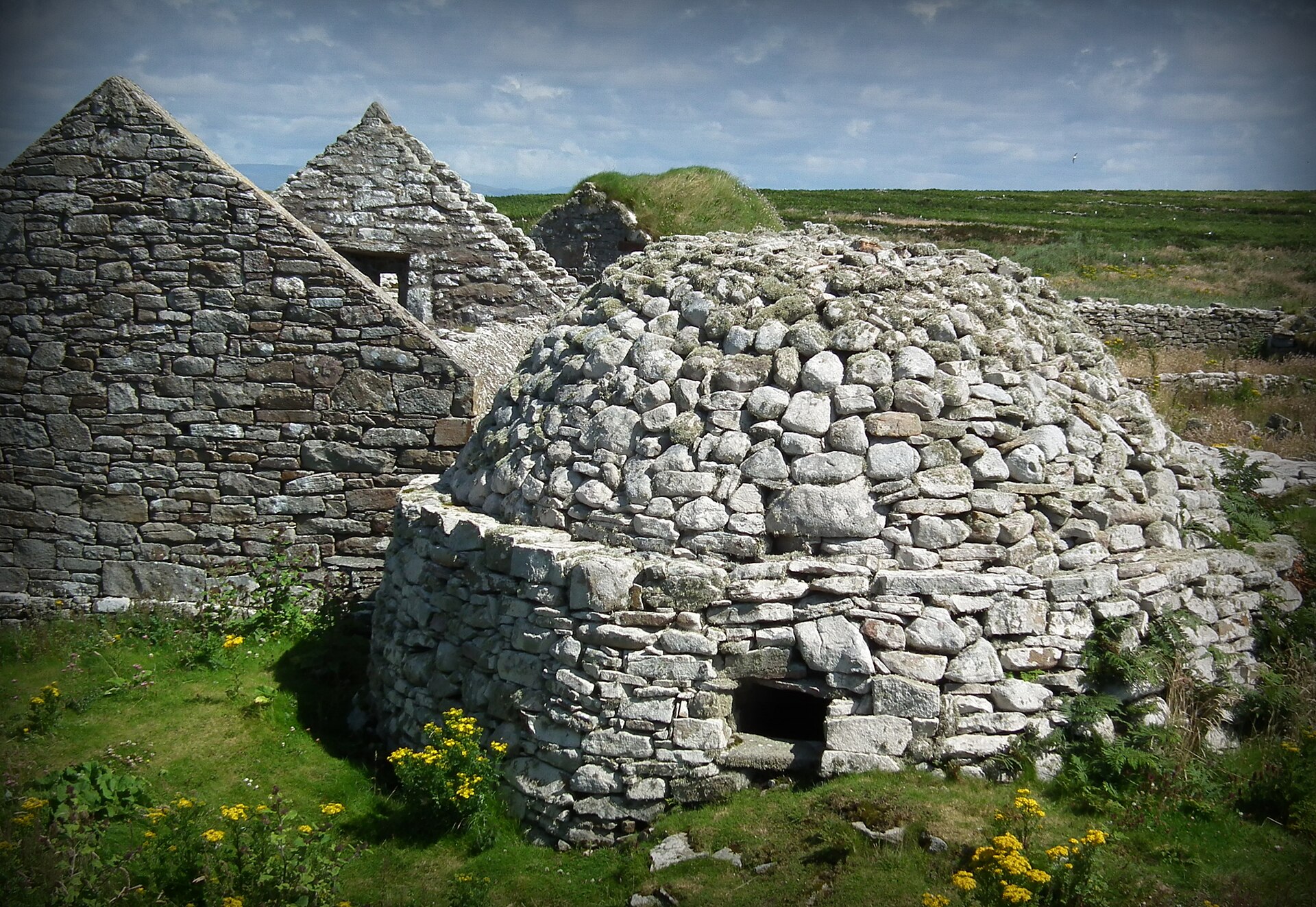
What he built endured. The cashel walls still stand, some sections rising above four metres. Inside, the ruins of the Church of the Men and the Church of the Women remain. Corbelled stone beehive huts, remarkably intact, dot the enclosure — small chambers where monks once slept and prayed through those exposed Atlantic winters.
Inishmurray became one of the most important early Christian sites in Connacht. Pilgrims came across the water seeking something the mainland could not provide — much as people have long sought Ireland’s holy wells when ordinary life offered no answers.
The People Who Lived There
For centuries, families lived on Inishmurray alongside its ruins. They farmed. They fished. They maintained the old patterns of island life with the tenacity that the Atlantic seems to demand of everyone who tries to live beside it.
By the 1940s, only 46 people remained. The last years were hard — schools, medicine, the ordinary infrastructure of modern life could not reliably cross those six kilometres of open water. In November 1948, the islanders asked to be resettled on the mainland. They left not entirely willingly, but because the alternative had quietly become impossible.
Theirs was one of the last of Ireland’s island evacuations — a melancholy echo of the abandoned settlements that haunt the western coast. Each departure left a particular kind of silence in its wake.
What You Find There Now
Reaching Inishmurray today requires deliberate effort. You charter a boat from Mullaghmore Harbour, about 12 kilometres north of Sligo town. The crossing takes roughly 30 minutes when conditions allow. Seasonal trips run in summer only — and on the Sligo coast, conditions are not always cooperative.
When you land, the island is entirely yours. No signage. No café. No path markers. Just the ruins, the wind, and the wide Atlantic horizon stretching away in every direction.
The cashel walls guide you through what remains. The roofless churches stand open to the sky. The beehive huts are astonishingly intact. And somewhere within the enclosure, you will find the Clocha Breaca still resting in their stone hollow — worn smooth by hands that used them with complete seriousness, in situations you would not want to be in.
Whether anyone has turned them since the last islanders left is a question no one can answer. The fact that anyone still asks it tells you everything about what this island does to the imagination.
Inishmurray is not a comfortable place. It does not promise ease or spectacle. It offers something rarer: the feeling of standing somewhere that mattered deeply to people who are gone — their faith, their justice, their community bonds still somehow present in the stone. Before you visit, use our Ireland planning guide to make sure you have the right season and the right skipper arranged. It is not the kind of journey you want to attempt unprepared.
Love Ireland? So do 65,000 of us.
Join the Love Ireland newsletter — free stories of Irish heritage, hidden gems, and the magic of the Emerald Isle delivered to your inbox.
☘️ Want More Hidden Ireland?
Join 64,000+ subscribers who discover Ireland’s best-kept secrets every week.
Subscribe Free — Join the Community →
Free forever · Unsubscribe anytime · No spam
📥 Free Download: Ireland Travel Planning Guide
Our most popular resource — itineraries, insider tips, and the 50 places you must not miss.
Tours & experiences you might love


Powered by Viator. Some links are affiliate links — we may earn a small commission at no extra cost to you.
Secure Your Dream Irish Experience Before It’s Gone!
Planning a trip to Ireland? Don’t let sold-out tours or packed attractions spoil your journey. Iconic experiences like visiting the Cliffs of Moher, exploring the Rock of Cashel, or enjoying a guided walk through Ireland’s ancient past often sell out quickly—especially during peak travel seasons.

Booking in advance guarantees your place and ensures you can fully immerse yourself in the rich culture and breathtaking scenery without stress or disappointment. You’ll also free up time to explore Ireland’s hidden gems and savour those authentic moments that make your trip truly special.
Make the most of your journey—start planning today and secure those must-do experiences before they’re gone!