

Long before Saint Patrick arrived on Irish shores, and long before the Celts themselves, Ireland belonged to another people entirely. Not humans as we know them. Something older. Something stranger. And if the old stories are to be believed — they never truly left.
A Race Unlike Any Before Them
The Tuatha Dé Danann — whose name means roughly “the people of the goddess Danu” — were said to be masters of magic, healing, and craftsmanship beyond anything the mortal world had seen.
They arrived in Ireland shrouded in mystery. Some legends say they came from the sky itself, descending in a cloud of mist. Others claim they sailed from four legendary cities in the far north — Falias, Gorias, Finias, and Murias — each home to a different kind of wisdom.
They were not mere mortals. They were gods. And they ruled Ireland as gods do.
The Four Treasures They Carried
From those four mythic cities, the Tuatha Dé Danann brought four sacred objects that would become the most powerful relics in Irish legend.
From Falias came the Lia Fáil — the Stone of Destiny, said to cry aloud beneath the feet of the rightful High King. It still stands today on the Hill of Tara in County Meath, silent now but never forgotten.
From Gorias came the Spear of Lugh, which never missed its mark. From Finias, the Sword of Nuada — once drawn, no enemy could escape it. From Murias, the Cauldron of the Dagda, from which no one ever left hungry, no matter how great the multitude.
These were not decorative myths. In the ancient Irish worldview, they were real. Alive, almost. And their power shaped every battle the Tuatha Dé Danann would fight.
Two Great Battles for the Land
The Tuatha Dé Danann did not inherit Ireland without a fight. First came war against the Fir Bolg — the peoples who held the land before them — at the First Battle of Magh Tuireadh. They won. But their king, Nuada, lost his arm in the fighting.
Under ancient Irish law, a king had to be physically whole. So the Tuatha Dé Danann’s healers fashioned Nuada a new arm — entirely from silver — restoring his crown and earning him the name Nuada Airgetlám: Nuada of the Silver Hand.
A second war came swiftly. The Fomorians — a dark, primordial force older than civilisation itself — rose against them. The Second Battle of Magh Tuireadh was fought with magic as much as blades. It was the sun god Lugh who turned the tide, slaying the Fomorian king Balor of the Evil Eye with a sling stone driven through his terrible, death-dealing gaze.
☘️ Enjoying this? 64,000+ Ireland lovers get stories like this every week. Subscribe free →
The Defeat That Was Not Quite a Defeat
For all their power, the Tuatha Dé Danann were eventually overcome. The Milesians — the sons of Míl, said to be the ancestors of the modern Irish — arrived from distant shores and defeated them at the Battle of Tailtenn.
But this is where the story becomes something truly remarkable.
Rather than die or flee Ireland forever, the Tuatha Dé Danann struck a bargain. Ireland would be divided in two. The Milesians would take the world above ground — the fields, the rivers, the living day. The Tuatha Dé Danann would take the world beneath, retreating underground into the great ancient mounds known as the síde.
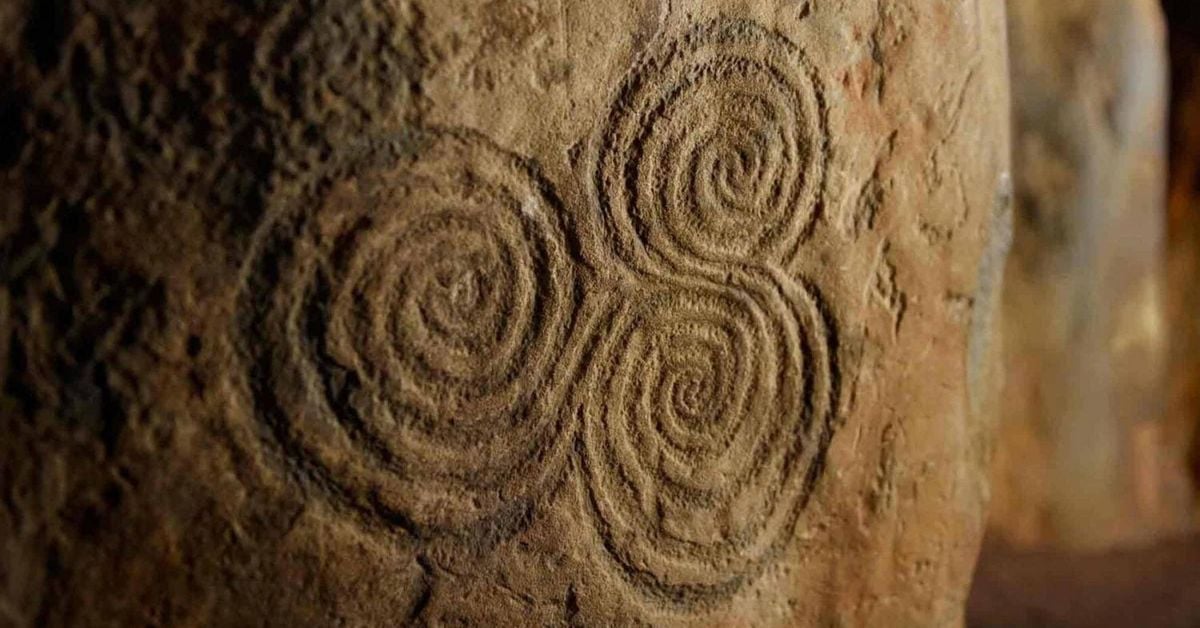
Chief among these was Brú na Bóinne — what we call Newgrange. The Dagda, their great father god, claimed it as his palace. Other mounds across Ireland became homes to other great figures. Each hill harbouring a god. Each mound a kingdom hidden in plain sight.
The People Who Became the Fairy Folk
From that moment, the Tuatha Dé Danann became the Aos Sí — the people of the mounds. Over centuries, as Christianity spread and the old gods faded from official memory, they shrank in story into something smaller: fairies, spirits, the Fair Folk.
But the reverence never fully died.
The ancient fairy forts that still dot every corner of Ireland? Those are their homes. The farmer who refuses to plough through one, the road that bends around an ancient mound rather than cut straight through it — that is a people still keeping faith with an old treaty, still honouring a bargain made long before history was written down.
Even the great festivals of the Irish year carry their fingerprints. Samhain — what became Halloween — was the night when the boundary between their world and ours grew thin. Bealtaine lit fires across every hilltop in their honour. These were not superstitions. They were a people remembering something older than memory itself.
Still There, Beneath the Hills
The great passage tombs of the Boyne Valley are older than the Egyptian pyramids — older than Stonehenge. They were built by hands that left no name behind. But in the Irish tradition, it is the Tuatha Dé Danann who sanctified them, who made them sacred, who chose to spend eternity inside them rather than vanish from Ireland entirely.
Which means, if the old stories are right, they are still there. Beneath the hills. Watching the light change. Patient as stone. Waiting.
If you want to walk in the landscape they left behind, our guide to planning your trip to Ireland will help you find the places where it lingers most strongly.
Love Ireland? So do 65,000 of us.
Join the Love Ireland newsletter — free stories of Irish heritage, hidden gems, and the magic of the Emerald Isle delivered to your inbox.
☘️ Want More Hidden Ireland?
Join 64,000+ subscribers who discover Ireland’s best-kept secrets every week.
Subscribe Free — Join the Community →
Free forever · Unsubscribe anytime · No spam
📥 Free Download: Ireland Travel Planning Guide
Our most popular resource — itineraries, insider tips, and the 50 places you must not miss.
Tours & experiences you might love


Powered by Viator. Some links are affiliate links — we may earn a small commission at no extra cost to you.
Secure Your Dream Irish Experience Before It’s Gone!
Planning a trip to Ireland? Don’t let sold-out tours or packed attractions spoil your journey. Iconic experiences like visiting the Cliffs of Moher, exploring the Rock of Cashel, or enjoying a guided walk through Ireland’s ancient past often sell out quickly—especially during peak travel seasons.

Booking in advance guarantees your place and ensures you can fully immerse yourself in the rich culture and breathtaking scenery without stress or disappointment. You’ll also free up time to explore Ireland’s hidden gems and savour those authentic moments that make your trip truly special.
Make the most of your journey—start planning today and secure those must-do experiences before they’re gone!