

One stormy night in 1639, the guests at Dunluce Castle were sitting down to dinner when part of their own home fell into the sea. Not a wall. Not a turret. The kitchen — with everyone inside it.
Got an Irish surname with a castle behind it? ☘️
Find Your Irish Castle — matches your surname to its ancestral castle and the family’s history.
One person lived. A kitchen boy, asleep in the corner, tucked out of the way of the collapse. Everyone else was gone — swallowed by the North Atlantic in an instant.
It is one of the most extraordinary moments in Irish history. And it happened in one of the most extraordinary places Ireland has ever produced.
The Castle That Should Not Exist
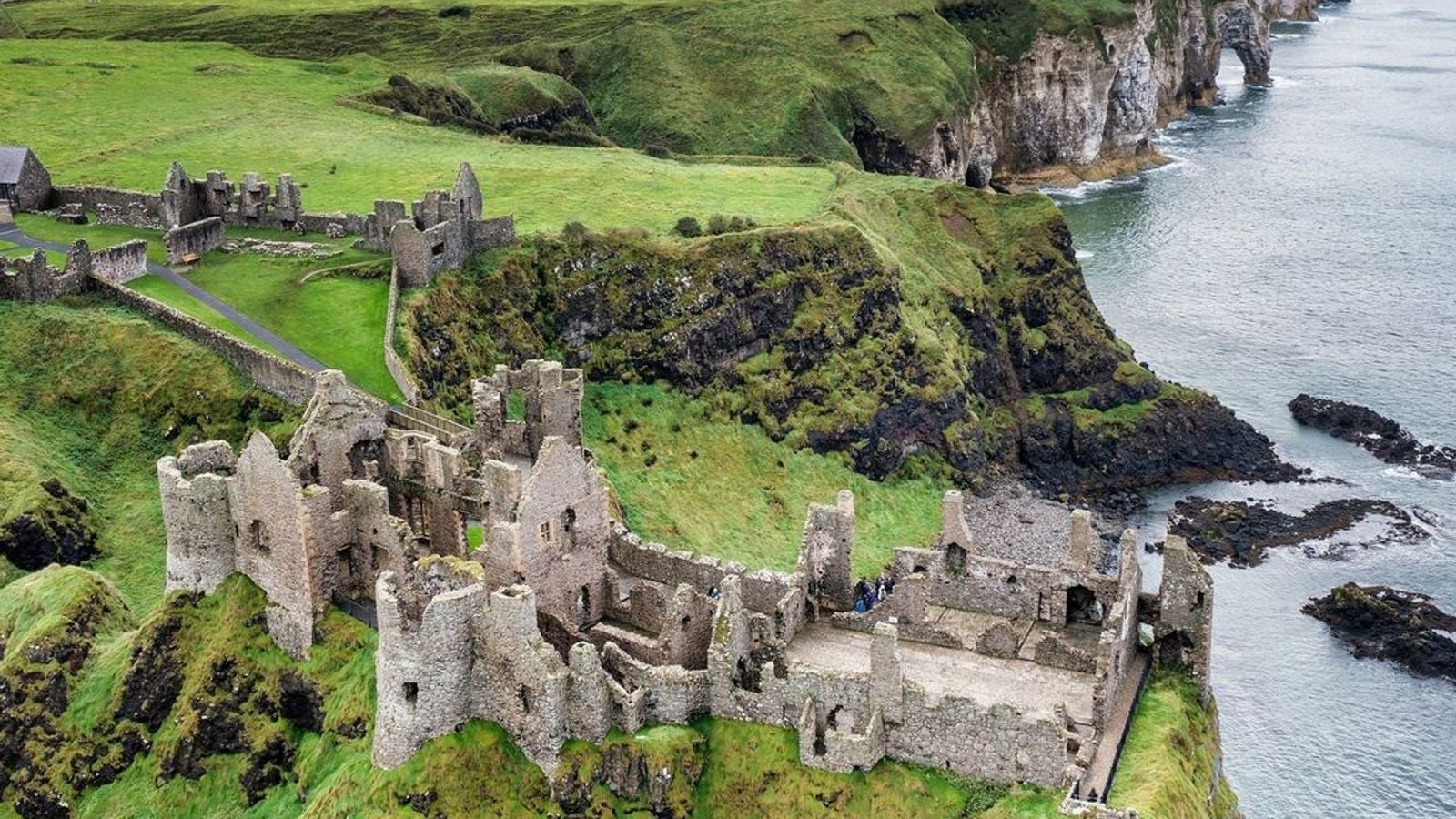
Dunluce Castle stands on a narrow basalt promontory on the Antrim coast, separated from the mainland by a chasm so deep and sheer that even today it takes your breath away. Below the rock, a sea cave tunnels straight through to the ocean.
It was built this way deliberately. The MacDonnells, a Scottish Gaelic clan who made the Antrim coast their stronghold from the fifteenth century, chose this impossible perch precisely because it was impossible to attack. The sea was not a danger. It was a weapon.
For two hundred years, Dunluce was the beating heart of MacDonnell power in Ulster — a fortress, a court, a place where alliances were sealed and enemies were warned off. Spanish Armada guns, salvaged from a wreck at nearby Lacada Point in 1588, were dragged up to reinforce the battlements. The castle grew grander, more ambitious, more elaborate with each generation.
At its peak, Dunluce was not a rough medieval holdout. It was a statement. A palace above the waves.
The Kitchen That Was Always in Danger
To understand what happened in 1639, you need to understand where the kitchen sat. It was not inside the main fortress. It was built on a separate rock stack nearby, connected to the castle by a wooden bridge.
Why? Because fire was the greatest threat to any castle household. Keeping the kitchen at a distance was practical wisdom — a precaution taken by great households across Ireland and Scotland.
But it also meant the kitchen sat directly over the sea. On calm days, this was simply an unusual inconvenience. On stormy nights on the Antrim coast, it was something else entirely.
The North Channel between Ireland and Scotland is one of the roughest stretches of water in the British Isles. Storms here do not politely announce themselves.
The Night Everything Changed
The exact circumstances remain disputed, shaded by three centuries of telling and retelling. What is agreed is this: in 1639, during the household of Randal MacDonnell, 2nd Earl of Antrim, and his wife Catherine Manners — an English noblewoman who had married into the Gaelic world — the kitchen fell.
The sea took it. The rock stack gave way, or the storm surge undermined the foundations, or the wooden bridge collapsed. The records are incomplete, as records often are when disasters destroy the very people who might have written them down.
Six kitchen staff died. The only survivor was a turnspitter — the boy whose job was to stand at the roasting fire and turn the spit by hand, hour after hour. He had fallen asleep in a corner of the room. When the kitchen dropped, the corner held long enough for him to be pulled free.
☘️ Enjoying this? 64,000+ Ireland lovers get stories like this every week. Subscribe free →
The Lady Who Never Returned
Catherine Manners, Countess of Antrim, was said to be so shaken by the disaster that she refused to sleep another night at Dunluce. The family relocated to Ballymagarry. The castle did not recover its former grandeur.
There is something deeply human in that response. All the power, all the prestige, all the elaborately constructed fortification — and it meant nothing against one bad night and the pull of the sea beneath their feet.
Dunluce was never fully abandoned. Parts of it were occupied, rebuilt, and repaired through the seventeenth century. But the catastrophe of 1639 marked the beginning of its slow decline. The era of the great MacDonnell stronghold was effectively over.
What You See Today
If you visit Dunluce today — and you absolutely should, if you are driving the Antrim coast — you can stand at the edge of the gap where the kitchen once was. The rock stack is still there. The absence is still there too, in the most literal sense.
You can see the sea cave below. You can hear the water working at the foundations. On a rough day, it is easy to understand exactly how this happened and precisely why it was always going to happen.
The ruins are managed by the Historic Environment Division of Northern Ireland and are open to visitors year-round. The audio guide inside is surprisingly moving. If you are planning a broader Irish journey and want to explore Ireland’s most legendary castles, Dunluce belongs near the top of any list.
The Story That Stayed
What makes the Dunluce kitchen story so lasting is not just its drama. It is the detail of the sleeping boy — a person of no importance whatsoever in the grand hierarchy of a sixteenth-century noble household, the lowest-ranked servant in the building, who happened to close his eyes at exactly the right moment.
Every account of Irish history eventually circles back to ordinary people caught in extraordinary circumstances. The earls and countesses may have moved away. Their names are in the history books. But the boy who survived because he was tired — his story is the one that has lasted four hundred years.
If you are planning a trip to Ireland, the Antrim coast will stay with you long after you have left. Dunluce will stay with you longer than most.
Love Ireland? So do 65,000 of us.
Join the Love Ireland newsletter — free stories of Irish heritage, hidden gems, and the magic of the Emerald Isle delivered to your inbox.
☘️ Join 64,000+ Ireland Lovers
Every Friday, get Ireland’s hidden gems, local secrets, and travel inspiration — the kind you won’t find in any guidebook.
Subscribe free — enter your email:
📲 Know someone who’d love this? Share on WhatsApp →
Free forever · · Unsubscribe anytime
📥 Free Download: Ireland Travel Planning Guide
Our most popular resource — itineraries, insider tips, and the 50 places you must not miss.
Tours & experiences you might love


Powered by Viator. Some links are affiliate links — we may earn a small commission at no extra cost to you.
Secure Your Dream Irish Experience Before It’s Gone!
Planning a trip to Ireland? Don’t let sold-out tours or packed attractions spoil your journey. Iconic experiences like visiting the Cliffs of Moher, exploring the Rock of Cashel, or enjoying a guided walk through Ireland’s ancient past often sell out quickly—especially during peak travel seasons.

Booking in advance guarantees your place and ensures you can fully immerse yourself in the rich culture and breathtaking scenery without stress or disappointment. You’ll also free up time to explore Ireland’s hidden gems and savour those authentic moments that make your trip truly special.
Make the most of your journey—start planning today and secure those must-do experiences before they’re gone!