

Two thousand years ago, someone gathered 275 oak trees, built the largest structure in ancient Ireland, packed it solid with limestone boulders — and then set the whole thing on fire. When the flames died down, they buried the remains under an enormous mound of earth and walked away.
Nobody has found a convincing explanation since.
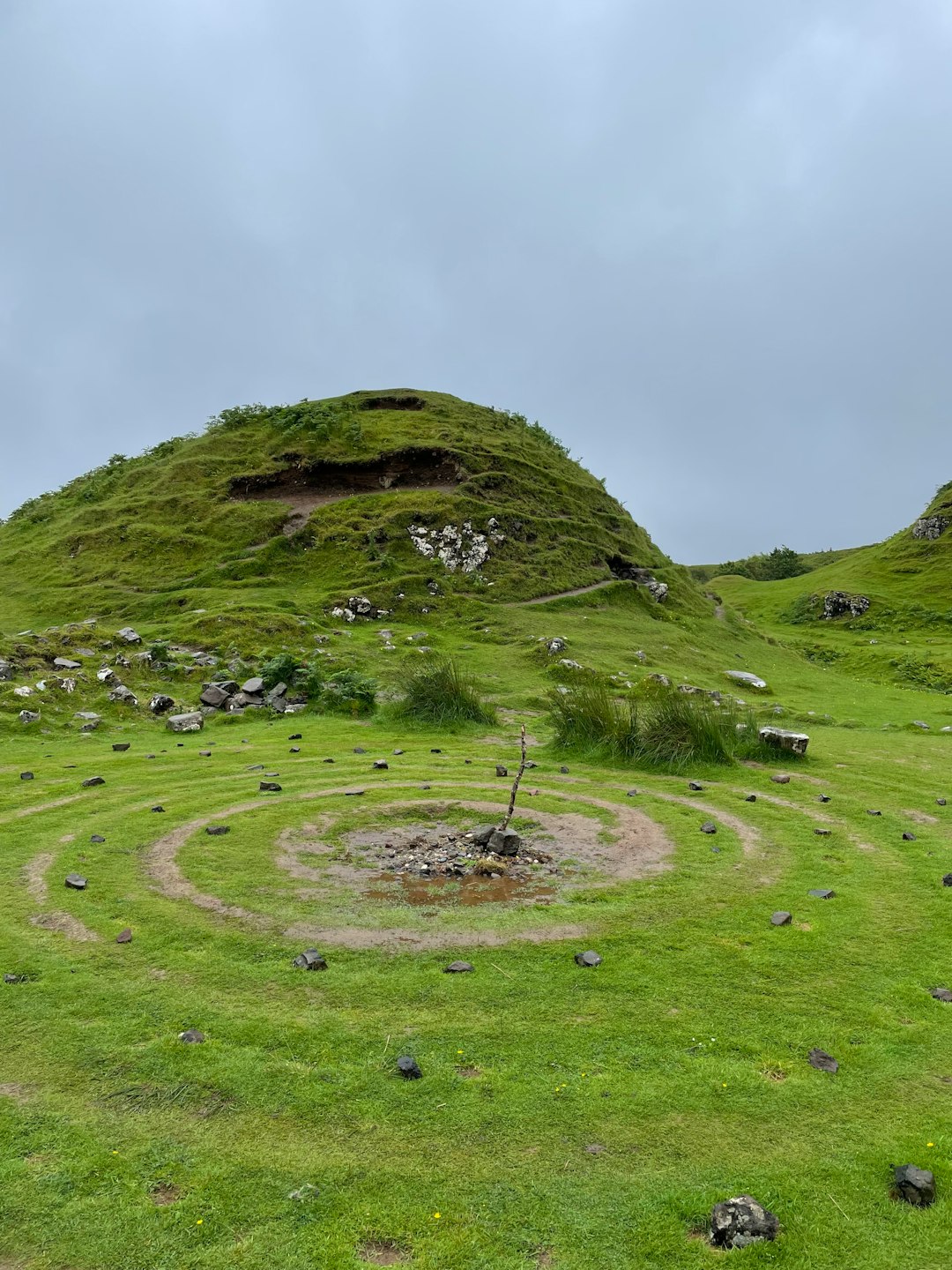
That mound still stands. You can climb it. And the silence at the top is the loudest thing in Ireland.
The Name That Holds a Curse
Emain Macha (pronounced roughly “Evin Mokha”) translates as the “twins of Macha.” The name comes from one of Ireland’s most haunting myths — and one of its darkest.
Macha was a woman of supernatural power who came to Ulster disguised as an ordinary person. She married a farmer. When she fell pregnant, the Ulster king forced her to race his horses. She begged for mercy. She was refused. She ran — and she won — and then she gave birth on the finishing line to twins.
Before she died, she laid a curse on the men of Ulster. For nine generations, whenever Ulster faced its greatest need, its warriors would be struck down with the weakness of a woman in childbirth, unable to fight for five days and four nights.
The curse came true in the great Ulster epic, the Táin Bó Cúailnge. The story of how Macha humiliated a king and brought Ulster to its knees is one of Irish mythology’s most powerful tales. And it all begins at this mound.
The Seat of the Ulster Kings
For centuries, Emain Macha was the most powerful place in Ireland. This was the seat of Conchobar mac Nessa, the High King of Ulster. His court was spoken of with reverence across the entire island.
The mythological tales describe three great halls at Emain Macha. The Red Branch Hall, where warriors stored their weapons and the walls were hung with shields. The Speckled House, where the severed heads of enemies were displayed as trophies. And Conchobar’s own hall — the Craobh Ruadh — where the feasting, the politics, and the plotting all happened.
Somewhere in this landscape, a boy called Setanta arrived to train with the Ulster warriors. He was small for his age and had walked from County Louth to get here. He became the greatest hero Ireland ever produced. The world knows him as Cú Chulainn.
Cú Chulainn’s final stand — alone against an entire army, refusing to fall even in death — is the defining image of Irish warrior culture. It was here at Emain Macha that his story began.
What Archaeologists Discovered Beneath the Mound
The mythology is extraordinary. The archaeology is stranger still.
In the 1960s and 1970s, excavations at Navan Fort produced findings that researchers are still arguing about. The mound on the hilltop — the one you can climb today — was not a natural feature. It was deliberately built.
Around 95 BC, someone constructed a massive circular timber building on this hill. It had a diameter of roughly 40 metres — bigger than most ancient buildings found anywhere in Ireland or Britain. The central post alone was enormous, taller than the surrounding trees. The structure required approximately 275 large oak posts, arranged in concentric rings around that single central pillar.
This took serious effort. It took planning. It took a community. And it was not a practical building — the design, with rings of posts so dense you could barely move between them, suggests it was ceremonial from the start.
Then, almost as soon as it was complete, the inside was packed solid with limestone boulders. Not scattered — packed, carefully, until the interior was a solid mass of stone all the way to the roof.
Then someone set it on fire.
Then they covered everything — the burning timber, the limestone, the ash — with an enormous mound of earth and turf. Creating the hill that stands there now.
☘️ Enjoying this? 64,000+ Ireland lovers get stories like this every week. Subscribe free →
A Ritual Nobody Can Explain
Why would you spend years building the greatest structure in Ireland — and then deliberately destroy it?
That question has occupied archaeologists, historians, and mythologists for decades. There is no consensus. There may never be one, because the people who did this left no written record. The Bronze Age Irish kept their reasons to themselves.
The most compelling theory is that this was a deliberate ritual act of closure. The ending of an era. Perhaps the people of this region were marking a transition — from one form of society to another, from one set of beliefs to a different world. The building was not abandoned. It was not accidentally destroyed. It was offered.
Some researchers link the timing — around 95 BC — to the advancing Roman presence in Britain. The peoples of Atlantic Europe were aware that the world was changing. Perhaps there was something in this act of magnificent destruction that spoke to that awareness. Build the greatest thing you can imagine. Then give it to the earth. Prove that you are not afraid of endings.
Others point to the central post — that enormous single pillar at the heart of the structure — as a kind of world-tree, an axis connecting the human world to the divine. To burn it was to send the offering directly upward, through fire, into whatever existed beyond.
Nobody knows. The mound keeps its silence.
What You See When You Visit Today
The earthwork at Emain Macha sits about three kilometres west of Armagh city in Northern Ireland. The mound rises roughly six metres above the surrounding countryside. From the top, on a clear day, you can see the city of Armagh itself — including its two cathedrals, both dedicated to St. Patrick.
That proximity is not coincidence. When St. Patrick chose to found his principal church in the fifth century AD, he picked a hill in sight of Emain Macha. This was the most sacred place in Ulster. Patrick knew that if he wanted to convert a people, he should plant his faith beside their existing one.
The Navan Centre & Fort stands beside the earthwork and tells the story well, with thoughtful exhibitions about both the mythology and the archaeology. But the site itself is freely accessible. You walk to the mound, you climb it, and you stand where something extraordinary — and inexplicable — once happened.
If you’re planning to explore Ireland’s ancient north, start with our full Ireland planning guide to make the most of your time.
The Places That Hold Ireland’s Oldest Questions
Ireland is full of ancient sites. Stone circles, passage tombs, ring forts, holy wells — the country is layered with evidence of the people who came before. But most ancient sites feel like puzzles with at least some of the pieces in place. Newgrange aligns with the winter solstice. The stone circles correspond to the stars. Even the most mysterious dolmens have a function we can guess at.
Emain Macha is different. The act of deliberate destruction — build it, fill it, burn it, bury it — is so specific, so purposeful, and so unexplained that it sits in a category of its own. Someone here made a decision so important that they were willing to spend enormous resources on something they intended to destroy. That is not accidental. That is not practical. That is an act of faith of a very particular and very human kind.
Standing at the top of the mound, looking out over the green fields of Armagh, you feel the weight of that unknown reason. Ireland does this to you. It gives you the landscape, the story, and then it withholds the answer.
Some places are worth visiting precisely because they refuse to explain themselves.
☘️ You Might Also Love
☘️ Join 64,000+ Ireland Lovers
Every Friday, get Ireland’s hidden gems, local secrets, and travel inspiration — the kind you won’t find in any guidebook.
Free forever · · Unsubscribe anytime
☘️ Want More Hidden Ireland?
Join 64,000+ subscribers who discover Ireland’s best-kept secrets every week.
Subscribe Free — Join the Community →
Free forever · Unsubscribe anytime · No spam
📥 Free Download: Ireland Travel Planning Guide
Our most popular resource — itineraries, insider tips, and the 50 places you must not miss.
Tours & experiences you might love


Powered by Viator. Some links are affiliate links — we may earn a small commission at no extra cost to you.
Secure Your Dream Irish Experience Before It’s Gone!
Planning a trip to Ireland? Don’t let sold-out tours or packed attractions spoil your journey. Iconic experiences like visiting the Cliffs of Moher, exploring the Rock of Cashel, or enjoying a guided walk through Ireland’s ancient past often sell out quickly—especially during peak travel seasons.

Booking in advance guarantees your place and ensures you can fully immerse yourself in the rich culture and breathtaking scenery without stress or disappointment. You’ll also free up time to explore Ireland’s hidden gems and savour those authentic moments that make your trip truly special.
Make the most of your journey—start planning today and secure those must-do experiences before they’re gone!