

There are boats, and then there is the Galway Hooker.
Named from the Dutch hoeker — a type of coastal fishing vessel — Ireland’s iconic húicéir has nothing to do with its cheeky modern meaning. That misunderstanding, if anything, has made the Galway Hooker even more beloved on this island. Its name is one of those quiet tests of character that tells a visitor something about the people who sail her.
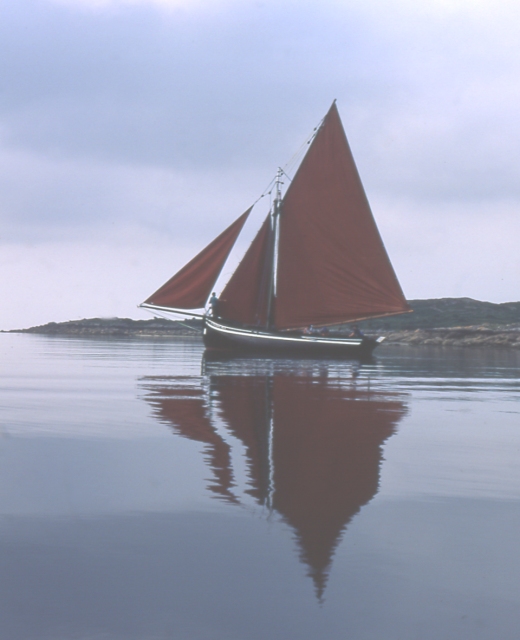
A Boat Built for Wild Water
The Galway Hooker was built for one purpose: survival on the wild Atlantic seaboard of Connacht. With a broad hull tarred black, a mast carrying rust-red sails treated with oak bark and tallow, and a draught shallow enough to navigate rocky inlets, she was equal to the moods of Galway Bay and the hidden channels of Connemara.
There were four sizes — the largest Bád Mór, the mid-sized Leath Bhád and Gleoiteog, and the small, nimble Púcán. Each was tuned to different waters, different cargoes, different crews. Every plank was chosen for a reason. Nothing about her was decorative.
The Boats That Kept the Islands Alive
On the Aran Islands, there was almost no turf to burn. Cooking, warmth, and survival all depended on what could be brought across the sound. The hookers carried it: load after load of cut peat from the Connemara bogs, stacked tight aboard and ferried across to the stone-walled islands of Galway Bay.
They carried more than turf. Cattle were swum out to the boats and heaved aboard. Kelp, sand, timber, and provisions made the crossing in both directions. The hooker was the lorry, the ferry, and the lifeline of the western seaboard. For a sense of the life these boats supported, The Island Life Tourists Don’t See When They Visit the Aran Islands reveals how isolated and self-reliant these communities truly were.
When the Hooker Almost Vanished
By the middle of the twentieth century, the Galway Hooker had all but disappeared. Diesel engines arrived. Roads improved. The old black hulls were dragged ashore and left to rot in the salt grass above the tide line.
By the 1960s, fewer than twenty remained. A craft that had shaped the lives of tens of thousands of people along Ireland’s Atlantic coast was on the edge of extinction — with almost no one, outside the west, noticing.
The Men Who Brought Them Back
A small group of men in Kinvara, County Galway, decided they would not let the hookers go. Through the 1970s, they tracked down survivors, sourced Irish oak and larch, and rebuilt what they could find. Their work was unhurried, precise, and quietly passionate.
In 1979, the first Cruinniú na mBád — the Gathering of the Boats — was held in Kinvara harbour. Hookers and gleoiteoga sailed in from across the bay, their rust sails rising against the grey Galway sky. It was a moment that felt less like a festival and more like a homecoming.
A Symbol That Still Sails
The Galway Hooker now appears on the county crest, on pub signs, and on murals painted across the west. There are approximately one hundred still sailing, maintained by families and enthusiasts for whom the boat represents something no engine can replicate.
Every August, the Cruinniú na mBád brings thousands to Kinvara to watch the old boats race through the harbour. It is one of the most quietly extraordinary sights in Ireland — not loud, not commercial, not performed for tourists. Just a community honouring what it once nearly lost.
The Galway Hooker is not the only ancient Irish vessel still on the water. The hand-stitched currach has paddled these same Atlantic waters for thousands of years. Both carry the same quiet defiance — a refusal to be replaced by something merely practical.
If Galway and the west coast are on your itinerary, consider timing your visit for the Cruinniú na mBád. Our Ireland trip planning guide can help you build an itinerary around the best of Connemara and Galway Bay.
The next time you see a Galway Hooker in a harbour — black hull sitting low, rust sails folded against the mast — know that you are looking at something that very nearly vanished. The people who saved her did so not because it was practical, but because some things are too beautiful, too meaningful, and too Irish to let go.
☘️ Want More Hidden Ireland?
Join 64,000+ subscribers who discover Ireland’s best-kept secrets every week.
Subscribe Free — Join the Community →
Free forever · Unsubscribe anytime · No spam
📥 Free Download: Ireland Travel Planning Guide
Our most popular resource — itineraries, insider tips, and the 50 places you must not miss.
Tours & experiences you might love


Powered by Viator. Some links are affiliate links — we may earn a small commission at no extra cost to you.
Secure Your Dream Irish Experience Before It’s Gone!
Planning a trip to Ireland? Don’t let sold-out tours or packed attractions spoil your journey. Iconic experiences like visiting the Cliffs of Moher, exploring the Rock of Cashel, or enjoying a guided walk through Ireland’s ancient past often sell out quickly—especially during peak travel seasons.

Booking in advance guarantees your place and ensures you can fully immerse yourself in the rich culture and breathtaking scenery without stress or disappointment. You’ll also free up time to explore Ireland’s hidden gems and savour those authentic moments that make your trip truly special.
Make the most of your journey—start planning today and secure those must-do experiences before they’re gone!