

Pick up an Aran jumper and you are holding more than knitwear. Every stitch has a name. Every pattern carries a meaning. And if you know what to look for, you can read one like a page of history.
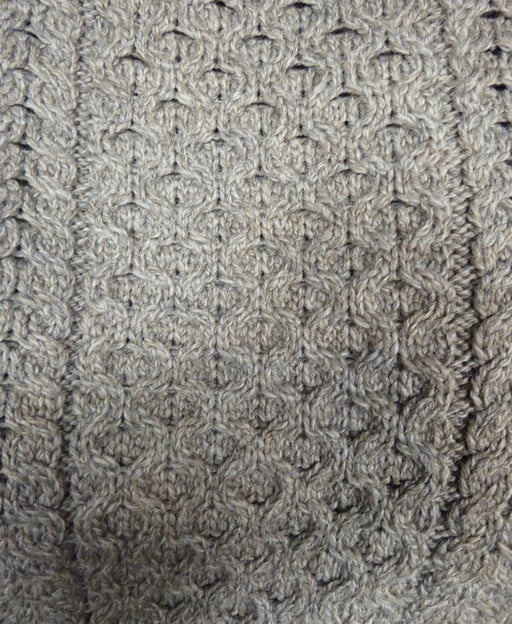
What Is an Aran Jumper, Exactly?
The Aran jumper comes from the Aran Islands, a cluster of three limestone islands off the Galway coast. Inis Mór, Inis Meáin and Inis Oírr are windswept, treeless, and edged by cliffs that drop straight into the Atlantic.
Life on these islands was shaped by the ocean. The men fished. The women farmed the thin, rocky soil. In the long winter evenings, they knitted — using cream báinín wool that held its natural lanolin, making it water-resistant enough for a day’s work on the water.
What made the jumpers extraordinary was not the wool. It was the surface.
The Stitch Names You Can Still Read Today
Aran knitting is built from named stitches, each with its own meaning. These are not decorative choices. They are a visual language passed down through generations.
The cable stitch represents fishing ropes — and is said to bring safety to those who wear it. The honeycomb mirrors the structure of a beehive: hard work and abundance. The diamond stitch reflects the small, stony fields of the islands and the wealth those fields represented.
The tree of life is perhaps the most striking: a branching pattern that runs vertically, representing family, strength, and long life. The trellis mirrors the dry stone walls that divide the island fields. And the blackberry stitch — plump rounded knots of wool — is linked to good fortune and natural abundance.
The Legend That Never Quite Goes Away
Here is the story most people have heard: each family on the Aran Islands had its own unique arrangement of stitches. If a fisherman drowned and washed ashore far from home, the pattern on his jumper could identify which family he belonged to — even when the sea had taken everything else.
It is a haunting idea. And it has been repeated so often that many believe it is historical fact.
The truth is more complicated. Historians and textile scholars have found no firm evidence that individual family patterns existed before the 20th century. The story appears to have been spread by a 1967 book, which lodged it firmly in the popular imagination. It was a powerful idea — and it worked.
☘️ Enjoying this? 64,000+ Ireland lovers get stories like this every weekday morning. Subscribe free →
What the Real History Says
The commercial Aran jumper was largely developed in the 1930s and 1940s, through Irish cottage industry programmes that trained island women to knit to an exportable standard.
Robert Flaherty’s 1934 documentary Man of Aran brought the islands to international audiences for the first time. The image of weather-beaten islanders in thick cream knitwear lodged itself in the global imagination.
By the 1950s and 1960s, exports were rising steadily. The Irish Countrywomen’s Association helped standardise patterns and connect island knitters with overseas buyers. The stitches and their names were real — the family identification system, almost certainly, was not.
That does not diminish them. It changes what they mean. These are not family crests encoded in wool. They are a vocabulary — developed and handed on by the women of the islands across more than a century of Atlantic winters.
Where to Find the Real Thing
The best place to buy a genuine Aran jumper is the Aran Islands themselves. If you visit Inis Mór, you will find small shops selling hand-knitted pieces made the traditional way — no two quite the same.
Galway city is the other natural stop. It sits on the mainland opposite the islands, and its craft shops carry some of the best hand-knitted work in the country.
If you are planning your Ireland trip, putting the Aran Islands on your itinerary gives the jumper a context that no shop counter can provide. The islands are quiet, windswept, and quietly extraordinary — much like the garment they gave to the world.
Still Worth Wearing, Still Worth Knowing
There is something satisfying about wearing a garment with a language built into it. Not a secret code. Not a family crest. But a vocabulary — of ropes, fields, bees, and trees — that island women developed across generations of hard winters.
You might not be able to read every stitch at a glance. But knowing they mean something changes how you hold the jumper in your hands.
When you pull on an Aran jumper, you are wearing the logic of an island — the weight of the sea, the shape of the walls, and the patience of the women who turned all of it into wool.
☘️ You Might Also Love
Tours & experiences you might love


Powered by Viator. Some links are affiliate links — we may earn a small commission at no extra cost to you.
Secure Your Dream Irish Experience Before It’s Gone!
Planning a trip to Ireland? Don’t let sold-out tours or packed attractions spoil your journey. Iconic experiences like visiting the Cliffs of Moher, exploring the Rock of Cashel, or enjoying a guided walk through Ireland’s ancient past often sell out quickly—especially during peak travel seasons.

Booking in advance guarantees your place and ensures you can fully immerse yourself in the rich culture and breathtaking scenery without stress or disappointment. You’ll also free up time to explore Ireland’s hidden gems and savour those authentic moments that make your trip truly special.
Make the most of your journey—start planning today and secure those must-do experiences before they’re gone!