

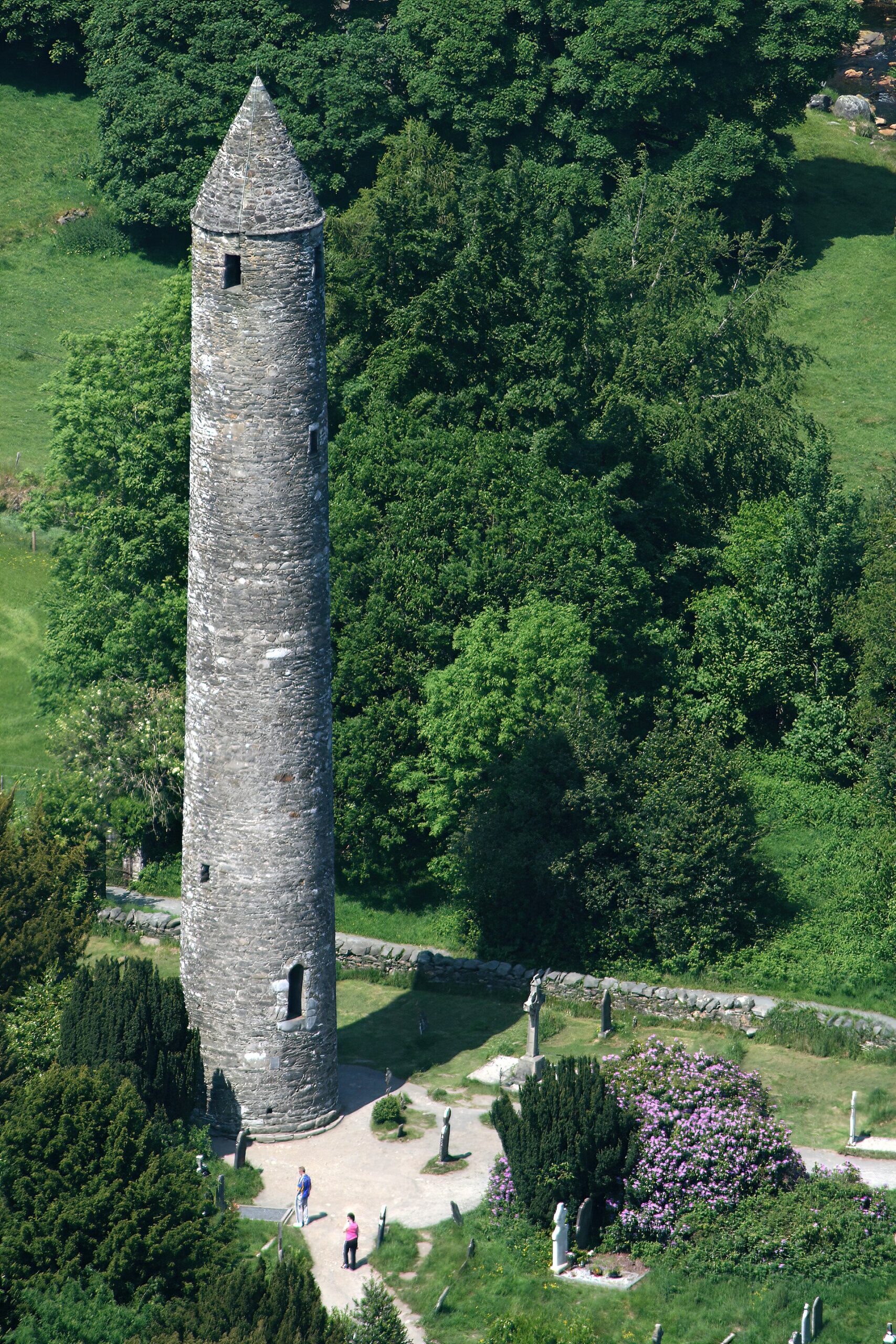
You can spot them from a distance — slender stone fingers pointing at the sky, tapering perfectly after a thousand years of Irish rain. Ireland has around 65 of them. No other country on earth has anything like them. But walk up close to any Irish round tower, and you’ll notice something odd. The door is not at ground level. It never is.
Built to Last — and Built in a Hurry
Ireland’s round towers were constructed between roughly 900 and 1200 AD, almost always on monastery grounds. They were built using the finest stone available — carefully cut, precisely fitted, with walls thick enough to survive whatever the centuries might throw at them.
Many are still standing exactly where the monks left them. Glendalough in County Wicklow. Clonmacnoise on the Shannon. Ardmore in Waterford. Devenish Island in Fermanagh. The ancient abbeys and monasteries of Ireland are scattered across the island, and where you find a monastery, you will usually find a tower.
They were built quickly by the standards of medieval construction. That urgency, historians now believe, tells you something about why they were needed.
The Door That Changed the Question
The single feature that has fascinated — and frustrated — researchers for two centuries is the doorway. On every surviving Irish round tower, the entrance is positioned between two and four metres above ground level.
There was no outside staircase. No permanent ramp. To enter, you climbed a removable wooden ladder — one that could be pulled in behind you once you were inside.
Why? On the face of it, the answer seems obvious.
The Viking Theory That Explains Almost Everything
From the late 700s onwards, Viking longships arrived on Irish coasts regularly. Monasteries were prime targets. Gold, silver, illuminated manuscripts, and food stores — everything a raiding party wanted was held inside monastery walls.
The elevated doorway, under this theory, was a defence mechanism. Monks could haul their most precious items upstairs, pull the ladder in behind them, and wait. The thick stone walls resisted fire. The narrow upper opening was almost impossible to force.
It makes complete sense. Except for one problem: no contemporary Irish account ever describes a round tower being used as a refuge during a Viking raid. Not one, in any surviving manuscript.
☘ Enjoying this? 64,000+ Ireland lovers get stories like this every week. Subscribe free →
The Theory That Challenges Everything
Some historians argue that the elevated door was never about defence at all. Ground-level doors in medieval Irish buildings were vulnerable to flooding, soil movement, and timber rot. A door several metres up kept the wooden frame dry and the structure stable for centuries.
Others point to the symbolic role of height in early Christian architecture. Raising the entrance was an act of reverence — not security.
And then there is this: every Irish round tower has its door facing the monastery church. If these were escape refuges, you’d expect the entrance to face outwards — towards approaching raiders. Instead, it faces inward, towards the sacred space.
What the Towers Were Saying
The communities that built these towers were also producing some of the most important manuscripts in European history. They were scholars, scribes, and artists — not soldiers building fortresses.
A round tower was a declaration. It said: we are here. We are permanent. You can see us from miles away. At a time when almost every building in Ireland was made of timber and thatch, a thirty-metre stone tower was extraordinary — a statement of ambition that drew pilgrims, scholars, and patrons from across the island.
The Irish word for a round tower is cloigtheach: bell house. Many historians believe the primary purpose was simply to hold and ring a bell loud enough to call the surrounding community to prayer.
Still There, Still Keeping Their Secrets
The towers were overbuilt for almost any single practical purpose. A bell tower does not need metre-thick walls. A defensive refuge could have been far simpler. A prestige monument only needed to stand — and stand they have, through centuries of history that destroyed almost everything built around them.
If you want to stand at the base of one yourself, Ireland makes it straightforward. From Timahoe in County Laois to the famous valley of Glendalough — start your planning here — the towers are scattered across the island, often in places of extraordinary quiet and beauty.
More than a thousand years after the last tower was completed, historians still debate what they were primarily built for. The Viking theory, the bell house theory, the monument theory — each explains part of the evidence and leaves the rest unanswered.
What is agreed on: no other country built anything like them. Not Scotland. Not Wales. Not anywhere else the Irish monks later travelled. The round tower is Ireland’s invention, Ireland’s mystery, and Ireland’s alone.
The door stays raised — somewhere between the earth and the sky, exactly where the monks left it.
☘️ You Might Also Love
Free forever · · Unsubscribe anytime
Tours & experiences you might love


Powered by Viator. Some links are affiliate links — we may earn a small commission at no extra cost to you.
Secure Your Dream Irish Experience Before It’s Gone!
Planning a trip to Ireland? Don’t let sold-out tours or packed attractions spoil your journey. Iconic experiences like visiting the Cliffs of Moher, exploring the Rock of Cashel, or enjoying a guided walk through Ireland’s ancient past often sell out quickly—especially during peak travel seasons.

Booking in advance guarantees your place and ensures you can fully immerse yourself in the rich culture and breathtaking scenery without stress or disappointment. You’ll also free up time to explore Ireland’s hidden gems and savour those authentic moments that make your trip truly special.
Make the most of your journey—start planning today and secure those must-do experiences before they’re gone!
Subscribe Free