

Why Did Ireland Ban Its Own Greatest Writers?
In October 1909, James Joyce came back to Dublin with an unusual plan. He was 27 and had lived abroad for five years. Books were not on his mind. He came to open a cinema.
His Triestine business partners backed him. He leased a building on Mary Street. The Volta Cinematograph, Dublin’s first dedicated movie theatre, opened on December 20, 1909. Joyce ran the early programme himself, showing Italian and continental films to puzzled audiences. He returned to Trieste in January 1910. The venture lost money, and his partners sold it.
There is something very Joycean about this. He would write the most celebrated novel of the twentieth century, set almost entirely in one Dublin day. Yet he came home to sell cinema tickets to people who would not read his books. No Irish publisher would print them.
Joyce made one last trip in 1912 to force his publisher’s hand. It failed. He left that summer and never lived in Ireland again. He died in Zurich in January 1941.
His story is the sharpest example of a wider pattern. Between its founding in the 1920s and a reform in 1967, the Irish state built one of the toughest literary censorship systems in any democracy. It silenced its own writers first.
The Manuscript No Irish Publisher Would Touch
Before there was a censorship board, there was George Roberts.
Roberts ran Maunsel and Company, a Dublin publishing house. Joyce wrote the stories of Dubliners between 1904 and 1907. Readers did not see them until June 15, 1914. Those ten years taught Joyce a lot about Irish cultural nerves.
The trouble began in 1906. London publisher Grant Richards signed a contract with Joyce. His printer then refused to set the story “Two Gallants”, which follows a man who manipulates a young woman. The printer wrote on the proof: “We cannot print this.” Richards demanded cuts. Joyce refused most of them. By September 1906, Richards had dropped the book.
Ten Years of Rejection
At least four more publishers passed over the next two years. In August 1909, Joyce signed with Maunsel. Roberts seemed keen. For three years he promised to publish. He never did.
His objections grew stranger. He insisted on fictitious names for the real Dublin pubs. He demanded a lawyer’s letter on “Ivy Day in the Committee Room”. That story shows ward politicians drinking stout and mourning Charles Stewart Parnell. Roberts feared it might libel the late King Edward VII. Joyce even wrote to King George V to ask. No royal reply survives.
The printer John Falconer set 1,000 copies. Nobody ever bound, shipped or sold them. Someone destroyed the sheets, by pulping or burning, depending on the account. Joyce saved a single proof copy.
On the train out of Ireland in 1912, he stopped at the Dutch port of Flushing. There he wrote a savage poem, “Gas from a Burner”. The poem speaks in Roberts’s voice. Joyce named Falconer outright. He also listed Dublin landmarks, from the Wellington Monument to the Sandymount tram, and let Roberts boast of suppressing them. Joyce left Ireland again. This time he did not return.
Grant Richards finally published Dubliners in London in June 1914. The run was 1,250 copies. Joyce earned no royalties on the first 500. He had to buy 120 copies himself. In Ireland, readers could only get the book by mail order or personal import.
The Machine That Came After
What Roberts did informally, the Irish state soon did by law.
Parliament passed the Censorship of Publications Act in 1929. A campaign had built since the early 1920s to protect Irish society from foreign influence. A Committee on Evil Literature urged tighter rules in 1926. The Censorship Board began work in 1930. The Minister for Justice appointed its five members.
Its first thirteen banned books included works by Aldous Huxley and Radclyffe Hall. That made a statement. The Board did not only police Irish writers. It cast Ireland as a moral counterweight to the English-speaking world.
The bans piled up for four decades. By 1942 the list held 1,600 titles. Senator John Keane, a rare critic, cited that figure in the Seanad. By the 1967 reform, the Board had prohibited more than 12,000 publications.
The Board never formally banned Ulysses. It did not need to. Booksellers and importers refused to stock it. Customs officers knew to treat it as unwelcome. Nobody wanted to test the point. Mid-century Ireland had many such grey zones. Strick’s 1967 film adaptation did get a formal ban. That ban stayed until 2000.
Other countries moved faster. A US federal judge, John Woolsey, ruled Ulysses publishable in December 1933. Britain dropped its customs ban in November 1936, when the Home Office declined to prosecute Bodley Head. Ireland, the novel’s own setting, kept readers away for decades more.
The Writers They Came For
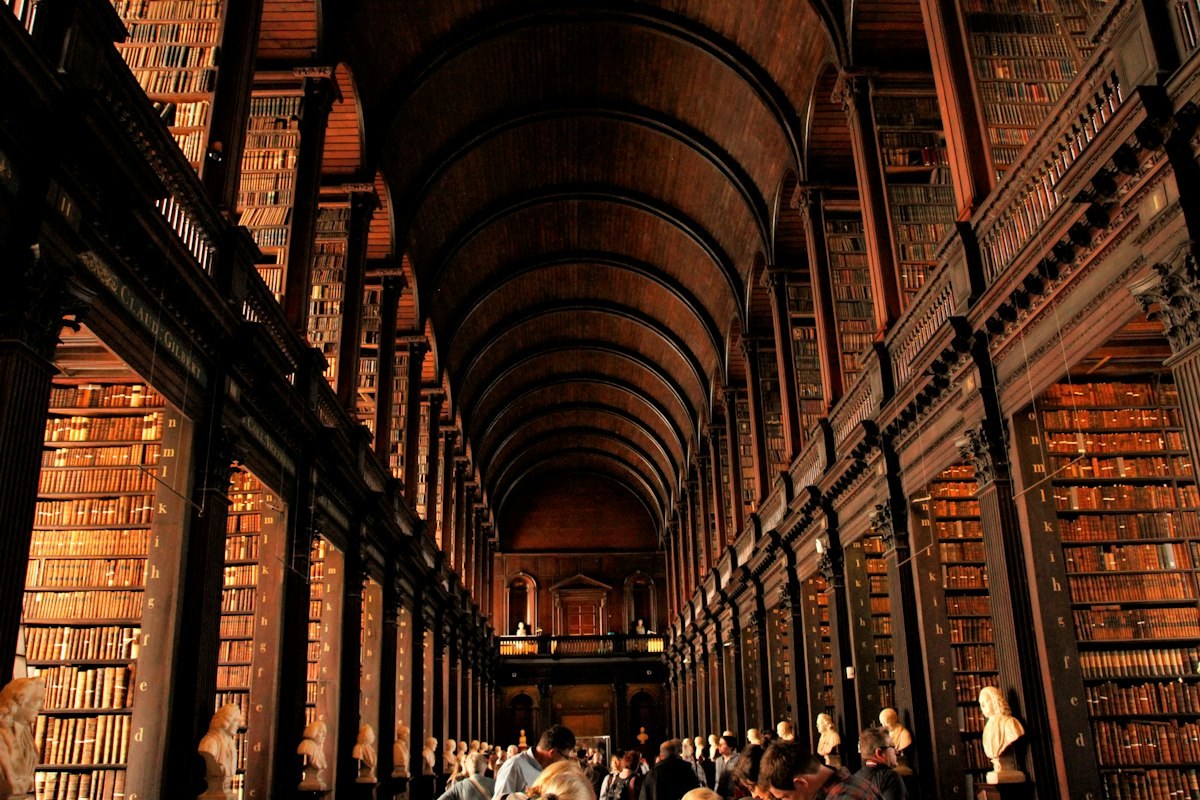
Samuel Beckett studied at Trinity College Dublin, home of the Long Room library shown above and of the Book of Kells. He left Ireland in 1937 at the age of 31. He moved to Paris, partly to escape the censors, scholars note. Ireland had banned his story collection More Pricks Than Kicks in 1934, the year London published it. The novels Watt and Molloy joined it on the list. Beckett wrote an essay attacking Irish censorship, “Censorship in the Saorstat”. He won the Nobel Prize in Literature in 1969. He lies buried in Montparnasse Cemetery.
Edna O’Brien’s The Country Girls met a ban on June 21, 1960. London had published it the same year to wide praise. It follows two young women from rural County Clare who want more from life. Critics called it “a smear on Irish womanhood”. A local priest burned copies. The Board banned five more of her novels. She later described a strange doubling. The country had produced her characters and then preferred not to see them.
The Board banned John McGahern’s second novel, The Dark, in 1965. McGahern taught at a Dublin primary school. The Church ran the national schools, and the school dismissed him after the ban. He spent years working in England. He then returned to farm in County Leitrim and wrote some of the finest Irish fiction of the century. His story, at least, had a better second act.
The list ran on. Liam O’Flaherty had five novels banned. Seán Ó Faoláin lost his first collection, Midsummer Night Madness, in 1932, the year it appeared. Frank O’Connor’s English version of the eighteenth-century poem “The Midnight Court” fell in 1946. That ban blocked Gaelic literature from reaching readers in the country’s other official language. Kate O’Brien and Austin Clarke lost novels too. Brendan Behan’s Borstal Boy joined them.
A Board With Few Limits
Dublin still keeps that literary memory alive. Brendan Behan drank in the city’s pubs, and you can read about one famous haunt in our guide to McDaid’s on Harry Street.
The Board had a broad mandate and little accountability. One complaint could trigger a review. Publishers got no prior notice. Authors had no appeal until 1946, and the process stayed difficult. Writers who dealt frankly with sex, poverty or the gap between pious words and real life felt the pressure.
The City in Joyce’s Head
Joyce never stopped writing about Dublin. Ulysses maps June 16, 1904 with staggering density. It tracks pub interiors, tram routes, newspaper offices and the light on the Liffey. Scholars have walked its routes with the text in hand. They found them accurate, decades after the city changed. His last work, Finnegans Wake, circles back to the Liffey and the Hill of Howth.
His biographers record a favourite Paris pastime. Joyce asked visitors fresh from Dublin to recite the shops and pubs along O’Connell Street, from Amiens Street to Nelson’s Pillar. He wanted to know what had changed. He wanted Dublin back, exactly, in a room far from home.
In A Portrait of the Artist as a Young Man, Stephen Dedalus states his position plainly: “I will not serve that in which I no longer believe, whether it call itself my home, my fatherland, or my church.” He vows to express himself freely, with three weapons only: “silence, exile, and cunning”. Elsewhere he calls Ireland “the old sow that eats her farrow”.
Those lines come from fiction, not biography. Still, few people argue that they miss Joyce’s own stance. He built his art around a city he last touched in 1912. The city, officially, built its life around ignoring his books.
The Night 5,000 Books Came Back
A new law in 1967 ended the worst of it.
That year’s Censorship of Publications Act added a twelve-year sunset clause. Any book banned for indecency or obscenity would leave the list after twelve years. The effect came at once. Many bans had piled up over nearly four decades. More than 5,000 titles became legal overnight. Behan, Beckett, Edna O’Brien and McGahern all reached Irish bookshops. Nobody needed a friend with a parcel from London any more.
What Remains of the Board
Key Dates at a Glance
- 1914: Dubliners appears in London.
- 1929: Parliament passes the Censorship of Publications Act.
- 1930: The Censorship Board starts work.
- 1967: A twelve-year sunset clause frees more than 5,000 titles.
- 2000: Ireland lifts its ban on the Ulysses film.
The Board still exists. It still meets. Nine books remain on its prohibited list today, and the oldest dates from 1942. Some 264 periodicals also remain banned. The machinery survives, though the appetite has gone. RTÉ archives record that serious literary censorship had “essentially ceased” by the mid-1970s.
Consider the full arc. Between the state’s founding and 1967, Ireland banned well over ten thousand books and periodicals. In the same years, it produced central figures in world literature. Joyce, Beckett, Edna O’Brien, McGahern, Frank O’Connor and Séan Ó Faoláin all belong on that list. Several won major prizes. Several lived most of their working lives abroad. Some left under cultural pressure. Others could not write under the threat of a ban. Beckett took the Nobel. Universities in every country teach Joyce. People now remember the Board mainly as a monument to institutional insecurity.
Joseph Strick came to Dublin in 1966 to film Ulysses. The 1967 Act was already law when he finished. It did not save him. Ireland banned the film that year and kept the ban for thirty-three years. It lifted the ban in 2000. That was seventy-eight years after the novel appeared and fifty-nine years after Joyce died without seeing Dublin again.
Silence, Exile and Cunning
Joyce left armed, as his character says, with silence, exile and cunning. Others imposed the silence. He chose the exile, or came as close to choosing it as his circumstances allowed. The cunning lived in the writing itself. You cannot suppress a city by refusing to read the books about it. Dublin still lives in every page of Ulysses, whatever the Board thought. The Board could not keep it out.
Ireland’s relationship with its writers has since changed. Bloomsday falls each year on June 16, the day on which the whole of Ulysses unfolds. Dublin marks it with readings, walks and theatre that follow Leopold Bloom through the city. The door from Bloom’s house on Eccles Street now stands in the James Joyce Centre on North Great George’s Street. Visitors can see it today. The country that could not bear to read Joyce now sells guided tours of him. You may call that a satisfying reconciliation. You may call it a very Irish irony.
Frequently Asked Questions
Did Ireland ban Ulysses?
Not formally. The Censorship Board never listed the novel. Booksellers and customs officers simply kept it out. The 1967 film adaptation did receive a formal ban, which ended in 2000.
When did the Irish censorship board begin?
Parliament passed the Censorship of Publications Act in 1929. The five-member Board started work in 1930. It banned more than 12,000 publications before the 1967 reform.
Which Irish writers did the Board ban?
The list includes Samuel Beckett, Edna O’Brien, John McGahern, Liam O’Flaherty, Brendan Behan, Frank O’Connor and Kate O’Brien. Each lost at least one book to the Board.
How did the 1967 Act change censorship?
It added a twelve-year sunset clause for books banned as indecent or obscene. More than 5,000 titles became legal at once. Nine books remain on the list today.
Can I visit Joyce’s Dublin today?
Yes. The James Joyce Centre on North Great George’s Street holds the door from Bloom’s fictional home. Dublin also runs Bloomsday walks and readings every June 16.
☘️ Join 64,000+ Ireland Lovers
Every Friday, get Ireland’s hidden gems, local secrets, and travel inspiration — the kind you won’t find in any guidebook.
Already subscribed? Download your free Ireland guide (PDF)
Free forever · One email per week · Unsubscribe anytime
Tours & experiences you might love


Powered by Viator. Some links are affiliate links — we may earn a small commission at no extra cost to you.
Secure Your Dream Irish Experience Before It’s Gone!
Planning a trip to Ireland? Don’t let sold-out tours or packed attractions spoil your journey. Iconic experiences like visiting the Cliffs of Moher, exploring the Rock of Cashel, or enjoying a guided walk through Ireland’s ancient past often sell out quickly—especially during peak travel seasons.

Booking in advance guarantees your place and ensures you can fully immerse yourself in the rich culture and breathtaking scenery without stress or disappointment. You’ll also free up time to explore Ireland’s hidden gems and savour those authentic moments that make your trip truly special.
Make the most of your journey—start planning today and secure those must-do experiences before they’re gone!