

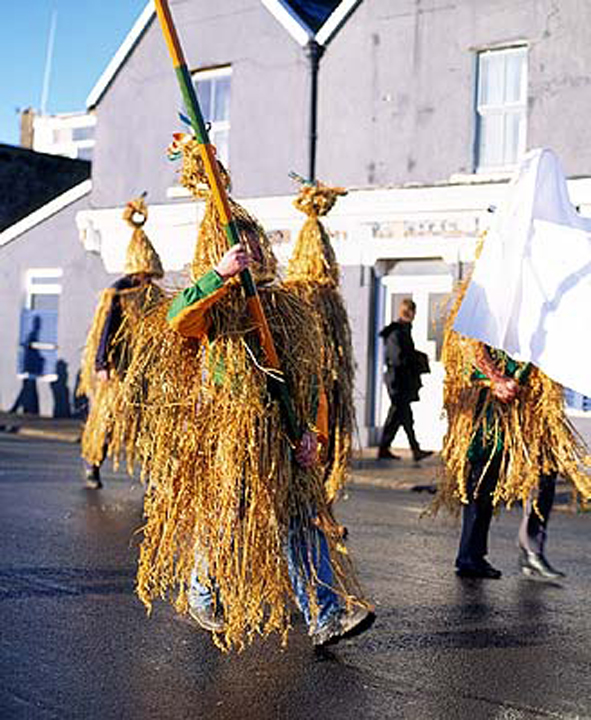
Every 26th December, something extraordinary happens across Ireland. Groups of people dressed in elaborate straw costumes and multicoloured outfits take to the streets, playing music, singing songs, and carrying a small decorated pole topped with a wren. This is Lá an Dreoilín — Wren Day — one of the oldest and least-known traditions in all of Ireland.
What Are the Wren Boys?
On St Stephen’s Day, groups known as the Wren Boys (or Wrenboys) travel from door to door through villages and town streets, playing music and asking for small donations in exchange for a song and a blessing.
The tradition dates back centuries — possibly millennia. Some scholars trace its roots to Celtic ritual; others to medieval folklore. What’s certain is that it has survived everything: the Famine, mass emigration, modernisation, and the arrival of the shopping centre.
Across Ireland, it remains one of the few living traditions that still belongs entirely to the community rather than to a tourist board or a heritage programme.
Why the Wren?
The wren holds a peculiar place in Irish folklore. Despite being one of the smallest birds in the country, it is also — according to legend — the cleverest. It won a contest to become King of the Birds by hiding in the feathers of an eagle, then flying higher than anyone else once the eagle gave out.
Yet on St Stephen’s Day, the wren is symbolically hunted. One legend says the wren betrayed St Stephen — the first Christian martyr — by alerting soldiers to his hiding place with its chirping. Another suggests the tradition predates Christianity entirely, tied to ancient beliefs about the death of the old year and the birth of the new.
Nobody knows the full truth. That ambiguity is part of what makes it so Irish.
Where Is It Most Alive?
The Wren Boys tradition is strongest in County Kerry — particularly in Dingle, where the celebration draws thousands of spectators every year. The streets fill with competing bands of Wrenboys, each dressed differently, playing everything from tin whistles to bodhrán drums to fiddles.
Listowel, Tralee, and towns across Clare and south Galway also hold strong traditions. In some areas, groups compete for the best costume or the best music, and the festivities stretch well into the cold evening air.
If you’re planning a trip to Ireland over the Christmas period, seeing the Wren Boys is one of the most genuinely Irish experiences you can have — and it costs nothing to watch.
The Song and the Ceremony
Most groups perform a version of the ancient Wren Boys song, which announces their arrival and explains — with characteristic Irish good humour — why they’ve come knocking:
The wren, the wren, the king of all birds,
St Stephen’s Day, was caught in the furze…
Money collected goes to charity or to fund the group’s own celebrations. In many communities, a formal Wren Boys Ball is held in the evening — a dance that extends the joy well into the night.
This sits at the heart of what makes Irish traditional music so different from anywhere else: it lives on the street, in the cold, unannounced, with everyone welcome to join in.
A Tradition Reclaimed
The Wren Boys were nearly lost during the 20th century. Television, consumerism, and the slow hollowing out of rural communities all took their toll. In many towns, the tradition simply faded away without announcement.
But in places like Dingle, it never wavered. And in recent decades, there’s been a quiet revival across the country. Communities that had let the tradition lapse began to reclaim it — young people learned the songs, new costumes were sewn, and the wren was lifted back onto its pole.
The small customs that still quietly shape Irish life often reveal more about the country’s soul than any heritage centre or guidebook ever could. The Wren Boys are proof of that.
For more on this ancient custom, see why the day after Christmas belongs to the Wren Boys and why straw-masked strangers still march through Irish villages every December.
When to Go
Wren Day falls on 26th December every year. For the best experience, head to Dingle in County Kerry, where the main parade typically begins around noon and fills the town for hours.
Dress warmly. Bring good spirits. Don’t be surprised if a bodhrán is pressed into your hands before the afternoon is over.
Ireland’s oldest traditions are best understood on your feet, in the place where they happen. For more stories that don’t make the guidebooks, join thousands of Ireland lovers at the Love Ireland newsletter — new Irish magic, every week.
☘️ You Might Also Love
☘️ Your Irish family has a story waiting to be found.
Discover where your Irish ancestors came from — their county, their name, their story. Our free step-by-step guide walks you through every record, DNA tool, and ancestry archive. Join 64,000+ readers staying connected to Ireland.
☘️ Want More Hidden Ireland?
Join 64,000+ subscribers who discover Ireland’s best-kept secrets every week.
Subscribe Free — Join the Community →
Free forever · Unsubscribe anytime · No spam
📥 Free Download: Ireland Travel Planning Guide
Our most popular resource — itineraries, insider tips, and the 50 places you must not miss.
Tours & experiences you might love


Powered by Viator. Some links are affiliate links — we may earn a small commission at no extra cost to you.
Secure Your Dream Irish Experience Before It’s Gone!
Planning a trip to Ireland? Don’t let sold-out tours or packed attractions spoil your journey. Iconic experiences like visiting the Cliffs of Moher, exploring the Rock of Cashel, or enjoying a guided walk through Ireland’s ancient past often sell out quickly—especially during peak travel seasons.

Booking in advance guarantees your place and ensures you can fully immerse yourself in the rich culture and breathtaking scenery without stress or disappointment. You’ll also free up time to explore Ireland’s hidden gems and savour those authentic moments that make your trip truly special.
Make the most of your journey—start planning today and secure those must-do experiences before they’re gone!