

You dress your children up every October. You carve a pumpkin. You buy sweets and wait by the door.
But here’s the thing. Every one of those traditions is Irish.
Halloween didn’t begin in America. It didn’t begin with horror films or candy companies. It began in Ireland, more than two thousand years ago, on a night the ancient Celts called Samhain — pronounced SOW-in, to rhyme with “cow-in”.
If your family came from Ireland — and seventy million people worldwide can trace roots there — this isn’t just folklore. It’s family history.
☘️ Your Irish family has a story waiting to be found.
Discover where your Irish ancestors came from — their county, their name, their story. Our free step-by-step guide walks you through every record, DNA tool, and ancestry archive. No experience needed.
What Is Samhain? The Celtic Festival That Started It All
Samhain is the oldest of Ireland’s four great Celtic festivals. The name says it plainly. In Irish, samh means summer and fuin means end or setting. Samhain means “summer’s end.”
The others were Lughnasadh (August 1st), Beltane (May 1st) and Imbolc (February 1st). Each marked a turning point in the year. Samhain marked the biggest one of all.
It was the moment summer ended and winter began. The Celts divided the year into two halves — a light half and a dark half. Samhain opened the dark half. It was both an ending and a beginning. The ancient Irish counted it as their New Year.
Early medieval Irish texts describe Samhain as one of the most powerful nights in the calendar. The laws changed on this night. The rules of ordinary life were suspended. Something shifted in the world. And the Irish took that seriously.
The Veil Between the Worlds
The Celts believed the boundary between the living and the dead grew thin at Samhain. This wasn’t mere superstition. It was a complete view of the world.
The ancient Irish believed in the Otherworld — a parallel realm where gods, ancestors and supernatural beings lived. You can read more about how certain places in Ireland were thought to be closer to this other realm. At Samhain, those passages opened.
The Tuatha Dé Danann — Ireland’s ancient supernatural beings — emerged from their fairy mounds and walked freely across the land. The spirits of the dead could return to their old homes. The gap between what was seen and what was unseen closed completely for one night.
Families prepared for both possibilities. They left food and drink outside to appease wandering spirits. They set a place at the table for ancestors who might return. They kept the fire burning so the dead could find their way home. These traditions survived in Irish households for more than a thousand years.
☘️ Enjoying this? 64,000 Ireland lovers get stories like this every week. Subscribe free →
What People Did on Samhain Night
The rituals of Samhain were specific. People took them seriously. They were not decorative — they were practical acts of protection and connection.
Fire came first. Great bonfires burned on hilltops across Ireland. Every household in a district put out their hearth fire. Then they relit it from the communal bonfire. This tied the whole community together in a single act.
Disguise was essential. People wore costumes — animal skins, straw masks, ragged clothes — to confuse the spirits moving through the world. If a wandering soul mistook you for one of its own, it would pass you by. This is where Halloween costumes come from.
Turnips told the story. Families carved faces into turnips and placed candles inside. The lanterns lit dark pathways and frightened away harmful spirits. In County Meath, County Sligo and across Connacht, old families kept this practise going well into the twentieth century. Some still do.
Barmbrack carried the future. Women baked small objects into a spiced fruit loaf — a ring for marriage, a coin for wealth, a rag for hard times. Children would eat a slice and see what they found. You can still buy barmbrack in bakeries across Ireland every October. The ring is still inside.
Divination was everywhere. Samhain was thought to be a time when the future was closer to the surface. Young people peeled apples in long spirals, dropped the skin over their shoulder, and tried to read the first letter of their future spouse’s name. They bobbed for apples in a barrel of water. They looked into mirrors by candlelight. Nearly every Halloween party game has a root in Samhain night.
How Irish Emigrants Carried Halloween to America
The famine years of 1845 to 1852 drove more than a million Irish people to America. They arrived with almost nothing. But they brought their traditions with them.
Samhain came across the Atlantic in their luggage. In the Irish communities of Boston, New York and Chicago, the old customs held. Children went door to door in costumes. Turnip lanterns became pumpkin lanterns — pumpkins were local and easy to carve. The guising of Irish country roads became trick-or-treating on American streets.
The Jack-o’-Lantern itself comes from an Irish legend — the story of a man called Stingy Jack who tricked the devil and was condemned to wander the earth carrying only a hollowed turnip for light. When Irish families arrived in America, they carved pumpkins instead. The legend made the journey intact.
Scottish emigrants added their own layer. In Scotland the same festival was called Hallowe’en, and the customs were nearly identical. Both peoples had celebrated Samhain for centuries before the first emigrant ship crossed the Atlantic.
By the late nineteenth century, Halloween was an American institution. But it was Irish and Scottish at its heart. If you have ancestry from either country, you are not celebrating a commercial holiday in October. You are keeping alive a tradition your great-great-grandparents brought across the sea.
Samhain in Ireland Today
Ireland has reclaimed Samhain. The festival is growing every year.
The Púca Festival now runs every year in County Meath from October 29th to November 1st. It is centred near Tlachtga Hill — the site scholars believe was home to the great Samhain fire. Music, storytelling, rituals and large outdoor events draw tens of thousands of visitors. It has become one of the most important cultural festivals in the Irish calendar.
Derry Halloween is one of the biggest Halloween events in the world. The ancient walls of the city light up. Parades and fireworks fill the streets from late October. Visitors come from across North America, Europe and Australia — many of them Irish diaspora families returning to see the festival their ancestors carried away.
Across rural Ireland, quieter traditions survive. In some parishes in Connacht, families still leave a light burning on Samhain night. Older residents in parts of County Mayo and County Sligo still refer, half-jokingly, to “going to the fairies” after dark on this one night. The phrase carries the old belief without quite stating it plainly.
Visiting Ireland at Samhain — What You’ll Find
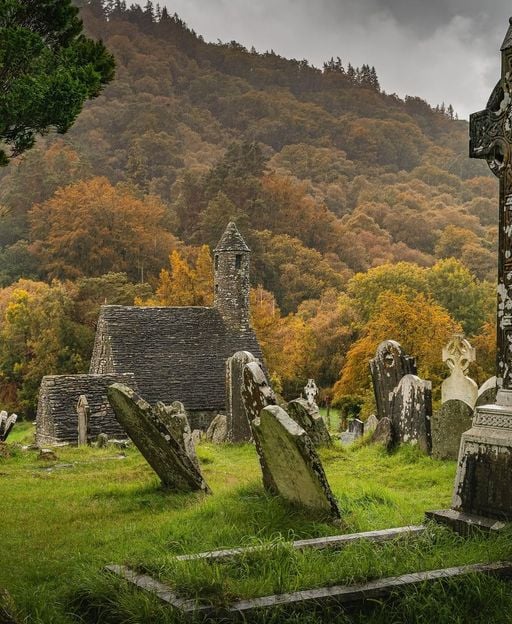
October is a beautiful time to visit Ireland. The summer tourists have gone. The countryside turns deep gold and amber. The light is low and clear in the afternoon. Rain comes quickly and passes quickly.
The ancient sites feel different at this time of year. Visit Newgrange in late October. Stand in the passage tomb that Irish people built five thousand years ago to honour their dead. The passage tomb’s famous solstice light show — when a beam of sunlight travels the length of the passage to fill the inner chamber — happens only in the days around December 21st, not in October. But standing in that dark, five-thousand-year-old chamber any time in autumn, with Samhain approaching, the connection to the thinning of the veil and the dead coming close is easy to feel.
Drive out to Tlachtga Hill near Athboy in County Meath. It’s a quiet, unremarkable field to look at. But it was the sacred centre of Samhain for more than a thousand years. Standing there on a grey October afternoon connects you to the oldest continuous tradition in Irish history.
If your family left Ireland, this is the season to come back. Samhain is when Ireland looks most like its older self.
Frequently Asked Questions About Samhain
Is Halloween really from Ireland?
Yes. The traditions at the heart of Halloween — costumes, carved lanterns, going door to door, leaving food for the dead — all come from the Irish and Scottish celebration of Samhain. Irish emigrants carried these customs to America during and after the Famine years of the 1840s and 1850s. The holiday as it exists today is the Irish tradition filtered through American popular culture. For the fuller story of how this Irish festival crossed the Atlantic and was gradually forgotten as Irish, read the real reason Halloween belongs to Ireland.
What does the word Samhain mean?
Samhain is an Old Irish word. It comes from samh (summer) and fuin (end or setting sun). It means “summer’s end.” The ancient Celts counted the year from this festival, so Samhain also served as their New Year. It is pronounced SOW-in — the first syllable rhymes with “cow.”
When is Samhain celebrated?
Samhain begins at sunset on October 31st and runs into November 1st. The Celts counted days from sunset to sunset, so Samhain night was October 31st. In the Christian calendar, November 1st became All Saints’ Day — All Hallows’ Day. October 31st became All Hallows’ Eve, which shortened over centuries into Halloween.
Are there still Samhain celebrations in Ireland today?
Yes. The Púca Festival in County Meath runs every year from October 29th to November 1st, centred near the ancient Samhain site at Tlachtga Hill. Derry hosts one of the world’s largest Halloween festivals every year. Across Ireland, local communities mark the season with bonfires, storytelling and traditional foods like barmbrack.
What is barmbrack and what does it have to do with Samhain?
Barmbrack is a spiced Irish fruit loaf, traditionally baked at Samhain. Families hid small objects inside the loaf — a ring predicted marriage, a coin predicted wealth, a rag predicted hard times. Children cut slices and checked what they found. The tradition continues today. Every October, bakeries across Ireland sell barmbrack with a ring baked inside.
☘️ Join 64,000+ Ireland Lovers
Every Friday, get Ireland’s hidden gems, local secrets, and travel inspiration — the kind you won’t find in any guidebook.
Subscribe free — enter your email:
Already subscribed? Download your free Ireland guide (PDF)
📲 Know someone who’d love this? Share on WhatsApp →
Love more? Join 43,000 Scotland lovers → · Join 29,000 Italy lovers → · Join 7,000 France lovers →
Free forever · One email per week · Unsubscribe anytime
Tours & experiences you might love


Powered by Viator. Some links are affiliate links — we may earn a small commission at no extra cost to you.
Secure Your Dream Irish Experience Before It’s Gone!
Planning a trip to Ireland? Don’t let sold-out tours or packed attractions spoil your journey. Iconic experiences like visiting the Cliffs of Moher, exploring the Rock of Cashel, or enjoying a guided walk through Ireland’s ancient past often sell out quickly—especially during peak travel seasons.

Booking in advance guarantees your place and ensures you can fully immerse yourself in the rich culture and breathtaking scenery without stress or disappointment. You’ll also free up time to explore Ireland’s hidden gems and savour those authentic moments that make your trip truly special.
Make the most of your journey—start planning today and secure those must-do experiences before they’re gone!