

Why So Many Americans Are Buying Homes in Rural Ireland
Across the rolling hills of County Mayo, the stone-walled laneways of West Cork, and the quiet harbour villages of County Kerry, a growing number of Americans are doing something that would have seemed extraordinary a generation ago: they are buying homes in rural Ireland and starting new lives there. Whether drawn by deep ancestral ties, a longing for a slower and more rooted pace of life, or simply the extraordinary beauty of the Irish landscape, the move to rural Ireland no longer belongs to the romantically inclined alone. A growing number of American families are now making this practical and deeply personal decision. If you are exploring what moving to Ireland actually looks like, our comprehensive move-to-Ireland guide is the place to start, and our guides to how Americans are actually moving to Ireland and buying property in Ireland as an American cover the practical steps.
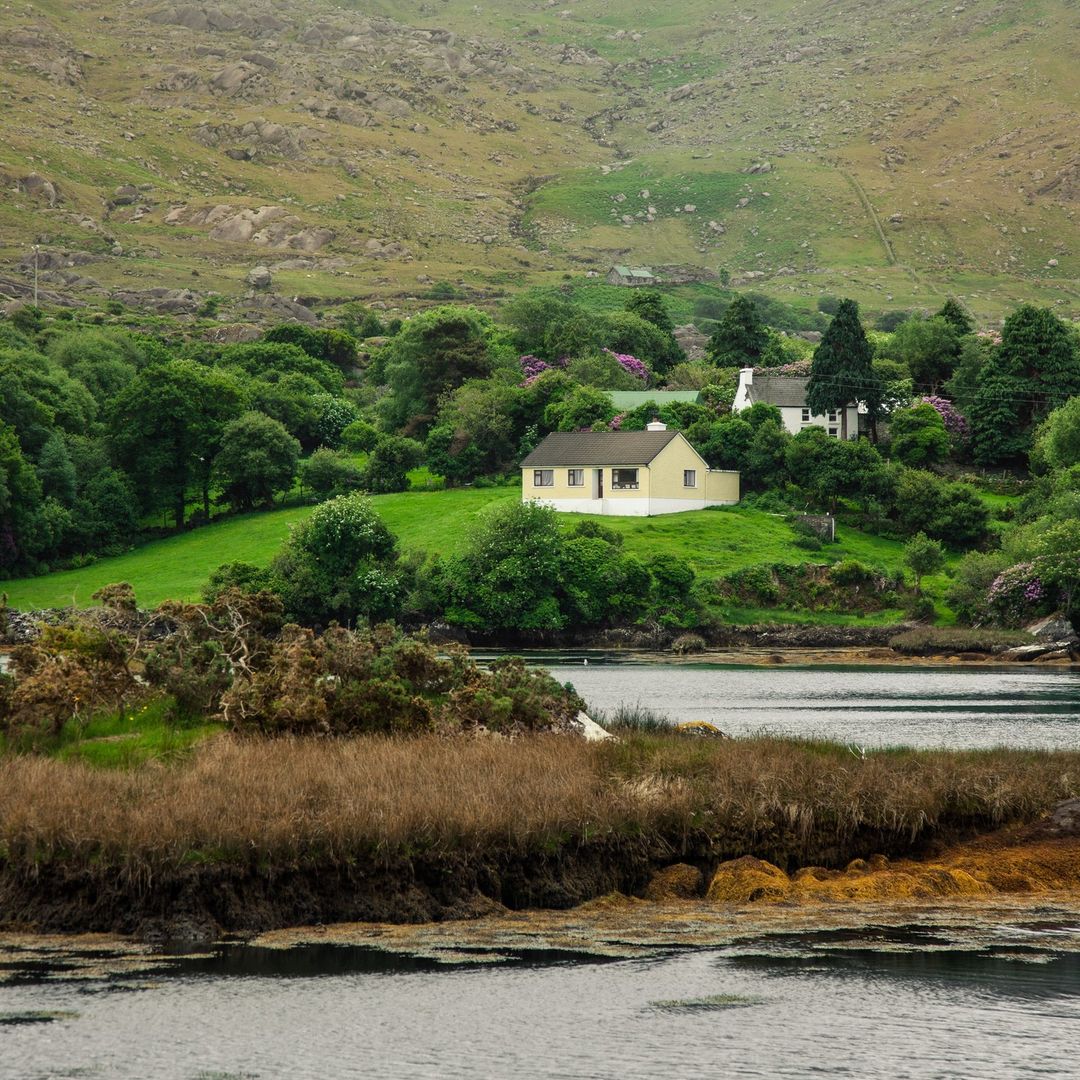
The Scale of the Shift — Why Rural Ireland?
Interest is real, even if the hard numbers are patchy. Estate agents and relocation advisers in the west and north-west report growing enquiries from North American buyers, and counties such as Leitrim, Roscommon, and Clare are often mentioned as places where overseas buyers still find relatively affordable homes. Official property-price records do not generally record a buyer’s nationality, so treat any headline figure about American purchases with caution. Leitrim in particular has a reputation as one of the most affordable and welcoming counties for those arriving from North America.
The appeal operates on multiple levels simultaneously. Ireland is English-speaking. It is a member of the European Union, giving residents eventual freedom of movement across 27 countries. The island is compact — most of the island is within roughly two to three hours’ drive of an international airport, although the far north-west and south-west corners can take longer. And for the roughly 31 million Americans who report Irish ancestry in the US Census Bureau’s American Community Survey, there is often something more personal at work: the feeling of returning to something, even if you have never been before.
☘ Planning a trip to Ireland?
Our free 7-day road trip itinerary covers the Wild Atlantic Way from Dublin to the west — day-by-day driving guide with hidden gems, practical tips, and local secrets.
The Ancestral Pull — It Runs Deeper Than Nostalgia
Many Americans who end up buying in rural Ireland describe a process that began with a genealogy search and ended with a set of keys. The 1901 and 1911 Irish Census records — both fully digitised and freely searchable online — let anyone trace a great-grandparent back to a specific townland, sometimes to a precise house site that still stands. Once you know that your family walked a particular boreen in County Clare or fished a particular harbour in County Kerry, the idea of owning property in that county feels rather different from a standard overseas purchase.
The Irish diaspora connection is not merely sentimental. In many rural parishes, communities welcome returning diaspora — even those arriving for the first time — with a warmth that can stop you in your tracks. Local knowledge of who went where and when is remarkably precise. Turn up in the right pub in the right village with the right surname and you may well find yourself introduced to a third cousin you never knew existed.
What Rural Ireland Actually Offers Day to Day
Americans who have made the move consistently describe a quality of daily life that is difficult to quantify but easy to feel. Here is what tends to come up most often:
- Human scale. Rural Irish towns and villages grew organically over centuries for people on foot, not for cars. The post office, the butcher, the pharmacy, the pub, and the church are typically within five minutes of each other. There is no car park culture, no strip mall, no drive-through. Life happens at a pace that feels deliberate.
- Community depth. The GAA club, the tidy towns committee, the local dramatic society, the traditional music session — rural Ireland has an extraordinary density of voluntary community life. Newcomers who engage with these structures tend to find their feet quickly.
- Landscape as daily companion. Whether you are in Connemara, the Burren, the Copper Coast, or the Iveragh Peninsula, rural Ireland offers a landscape that is never domesticated in the way of suburban America. The light changes every hour. The weather arrives in layers. The sea or the hills or the bogs are always within sight.
- Food culture that has transformed. Rural Ireland’s food scene has changed dramatically since the 1990s. Towns with populations of two or three thousand now support farmers’ markets, artisan producers, and destination restaurants. The access to fresh seafood, local dairy, and seasonal produce along the Wild Atlantic Way in particular is extraordinary.
The Counties Americans Are Choosing — and Why
Not all of rural Ireland is equally popular with American buyers. Certain counties and regions have developed strong reputations, often through word of mouth within specific diaspora communities.
County Kerry — The Classic Choice
Kerry has long attracted Americans, partly because of its dramatic landscape — the Ring of Kerry, the Dingle Peninsula, Skellig Michael — and partly because so many Kerry families emigrated during the Famine and in subsequent waves, seeding strong diaspora communities in Boston, New York, and Chicago. Towns like Kenmare, with a population of around 2,600, and Dingle, with fewer than 2,000 residents, offer genuine cultural life, excellent restaurants, and a year-round community that does not simply disappear in October when the tourist season ends. The Dingle Peninsula — a Gaeltacht area where Irish remains a living daily language — has attracted a number of Americans who specifically want that immersion in older Irish culture. For a closer look at where to settle, see our guide to the best places to live in County Kerry, or trace a family link with our 5-day Kerry ancestral heritage plan.
County Leitrim — The Affordable Frontier
Leitrim is the county that surprises most people. It is the least densely populated county in Ireland, with a population of approximately 35,000 across its entire area. It is also frequently cited as one of the most affordable counties for overseas buyers, although firm figures on buyer nationality are scarce. The Leitrim landscape — drumlins, lakes, river valleys, and bog — is quietly beautiful rather than dramatically so, and the community of international arrivals has been building for long enough that there is now real infrastructure for newcomers.
County Clare — The Burren and Beyond
Clare occupies a unique position. It has the Burren — one of the most singular landscapes in Western Europe, a limestone region covering roughly 250 to 530 square kilometres, depending on how it is defined, where Arctic, Mediterranean, and Alpine plants grow side by side. It has the Cliffs of Moher, which draw over 1.5 million visitors a year. And it has Ennis, a market town of around 28,000 that punches well above its weight for traditional music, food, and services. For Americans wanting both landscape and amenity, Clare is a compelling combination.
County Cork — Community, Coast, and Culture
West Cork has been attracting international arrivals since the 1970s, when a first wave of back-to-the-land settlers discovered the Mizen Peninsula, Sheep’s Head, and the Beara. That foundation means there is now a deeply established culture of welcoming newcomers in West Cork towns like Skibbereen, Bantry, and Schull. The food culture here is arguably the strongest in rural Ireland — Clonakilty black pudding, Union Hall smoked salmon, and Gubbeen farmhouse cheese are just three of dozens of artisan producers operating within a 30-mile radius. For an on-the-ground view, read what life is really like in West Cork.
☘ Enjoying this? 64,000+ Ireland lovers get stories like this every week. Subscribe free →
The Practical Realities — What Buyers Discover
Americans who have gone through the process of buying property in rural Ireland are generally candid about the gap between the romantic vision and the practical reality. None of this makes the move inadvisable — but it does make preparation important.
Buying a Home Is Not the Same as Gaining Residency
Americans can generally buy property in Ireland without restriction, but ownership does not give you the right to live there. US citizens can normally visit for up to 90 days without a visa; staying longer requires a separate immigration permission, such as a long-stay visa, or Irish citizenship for those who qualify through an Irish-born grandparent or parent via the Foreign Births Register. Check the current rules with the Irish immigration authorities before committing, and see our guide to the best places to retire in Ireland for Americans for more on the visa side.
The Planning Permission Question
Rural Ireland has a complex relationship with planning permission, particularly for new builds on agricultural land. Older stone cottages — the type that buyers most commonly romanticise — frequently require substantial renovation. Irish building standards and the process of obtaining planning permission for modifications can take longer than American buyers expect. Engaging a local solicitor and architect early is consistently the advice of those who have been through it.
The Broadband Reality
The Irish government’s National Broadband Plan has been extending fibre connectivity to rural areas, and coverage has improved considerably since 2020. However, connectivity in the most remote townlands remains variable. For Americans who intend to work remotely — a common profile among those making the move — verifying actual broadband availability at a specific property before purchase is essential, not optional.
The Community Integration Timeline
Rural Irish communities are warm but not immediately open. Most people find that genuine embedding in a local community takes years rather than months. Americans who have done this successfully tend to identify a common pattern: show up consistently, engage with whatever local structures genuinely interest you — the GAA, the tidy towns, the music session — and resist the impulse to form an exclusively expatriate social circle. Patience rewards you with a quality of community belonging that contemporary American suburban life rarely delivers.
The Heritage Connection — A Two-Way Journey
For many of the Americans buying in rural Ireland, the move has deepened rather than completed a journey of ancestral discovery. Living in the county your great-grandmother left in 1921 changes your relationship to that history in ways that occasional visits never quite do. Local parish records, graveyards, and the living memory of older residents fill in details that no genealogy database ever captures.
The National Archives of Ireland, the Bureau of Military History, the Irish Genealogical Research Society, and the county genealogy centres across Ireland all offer resources that residents access far more effectively than tourists ever do. October is Family History Month across North America — and if the counties above have a personal connection through your own Irish roots, spending time in the right townland during October, when local genealogy societies often hold open days and special events, can turn a property viewing trip into something altogether more meaningful. Our move-to-Ireland guide includes a dedicated section on using local Irish resources to deepen your ancestral research once you are on the ground.
☘ Join 64,000+ Ireland Lovers
Every weekday morning, get Ireland’s hidden gems, local secrets, and travel inspiration — the kind you won’t find in any guidebook.
Subscribe free — enter your email:
Already subscribed? Download your free Ireland guide (PDF)
📲 Know someone who’d love this? Share on WhatsApp →
Love more? Join 43,000 Scotland lovers → · Join 29,000 Italy lovers → · Join 7,000 France lovers →
Free forever · Unsubscribe anytime
FAQ — Americans Buying Homes in Rural Ireland
What are the most popular counties in Ireland for Americans buying property?
County Kerry, County Clare, County Leitrim, and West Cork are consistently cited as the most popular destinations for American buyers. Kerry and Clare attract those drawn by dramatic landscape and strong diaspora connections; Leitrim appeals to buyers seeking affordability and a welcoming community of international arrivals; West Cork draws those interested in food culture and an established tradition of welcoming newcomers.
Is rural Ireland genuinely welcoming to Americans who move there?
By the consistent testimony of those who have done it, yes — though the warmth of the welcome and the depth of integration depend heavily on how much effort the newcomer puts in. Rural Irish communities are not automatically or immediately open to outsiders, but they are not hostile either. Americans who engage genuinely with local life — the pub, the parish, the local voluntary organisations — typically report a quality of welcome and community that exceeds their expectations.
How close is rural Ireland to international airports for transatlantic flights?
Ireland is compact, and most of the island is within roughly two to three hours’ drive of an international airport, though the far north-west and south-west corners can take longer. Dublin Airport and Shannon Airport (County Clare) are the two main gateways with direct transatlantic flights, and both offer US border pre-clearance. Cork Airport and Ireland West Airport (Knock, County Mayo) currently have no direct North American service, so travellers connect through Dublin, London, or another European hub. County Kerry is served by Kerry Airport, which links to Dublin and the UK. For most of the rural counties popular with American buyers, a two-to-three-hour drive to Shannon or Dublin is a realistic expectation; West Cork and Donegal can take longer.
Tours & experiences you might love


Powered by Viator. Some links are affiliate links — we may earn a small commission at no extra cost to you.
Secure Your Dream Irish Experience Before It’s Gone!
Planning a trip to Ireland? Don’t let sold-out tours or packed attractions spoil your journey. Iconic experiences like visiting the Cliffs of Moher, exploring the Rock of Cashel, or enjoying a guided walk through Ireland’s ancient past often sell out quickly—especially during peak travel seasons.

Booking in advance guarantees your place and ensures you can fully immerse yourself in the rich culture and breathtaking scenery without stress or disappointment. You’ll also free up time to explore Ireland’s hidden gems and savour those authentic moments that make your trip truly special.
Make the most of your journey—start planning today and secure those must-do experiences before they’re gone!