

Your Irish ancestors left Ireland by ship. But which port did they sail from? Cobh in County Cork, Derry in the north, Dublin, or Belfast? The answer matters. The departure port helps you find the right records. It often reveals which county your family came from too.
Over 4.5 million Irish people emigrated to North America between 1820 and 1930. They did not all leave from the same place. The port they used depended on where they lived in Ireland and which ships were running. Here is how to find out where your own ancestors left from.
Watch: Do You Qualify for an Irish Passport?
Tracing your Irish family? If one of your grandparents was born in Ireland, you may be able to become an Irish citizen. This 14-minute guide explains who qualifies, what it costs and how long it takes. Thinking of making the move? Get the free Moving to Ireland checklist.
Why the Departure Port Matters
Ship records are lists of names recorded when a ship left port. They are one of the best tools for Irish ancestry research.
Early records from the 1840s and 1850s often listed only a name. By the 1890s, records were much more detailed. Manifests from this era include the port of departure, the last address in Ireland, a contact’s name left behind, and a place in America.
Knowing the departure port tells you two things. It tells you which shipping records to search. It also helps confirm the county your family came from. Irish emigrants nearly always used the port closest to home.
Ireland’s Main Departure Ports
Cobh (Queenstown), County Cork
Cobh was Ireland’s biggest departure port. It was called Queenstown from 1849 to 1920. Around 2.5 million people left from here between 1848 and 1950. Cobh was also the Titanic’s last stop in April 1912, where 123 passengers boarded.
If your family came from Munster — the province covering Cork, Kerry, Limerick, Tipperary, Waterford, and Clare — Cobh is the most likely port. Many families from Connacht also went south to Cobh when heading to the United States.
- Main counties served: Cork, Kerry, Limerick, Tipperary, Waterford, Clare
- Main places: New York, Boston, Philadelphia, Quebec
- Peak emigration years: 1845–1855 and 1880–1900
- Records held: Cobh Heritage Centre, Cork City and County Archives
Londonderry (Derry)
Derry was the main port for Ulster emigrants. Over 250,000 people left from here between 1750 and 1850. Families from Donegal, Tyrone, Antrim, and Fermanagh mainly used this port.
Many early emigrants from Derry were Presbyterian Scots-Irish. They headed to Pennsylvania, Virginia, and the Carolinas. Derry ships sometimes stopped at Scottish ports before crossing the Atlantic. This can cause confusion in records. Your ancestor may appear to have left from Glasgow even if they first boarded at Derry.
Dublin Port
Dublin served emigrants from Leinster — the eastern province. This covers Dublin, Wicklow, Wexford, Kilkenny, Carlow, Laois, Offaly, Longford, Westmeath, Meath, and Louth.
Dublin was also a transit point. Many emigrants from the midlands took a train to Dublin. They then crossed by ferry to Liverpool. From Liverpool they boarded a large transatlantic ship. If you cannot find your ancestor in Irish records, search Liverpool departures next.
Belfast
Belfast served northeast Ulster — mainly Counties Antrim and Down. The city had strong links to North American linen and textile businesses. Many emigrants here already had contacts in cities like Philadelphia and New York.
Belfast records are held at the Public Record Office of Northern Ireland (PRONI). Many collections are free to search online at nidirect.gov.uk/proni.
Smaller Ports: Sligo, Westport, and Galway
Smaller ports were important during the Famine years (1845–1852). Families in Connacht could not always travel as far as Cobh. Sligo served emigrants from Counties Sligo, Roscommon, and Leitrim. Westport and Killala in County Mayo handled some of the poorest Famine emigrants. Records from these smaller ports are often incomplete.
☘️ Enjoying this? 64,000+ Ireland lovers get stories like this every week. Subscribe free →
How to Search Irish Passenger Records
Free Resources to Start With
Several websites let you search passenger records for free. The Ellis Island database covers arrivals in New York from 1820 to 1957. It has over 65 million records and is free to use.
Castle Garden was America’s main immigration station before Ellis Island opened, covering arrivals before 1892 — the original CastleGarden.org site is no longer online, but the same records are searchable for free via FamilySearch or the Castle Garden search tool at SteveMorse.org.
The National Archives of Ireland gives free access to the 1901, 1911, and 1926 Irish census records. These show where families lived in Ireland before emigration took place.
Paid Databases Worth Using
- Ancestry.com — The biggest collection of Irish passenger records. Strong for Liverpool departures and 1890–1930 arrivals.
- Findmypast — Very strong for Irish and British records. Has many original Famine-era departure records from Cobh.
- MyHeritage — A growing Irish collection with a free 14-day trial available.
What to Look for in a Passenger Manifest
When you find a passenger record, look for these details in order of usefulness:
- Port of departure in Ireland
- Last place of residence in Ireland
- Name of a relative left behind in Ireland (often includes their address)
- Age and occupation at time of travel
- Name of the ship
From 1907 onwards, American law required ships to record the passenger’s home village or town. These later records are extremely useful. They can help you find the exact townland your family came from.
When the Port Is Not Recorded
Sometimes a passenger record simply says “Ireland” with no port listed. Three approaches can help.
Check the ship’s route. Many ships called at only one Irish port. If you know the ship’s name, search it in the archived TheShipsList.com records (the site itself has gone offline, but its passenger and ship-route data is preserved on the Wayback Machine). A ship that always called at Cobh almost certainly picked your ancestor up there.
Look at other family members. Irish emigration was a chain process. Neighbours and relatives often followed the same route. If a cousin or sibling emigrated later with a recorded port, that is a strong clue for your whole family.
Search Irish census records. The 1901 and 1911 censuses are free at the National Archives of Ireland’s census search. They show where families lived in Ireland. That points directly to the nearest likely departure port.
Visiting the Port Your Ancestors Left From
For many people, visiting the departure port is the most powerful part of a heritage trip to Ireland. Standing at the water’s edge — knowing your ancestors once stood somewhere nearby, looking out at the same Atlantic — is hard to prepare for.
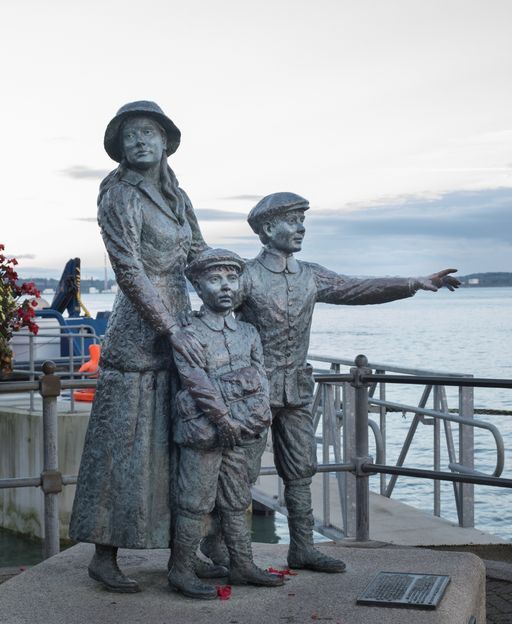
- Cobh Heritage Centre — Tells the emigrant story through life-size displays and original records. The Annie Moore statue on the quayside marks the spot near where the first person through Ellis Island once stood. She was a 17-year-old girl from Cork. Cobh is 25 km from Cork city and just 30 minutes by train.
- Derry’s Guildhall — Covers the Ulster emigrant story, including the Scots-Irish who left in the 18th century. The Free Derry Museum and the city walls add historical depth.
- PRONI, Belfast — The Public Record Office of Northern Ireland holds passenger records, estate papers, and church registers for northeast Ulster. It is open to the public and free to use.
How do I find out which Irish port my ancestors left from?
Start by searching the Ellis Island database (free, covers 1820–1957) or the Castle Garden records now hosted on FamilySearch (free, covers arrivals before 1892). The ship record often lists the port of departure, the last Irish address, or a relative’s name and location. If the port is not recorded, look up the ship’s route — Cobh vessels mainly served Munster, while Derry ships served Ulster.
What was Ireland’s biggest departure port?
Cobh — known as Queenstown from 1849 to 1920 — was Ireland’s largest departure port. Around 2.5 million people left from Cobh between 1848 and 1950. It served emigrants from Munster (Cork, Kerry, Limerick, Tipperary, Waterford, Clare) and was the Titanic’s last stop in April 1912.
Are Irish emigration passenger records free to search?
Yes — several large websites are completely free. The Ellis Island Foundation database has over 65 million New York arrival records (1820–1957). Pre-1892 Castle Garden arrival records are now searchable for free through FamilySearch. FamilySearch also has a large free Irish collection. The National Archives of Ireland offers free access to the 1901, 1911, and 1926 Irish census records. Ancestry.com and Findmypast are paid but both offer free trials.
Finding the port your ancestors left from is a small step. But it often opens a much bigger picture — confirming the county they came from, the ship they sailed on, and the records most likely to hold their names.
If your family has Cork, Kerry, or Clare roots, County Cork was one of the counties most affected by the Great Famine. Our free Irish Ancestral Heritage Guide includes townland maps and departure records for every county — to help you find the exact place your family called home.
☘️ Join 64,000+ Ireland Lovers
Every weekday morning, get Ireland’s hidden gems, local secrets, and travel inspiration — the kind you won’t find in any guidebook.
Subscribe free — enter your email:
📲 Know someone who’d love this? Share on WhatsApp →
Love more? Join 43,000 Scotland lovers → · Join 29,000 Italy lovers → · Join 7,000 France lovers →
Free forever · Unsubscribe anytime
Tours & experiences you might love


Powered by Viator. Some links are affiliate links — we may earn a small commission at no extra cost to you.
Secure Your Dream Irish Experience Before It’s Gone!
Planning a trip to Ireland? Don’t let sold-out tours or packed attractions spoil your journey. Iconic experiences like visiting the Cliffs of Moher, exploring the Rock of Cashel, or enjoying a guided walk through Ireland’s ancient past often sell out quickly—especially during peak travel seasons.

Booking in advance guarantees your place and ensures you can fully immerse yourself in the rich culture and breathtaking scenery without stress or disappointment. You’ll also free up time to explore Ireland’s hidden gems and savour those authentic moments that make your trip truly special.
Make the most of your journey—start planning today and secure those must-do experiences before they’re gone!