

If your family name is Walsh, Burke, O’Malley, Jordan, or Moran — there is a strong chance your ancestors came from County Mayo. For generations, this rugged county on Ireland’s western seaboard sent its sons and daughters across the Atlantic. This heritage journey is for those who want to trace their Mayo roots back to where it all began.
County Mayo and New York share one of the oldest and deepest bonds in Irish-American history. The Bronx, Woodside in Queens, and Yonkers all had large Mayo communities in the 19th and early 20th centuries. Many of those families came during or after the Great Famine. Some came with nothing but the clothes on their backs and the memory of a townland name.
Now, a century and a half later, their descendants are going back to find where it all began.
The Mayo-New York Connection
County Mayo lost more than 400,000 people during and after the Famine (1845–1852). Few counties in Ireland suffered as badly. The phrase “Mayo, God Help Us” emerged from those years — a dark saying that captured the scale of the devastation.
The county’s landscape still carries those marks. Ruined cottages stand on hillsides above Clew Bay. Deserted villages dot the slopes of Achill Island. You can walk through townlands where no one has lived since the 1840s.
Many who left never forgot the names of those places. Irish-American families in the Bronx spoke of Ballinrobe, Claremorris, Belmullet, and Ballyhaunis for generations. Some kept that memory alive through the Ancient Order of Hibernians or the Mayo Society of New York, which still holds its annual dinner to this day.
That thread has not broken. It just needs to be followed.
Before You Leave New York: Research First
The best heritage trips start at home. Before you book your flight, spend a few evenings gathering what you already know.
Write down everything you have:
- Your Mayo ancestor’s full name (and any spelling variants you’ve seen)
- Their approximate birth year and their parents’ names
- Any townland, parish, or county name you have heard mentioned in the family
- When they arrived in America and where they first settled
- Names of siblings who may have also emigrated — they often came in groups
Then check these resources before you travel:
Ellis Island records (1892–1954): Search at stevemorse.org for passenger manifests. These often list the “last residence” in Ireland — which may give you a townland or village name.
Castle Garden records (1855–1890): For earlier arrivals, the CastleGarden.org database covers pre-Ellis Island immigration into New York.
IrishGenealogy.ie: Free access to civil birth, marriage, and death records from 1845 onwards. If your ancestor was born in Mayo after 1864, there is likely a birth record here with their exact townland.
Griffith’s Valuation (1857): Search free at askaboutireland.ie. This land survey lists every householder and tenant in Ireland, with their exact townland. It is the most useful record for placing a family in a specific location in mid-19th-century Mayo.
The more information you bring, the more productive your time in Mayo will be. Even a single townland name can transform a heritage visit from a general tour into a personal pilgrimage.
☘️ Your Irish family has a story waiting to be found.
Discover where your Irish ancestors came from — their county, their name, their story. Our free step-by-step guide walks you through every record, DNA tool, and ancestry archive. No experience needed.
Claim Your Free Irish Ancestry Guide →Day 1: Arriving in Westport
Westport is the natural base for a Mayo heritage trip. It sits on Clew Bay, with Croagh Patrick rising above it and the bay’s scattering of small islands — local legend puts the count at 365, one for every day of the year — dotting the water below. It is also a town with history in its bones.
Your ancestors would have known Westport. Ships once sailed from Westport Quay to Liverpool and beyond, carrying emigrants who had decided — or been forced — to leave. The quayside is quiet today. Stand there for a moment and think about what that departure looked like in 1847.
The town itself was built as a planned estate town in the 18th century by architect Richard Cassels for the Browne family, later the Marquis of Sligo. Walk the tree-lined Mall beside the Carrowbeg River and you see the elegance that was built on the same land that witnessed so much suffering.
What to do on Day 1
- Walk the town and settle into your accommodation
- Visit Westport House, built on the site of the castle of Grace O’Malley — the Pirate Queen of Connacht who negotiated directly with Queen Elizabeth I
- Stop at Matt Molloy’s pub on Bridge Street — Molloy was the flautist in The Chieftains, and the music here is the real thing
- Visit Westport Quay in the early evening and look out at Clew Bay
Day 2: The Famine Trail
No heritage trip to Mayo is complete without standing at the National Famine Memorial at Murrisk.
The memorial, created by sculptor John Behan in 1997, depicts a coffin ship with skeletal figures clinging to its rigging. It stands on the shore of Clew Bay, with Croagh Patrick rising behind it. The mountain, the water, and the bronze ship together say everything about what happened here without needing a single word.
Your Mayo ancestors may have boarded vessels not far from this spot. They crossed the Atlantic on overcrowded ships, many of them already ill or malnourished before they set foot on board. One in five did not survive the crossing on the worst of these vessels — the so-called coffin ships.
Stand there. Let it land.
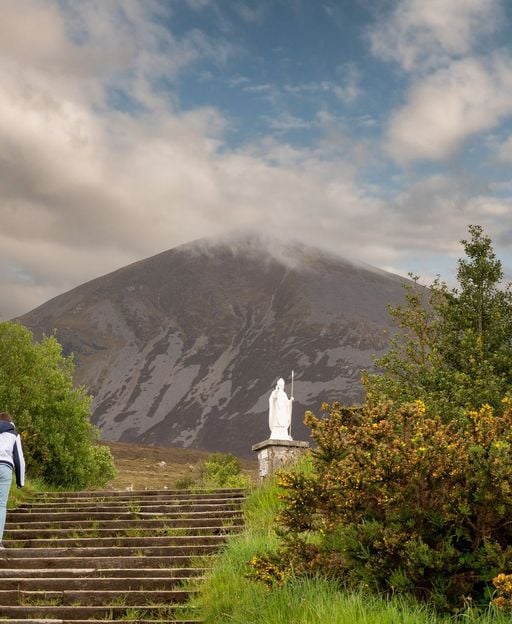
Behind the memorial, the pilgrim path leads up Croagh Patrick. You do not need to climb the full mountain. Even walking part of the lower path gives you something powerful. The view of Clew Bay from the lower slopes — the islands, the light on the water, the vast Atlantic silence — is the view your ancestors carried with them for the rest of their lives.
What to do on Day 2
- Visit the National Famine Memorial at Murrisk (early morning is quietest and most moving)
- Walk part of the Croagh Patrick pilgrim path — even 20 minutes up the mountain changes the scale of the view
- Drive the Louisburgh road toward Delphi — this is Famine country, empty and powerful
- Return to Westport for the evening
☘️ Enjoying this? 64,000 Ireland lovers get stories like this every week. Subscribe free →
Day 3: The Genealogy Quest in Castlebar
This is the day for research. Make it count.
Castlebar is the county town of Mayo, about 20 minutes east of Westport. The County Mayo Family History Research Centre is one of the best genealogy resources in Connacht for tracing Irish roots.
The centre holds indexes to:
- Griffith’s Valuation (1857) — lists every householder in Mayo with their exact townland
- Tithe Applotment Books (1823–1837) — records landholders before the Famine, useful for pre-1845 research
- Catholic parish registers — baptisms and marriages, some going back to the 1790s
- Civil birth, marriage, and death records from 1864 onwards
- Gravestone inscriptions from across the county
- Emigrant newspapers and early American records
Go early and be specific. Tell the researchers exactly what you know — your ancestor’s name, the approximate birth year, and any place name you have. The staff are experienced at narrowing a family down to a specific townland.
If your family name is one of the major Mayo surnames — Walsh, Burke, Browne, O’Malley, Gibbons, Jordan, Moran, Stanton, Flatley, or Durkan — the researchers can help you identify which part of the county your particular branch came from. The same surname often appears in dozens of townlands.
Practical tips for the research day
- Book an appointment in advance if possible
- Bring all your notes and any documents you already have
- Ask to see the townland maps — these help you see exactly where a family lived in the landscape
- Photograph everything you find — you will want to study it later
The National Museum of Ireland – Country Life at Turlough Park, just outside Castlebar, is also worth a visit. It holds one of the most important collections of 19th-century rural Irish artefacts in the country — tools, furniture, clothing, and objects from the world your ancestors lived in before they left.
See also: Irish Surnames of County Cork and Irish Surnames from County Galway for background on how Gaelic surnames work across Connacht.
Day 4: Knock and the Family Research Centre
Knock is known worldwide as a Marian shrine. In 1879, fifteen witnesses reported seeing an apparition on the gable wall of the parish church — Our Lady, St Joseph, and St John the Evangelist, with a lamb on an altar.
What is less often told is that 1879 was also a year of near-famine conditions in Mayo. The people who gathered at that gable wall were hungry and frightened. For Irish-American families with Catholic Mayo roots, Knock carries weight that goes beyond the religious. Many kept a prayer card to Our Lady of Knock on their wall for generations, passed down from the emigrant who brought it across the Atlantic.
The Knock Family Research Centre operates beside the shrine and offers free genealogy advice. Expert volunteers help visitors search Catholic parish registers, civil records, and local newspaper archives. The centre covers all of County Mayo and is particularly strong for east Mayo — the Claremorris, Knock, and Ballinrobe area, which sent thousands of emigrants to New York in the late 19th century.
What to do on Day 4
- Arrive at Knock Shrine early and walk the basilica grounds
- Visit the Family Research Centre (check opening hours before travelling)
- Take time at the original apparition chapel — it is small and quiet
- Drive through Claremorris, a major railway junction that carried generations of emigrants to Cobh (Queenstown) and the ships to America
If you have already discovered a specific townland or parish from your research in Castlebar, consider driving out to find it on Day 4. Many visitors discover that the family’s townland is a short drive from Knock. Walking the actual ground where your ancestors lived is unlike anything else on a heritage trip.
Day 5: Achill Island and the Atlantic
Achill Island is the largest island in Ireland, connected to the mainland by a bridge. It sits at the western edge of County Mayo, exposed to the full force of the Atlantic. Nothing prepares you for the scale of it.
The island carries one of the most haunting diaspora stories in all of Ireland. Each summer, young Achill men travelled to Scotland to work the potato harvest — seasonal labourers known as spalpeens. In June 1894, thirty-two of them drowned when their overloaded hooker boat capsized returning across Clew Bay.
The tragedy fulfilled a centuries-old prophecy. In the 17th century, the Mayo seer Brian Rua O Cearbháin foretold that carriages on iron wheels, breathing smoke and fire, would one day carry coffins to Achill — on both the railway’s first journey and its last. The first train onto the island in 1894 carried the coffins of the thirty-two drowned. Decades later, in 1937, the closed line was reopened one final time to bring home the bodies of ten young Achill workers killed in a bothy fire at Kirkintilloch, Scotland — the line’s last journey, fulfilling the prophecy’s second half.
Walk the Achill Diaspora Trail if time allows. It passes through the island’s landscape and tells the story of the people who lived and left here. Visit Slievemore Deserted Village, high on the mountain above the island’s northern shore. More than 80 ruined cottages stand there — a community that was once alive and is now silent. Nobody knows exactly when the last family left. Walking through it gives you something hard to put into words.
On the last day of your trip, drive out to Keem Bay and stand at the cliff edge. Look west. On a clear day, there is nothing between you and New York but 3,000 miles of Atlantic. Your ancestors looked at that same horizon. Some of them never saw Mayo again.
You came back for them.
Essential Resources for Your Mayo Research
Before you leave Ireland, note down these resources and take any reference numbers or copies of documents you have found.
In County Mayo
- County Mayo Family History Research Centre, Castlebar — mayogenealogy.ie
- Knock Family Research Centre, Knock — knock-shrine.ie
- National Museum of Ireland – Country Life, Turlough Park, Castlebar (Famine-era artefacts and rural life)
Online (free)
- IrishGenealogy.ie — civil birth, marriage, and death records from 1864
- AskAboutIreland.ie — Griffith’s Valuation (1857), fully searchable
- FamilySearch.org — free Mayo parish records and civil records
- Ancestry.com — Tithe Applotment Books, passenger lists, and US naturalisation records
Common Mayo surnames by area
- North Mayo: Durkan, Lavelle, Stanton, Flatley, Gallagher
- East Mayo: Gibbons, Jordan, Moran, Conway, Hastings
- South Mayo: Burke, Walsh, Browne, O’Malley, Flannery
- West Mayo / Achill: Lavelle, O’Malley, Moran, McNamara, Tighe
For more on Irish surname origins, see our guides to Irish surnames from County Mayo, Irish surnames from Cork, and how to plan a heritage trip to your ancestral county.
Frequently Asked Questions
What are the most common surnames in County Mayo?
The most common Mayo surnames include Walsh (Breathnach), Burke (de Búrca), Moran (Ó Moráin), O’Malley (Ó Máille), and Gibbons (Mac Giobúin). Other common names are Jordan, Stanton, Flatley, Lavelle, Durkan, Conway, Flannery, and Browne. Each surname tends to cluster in a specific part of the county, which can help narrow your research to the right barony and parish.
Where is the best place to research Mayo ancestry?
The County Mayo Family History Research Centre in Castlebar is the primary genealogy resource for the county. The Knock Family Research Centre offers strong help for east Mayo families. Online, IrishGenealogy.ie gives free access to civil birth, marriage, and death records. AskAboutIreland.ie has Griffith’s Valuation (1857) searchable by surname and county — the most useful record for identifying a specific Mayo townland.
What is the best time to visit County Mayo for a heritage trip?
May to September is the best window for most visitors. Days are long, heritage centres are fully staffed, and the landscape is green. September is often ideal — quieter than summer, still good weather, and the light in the west of Ireland in early autumn is extraordinary. Avoid the last Sunday in July (Reek Sunday on Croagh Patrick) if you want a quiet pilgrimage — tens of thousands of people climb the mountain that day.
How long should I spend in County Mayo on a heritage trip?
Plan for at least five days. Two days for heritage and genealogy centres, one day on the Famine Trail, one day for Achill Island, and one day to explore the county town and any townlands you have identified through research. If you find a significant lead in the archives, build in an extra day — some heritage visitors extend their stay to visit the exact field where their family’s cottage once stood.
Did my Mayo ancestors leave during the Great Famine?
Possibly. Mayo was one of the hardest-hit counties during the Famine (1845–1852), and more than 400,000 people left the county during and after that period. Many sailed from Westport or made their way to Cobh (Queenstown) in Cork. If your Mayo ancestor arrived in the United States between 1845 and 1880, the Famine was very likely a factor in their departure — either directly, or because the economic collapse it caused continued for decades after the worst years ended.
☘️ Join 64,000+ Ireland Lovers
Every Friday, get Ireland’s hidden gems, local secrets, and travel inspiration — the kind you won’t find in any guidebook.
Subscribe free — enter your email:
Already subscribed? Download your free Ireland guide (PDF)
📲 Know someone who’d love this? Share on WhatsApp →
Love more? Join 43,000 Scotland lovers → · Join 29,000 Italy lovers → · Join 7,000 France lovers →
Free forever · One email per week · Unsubscribe anytime
Tours & experiences you might love


Powered by Viator. Some links are affiliate links — we may earn a small commission at no extra cost to you.
Secure Your Dream Irish Experience Before It’s Gone!
Planning a trip to Ireland? Don’t let sold-out tours or packed attractions spoil your journey. Iconic experiences like visiting the Cliffs of Moher, exploring the Rock of Cashel, or enjoying a guided walk through Ireland’s ancient past often sell out quickly—especially during peak travel seasons.

Booking in advance guarantees your place and ensures you can fully immerse yourself in the rich culture and breathtaking scenery without stress or disappointment. You’ll also free up time to explore Ireland’s hidden gems and savour those authentic moments that make your trip truly special.
Make the most of your journey—start planning today and secure those must-do experiences before they’re gone!