

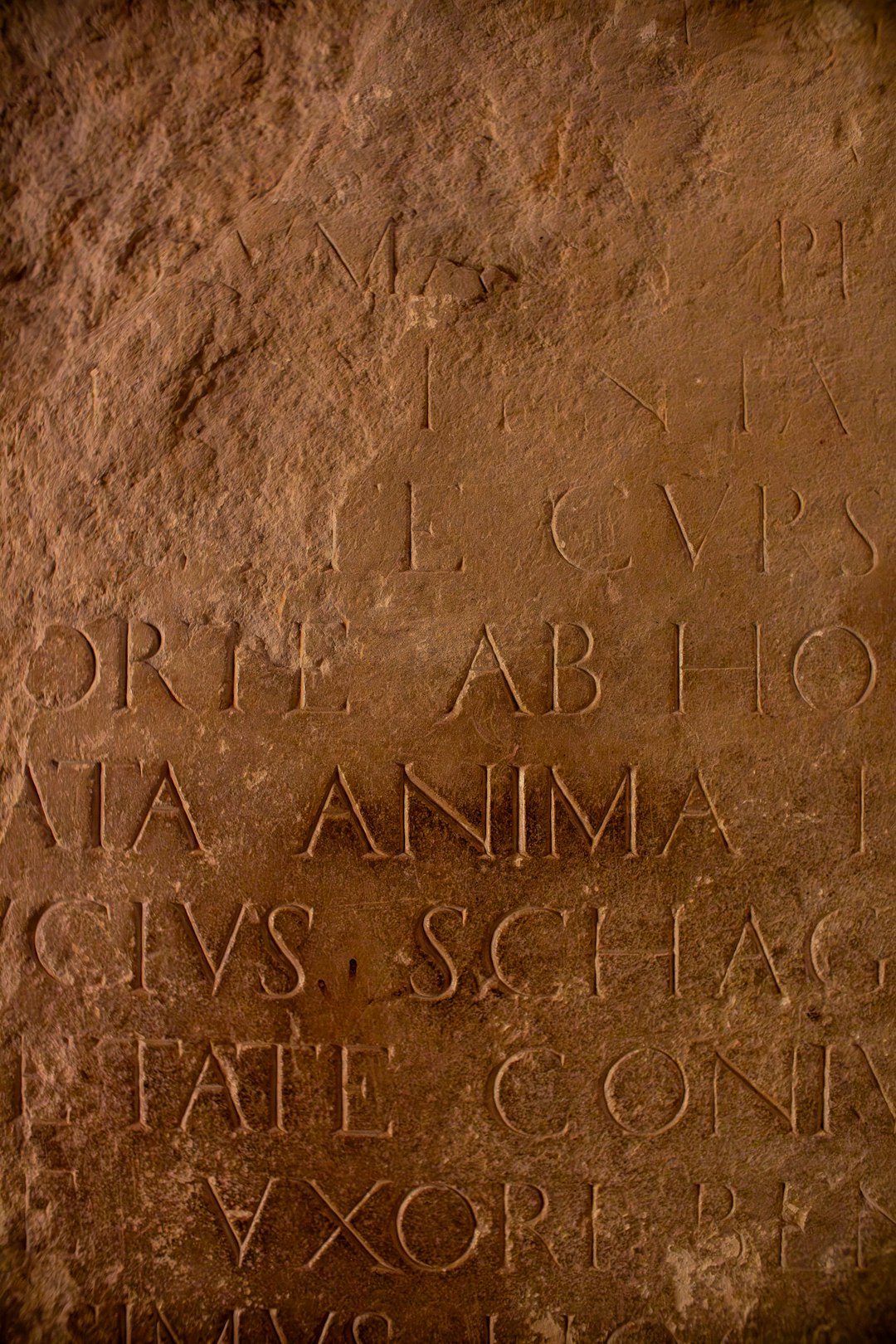
Scattered across Ireland’s roadsides, fields, and museum corridors are stones that hold a secret. Carved with rows of notches and lines along their edges, they’re easy to walk past without a second glance. But those marks are words — written in the oldest surviving form of the Irish language, carved into stone over 1,500 years ago.
The Alphabet That Came Before Christianity
Before the first monastery rose on an Irish hillside, before Latin crossed the sea with the first missionaries, Ireland had its own system of writing. It was called ogham — pronounced OH-um — and it is the earliest form of written Irish ever found.
The alphabet dates back to at least the 4th century AD, and possibly earlier. It consists of 20 letters, each made from groups of straight lines or notches cut across a central stemline. That stemline was usually the edge of a standing stone. You read from the bottom upwards, like text climbing a ladder. To someone who doesn’t know it’s there, an ogham stone can look like nothing more than a worn, scratched rock.
The alphabet is thought to take its name from Ogma, the Celtic god of eloquence and learning. Some scholars believe early Irish scholars developed ogham deliberately — partly to create a native system distinct from Latin, and partly to record things that outsiders weren’t meant to read easily. Whether it was designed as a code or simply as a practical script, ogham succeeded in doing something remarkable: it outlasted almost every other aspect of the world that created it.
Who Carved Them — and What Do They Say?
Most ogham inscriptions are memorials. They record names — usually in the form “X, son of Y” or “X, son of Y, grandson of Z.” They marked territory, honoured ancestry, and identified burial sites. A chieftain might have a stone raised at the edge of his land. A family might mark a grave with their ancestor’s name carved in stone so it could not be taken away.
Around 400 ogham stones survive today. The highest concentration is in County Kerry, with significant numbers in Cork, Waterford, and Kilkenny. But ogham has been found far beyond Ireland — in Wales, Scotland, the Isle of Man, and even Devon and Cornwall in England. This spread is evidence of how widely Irish culture moved during the early medieval period, carried by settlers, traders, and travellers across the Celtic world.
The inscriptions themselves may look simple. But hidden within names and genealogies are remarkable clues. Linguists have used ogham stones to trace the evolution of the Irish language across centuries. They have mapped ancient tribal territories, identified family connections across wide distances, and tracked the movement of people long before census records or parish registers existed. Each stone is both a gravestone and a document.
The Druidic Dimension
The romantic image of ogham as a Druidic secret language isn’t entirely without foundation. Medieval Irish manuscripts describe dozens of variations on the base ogham alphabet — “tree ogham,” “bird ogham,” “colour ogham,” “river ogham” — elaborate systems that replaced the written marks with natural objects to encode messages.
Under tree ogham, each letter corresponds to a specific tree: birch, rowan, ash, alder, willow, and so on. A Druid sending a message might snap a branch in a deliberate pattern. A traveller might read meaning in the arrangement of stones beside a path. The base alphabet was a key to a much wider symbolic language, one that used the natural world itself as its medium.
The scholarly text known as the Auraicept na n-Éces — the Scholars’ Primer — describes ogham’s origins in mythological terms, claiming the first ogham message was carved to warn the god Lug of a danger to his wife. Whatever one makes of the legend, the tradition of ogham as a language of power, knowledge, and protection runs deep in Irish cultural memory. It was never just a writing system. It was a way of seeing.
☘️ Enjoying this? 64,000+ Ireland lovers get stories like this every week. Subscribe free →
Is Ogham a Druid Alphabet?
Ogham is often called a “druid alphabet” because medieval Irish tradition credited its invention to druidic scholarship — the learned class of poets, judges, and ritual specialists in pre-Christian Ireland. The Auraicept na n-Éces ties ogham’s origin directly to the god Lug and to the secretive, symbolic tree-alphabets that only trained druids and filid (poet-scholars) were meant to read fluently. In that sense, ogham was never designed to be casually deciphered by outsiders: it was a script built for an educated caste that guarded its own knowledge.
That doesn’t mean every ogham stone is a druidic artifact, though. Most surviving inscriptions are straightforward name-memorials rather than magical texts — it’s the origin story, not the everyday use, that carries the druidic association. If you want to see the sheer range of what survives, our guide to the hundreds of ogham stones scattered across Ireland covers the practical, travel-focused side of the story, while our piece on what ogham inscriptions actually say breaks down the memorial name-formulas letter by letter. And if you’ve ever driven past one of the ogham stones most visitors walk straight past, now you know why it might be worth stopping.
How to Read an Ogham Stone
The ogham alphabet has 20 original letters, each carved as a set of notches or lines relative to a central stemline. They fall into four groups of five — lines on the right, lines on the left, diagonal lines crossing, and lines crossing straight through. Later additions called the Forfeda brought in extra letters as Irish pronunciation developed and new sounds arrived with Christianity and Latin influence.
The key to reading ogham is finding the edge of the stone. That edge is the stemline. Start at the base and work upward. Count the notches on each side. One notch on the right = B. Two notches on the right = L. Five notches on the left = Q. Cross strokes give you the vowels and some consonants. It takes time to learn, but once you can do it, every ogham stone becomes readable.
If you visit a stone in a field or a museum, try this: place your finger at the base of the inscribed edge and trace upwards. You’re following the same path a scholar followed 1,500 years ago when they read this inscription aloud. The stone hasn’t changed. Only the world around it has.
Where to Find Ogham Stones in Ireland
County Kerry has the largest collection of ogham stones anywhere in the world. The Dingle Peninsula has several accessible examples, and the Ogham Stones display at the Ballyvourney Heritage Centre in Cork is worth a visit. The National Museum of Ireland in Dublin holds important stones that were moved for protection. Many more remain in the landscape where they were first raised.
For atmosphere, nothing compares to finding a stone still standing in its original location. Dunmore Head in Kerry, Knocknagree in Cork, and the Clonmacnoise monastic site in Offaly all have stones worth seeking out. The ogham stone at Oweynagat — the Cave of Cats in County Roscommon — stands at the entrance to one of Ireland’s most sacred prehistoric sites. Oweynagat was associated with Samhain and the passage to the otherworld. The ogham inscription there feels fitting: words carved at the threshold between two worlds.
If you’re planning a trip to Ireland and want to explore its ancient past, our Ireland trip planning guide is the best place to start. You might also enjoy reading about Ireland’s mysterious stone circles, which share the same dramatic landscape as many ogham stones and belong to the same ancient world.
Ogham Today — Ancient Letters in a Modern World
Ogham hasn’t stayed buried in the past. It appears today on jewellery, road signs, tattoos, and craft products sold across Ireland. Ogham name rings — silver bands engraved with your name in the old alphabet — are among the most popular Irish gifts. Celtic spirituality movements have adopted ogham as a divination system, using carved staves in a way similar to Norse rune reading.
There’s something deeply appealing about an alphabet born from the natural world. Each letter carries the name of a tree. Each tree carried its own meaning in early Irish culture. To write in ogham was to write in a language where ash meant strength, birch meant new beginnings, and yew meant death and renewal. That depth doesn’t disappear just because the writing system fell out of everyday use.
For people with Irish heritage, discovering ogham can feel like finding something real — a direct thread back to the people who first named this island, who cut their words into stone so they would last. And last they have. When you trace your finger along the edge of an ogham stone, you are touching a message that was carved before England had a king, before Dublin had walls, before Ireland had a name that the rest of the world recognised.
Those notches aren’t decoration. They’re someone’s name. They carved it so it would not be forgotten.
It hasn’t been.
Frequently Asked Questions About Ogham
What is the ogham alphabet?
Ogham is Ireland’s oldest written language, an alphabet of 20 letters made from notches and lines carved along the edge of a standing stone, dating to at least the 4th century AD.
Is ogham a druid alphabet?
Medieval Irish tradition linked ogham to druidic learning and myth, including a legend that the first ogham message warned the god Lug of danger — though most surviving stones are practical name-memorials rather than magical texts.
Where can I see ogham stones in Ireland?
County Kerry has the largest concentration, especially the Dingle Peninsula, with more at the National Museum of Ireland in Dublin and sites in Cork, Waterford, and Kilkenny.
☘️ You Might Also Love
☘️ Want More Hidden Ireland?
Join 64,000+ subscribers who discover Ireland’s best-kept secrets every week.
Subscribe Free — Join the Community →
Free forever · Unsubscribe anytime · No spam
📥 Free Download: Ireland Travel Planning Guide
Our most popular resource — itineraries, insider tips, and the 50 places you must not miss.
Tours & experiences you might love


Powered by Viator. Some links are affiliate links — we may earn a small commission at no extra cost to you.
Secure Your Dream Irish Experience Before It’s Gone!
Planning a trip to Ireland? Don’t let sold-out tours or packed attractions spoil your journey. Iconic experiences like visiting the Cliffs of Moher, exploring the Rock of Cashel, or enjoying a guided walk through Ireland’s ancient past often sell out quickly—especially during peak travel seasons.

Booking in advance guarantees your place and ensures you can fully immerse yourself in the rich culture and breathtaking scenery without stress or disappointment. You’ll also free up time to explore Ireland’s hidden gems and savour those authentic moments that make your trip truly special.
Make the most of your journey—start planning today and secure those must-do experiences before they’re gone!