

Twice a year, at sunrise on the winter solstice, the last rays of light fall through a carefully placed gap in a ring of standing stones in County Cork. The alignment is precise to the degree. It has been this way for over 3,000 years.
Nobody built a ring of seventeen stones like that by accident.
Scattered Across the Landscape, Waiting
More than a hundred stone circles survive in Ireland today. Most are modest — a dozen or so stones, waist-high, arranged in a rough ring in the middle of a field. Cows graze around them. Cars pass without stopping.
But look closely at their positions and something remarkable emerges. Many of these circles align with the movement of the sun or moon at specific moments in the year. They were clocks, calendars, and cathedrals, all constructed from stone.
The builders left no writing behind. No record of who stood inside these circles, or what was said.
The Circle That Speaks to the Sun
The Drombeg Stone Circle in County Cork is perhaps the most famous. Seventeen stones stand in a near-perfect ring on a hillside just outside the village of Glandore. At the winter solstice — the shortest day of the year — the setting sun aligns exactly with a notch formed by two of the recumbent stones.
This was not decoration. To people entirely dependent on the seasons for food, warmth, and survival, the moment the sun began its return journey north was the most important event of the year. They marked it in stone so that it could never be missed.
The Kenmare Stone Circle in County Kerry is the largest stone circle in the south-west of Ireland, with fifteen stones encircling a central boulder burial. Even now, locals refer to it simply as “the circle” — as if no further explanation is needed.
The Circle That Stops People Mid-Breath
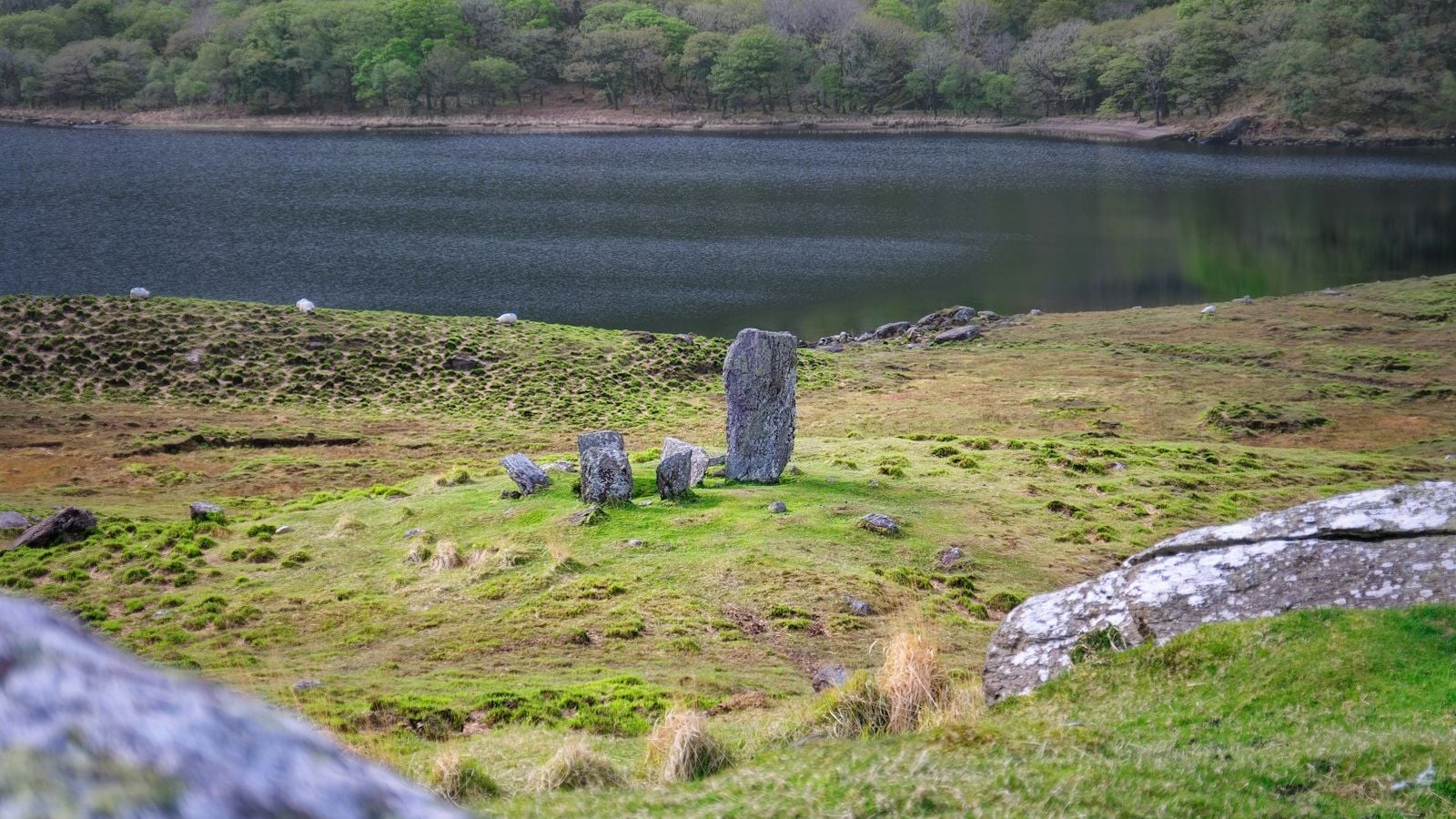
The Uragh Stone Circle on the Beara Peninsula offers one of the most arresting sights in the country. Five standing stones sit on the edge of Lough Inchiquin, mountains reflected in the water behind them. Ancient and composed, it has the feeling of a place that knows it will outlast everything around it.
The Beara Peninsula itself is one of Ireland’s least-visited corners, a place where the old landscape has changed very little. If you are planning a visit, the circle is one of the most extraordinary places to sit in silence anywhere in Ireland — you can find it along the Ring of Beara route here.
What Really Happened Inside Them
Archaeologists have found evidence of cremated remains near some stone circles. Others contained ceremonial deposits — pottery, animal bones, charcoal. Some appear to have been gathering places for communities spread across a wide area.
The honest answer is: nobody is entirely certain what they were for.
What we do know is that these places were central to the lives of the communities that built them. Some stones were transported miles from their quarry source. The people who moved them clearly believed the destination was worth the journey.
Why Locals Never Stopped Believing
Long after the Bronze Age cultures that built the circles had faded, the stones remained part of the landscape — and the imagination. In Irish folklore, stone circles were often associated with the fairy world, places where the boundary between worlds was thin and time moved differently.
Farmers left them undisturbed for reasons that were never entirely practical. Many landowners in Ireland will not plough near a standing stone, following an instinct that runs deeper than superstition.
The same quiet reverence shows up around Ireland’s ogham stones and ancient carved monuments — a sense that the land holds memory that belongs to everyone, and that it is not yours to disturb.
Finding the Circles Today
Ireland has stone circles in almost every county, from the low-lying rings of Cork and Kerry to the Beltany Stone Circle in County Donegal, perched on a hilltop with sweeping views across the surrounding countryside. Many can be visited with no entry fee, no visitor centre, no interpretation board.
You arrive in a field, stand at the edge of a ring of stones, and feel the distance between you and the people who placed them there begin to collapse.
It is one of the genuinely uncommon experiences Ireland offers. The stones have been there for thousands of years. They will be there long after you leave.
If you are ready to find the Ireland that still carries all of this quietly inside it, start planning your visit here.
That alignment. That silence. Somehow, it still speaks.
Love Ireland? So do 65,000 of us.
Join the Love Ireland newsletter — free stories of Irish heritage, hidden gems, and the magic of the Emerald Isle delivered to your inbox.
☘️ Want More Hidden Ireland?
Join 64,000+ subscribers who discover Ireland’s best-kept secrets every week.
Subscribe Free — Join the Community →
Free forever · Unsubscribe anytime · No spam
📥 Free Download: Ireland Travel Planning Guide
Our most popular resource — itineraries, insider tips, and the 50 places you must not miss.
Tours & experiences you might love


Powered by Viator. Some links are affiliate links — we may earn a small commission at no extra cost to you.
Secure Your Dream Irish Experience Before It’s Gone!
Planning a trip to Ireland? Don’t let sold-out tours or packed attractions spoil your journey. Iconic experiences like visiting the Cliffs of Moher, exploring the Rock of Cashel, or enjoying a guided walk through Ireland’s ancient past often sell out quickly—especially during peak travel seasons.

Booking in advance guarantees your place and ensures you can fully immerse yourself in the rich culture and breathtaking scenery without stress or disappointment. You’ll also free up time to explore Ireland’s hidden gems and savour those authentic moments that make your trip truly special.
Make the most of your journey—start planning today and secure those must-do experiences before they’re gone!