

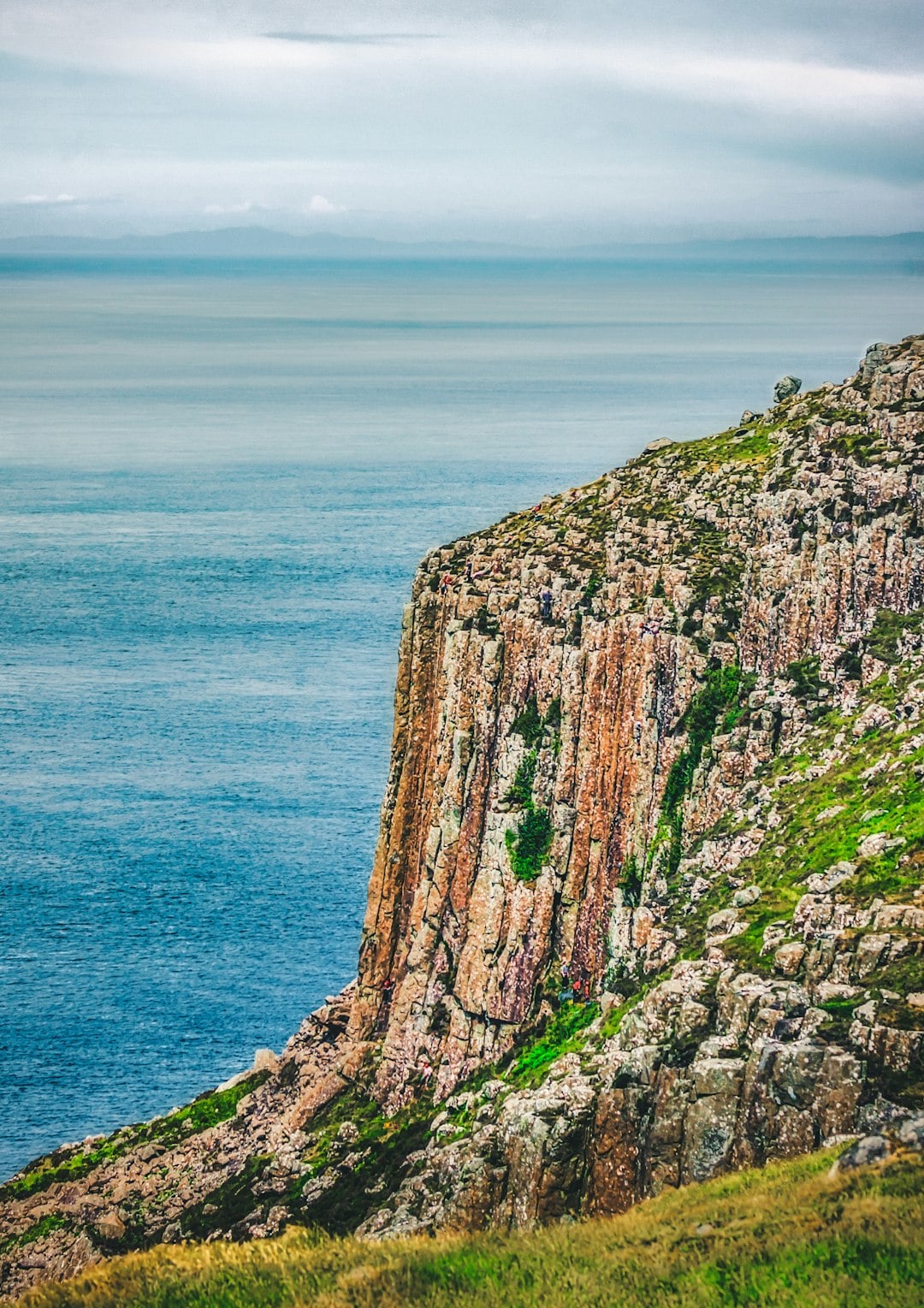
County Antrim sits at the northern tip of Ireland. Scotland is so close you can see it from the clifftops on a clear day. That nearness shaped Antrim’s surnames more than anything else. Gaelic clans crossed the water in both directions for centuries. Then the Ulster Plantation of 1610 brought thousands of Scottish settlers. The result is a county with a surname heritage unlike anywhere else on the island. Irish surnames from Antrim carry stories that reach from ancient sea-kingdoms to the Famine ships — and all the way to America.
Try our free Irish ancestry tools ☘️
Have an Irish surname? Find your ancestral Irish county — type your surname and we’ll trace it back to the county where it originated, with a short note on the family’s history.
Curious about your first name in Irish too? Your Irish Name translates first names to their Gaelic equivalent — with the meaning and the pronunciation.
Irish Surnames from Antrim: A Kingdom Between Two Shores
County Antrim is in Northern Ireland. It was once part of the ancient kingdom of Dál Riata. This kingdom crossed both sides of the North Channel. It covered northeast Ireland and southwest Scotland at the same time. For centuries, Irish and Scottish families shared this sea-kingdom. They moved freely between both shores.
Watch: Do You Qualify for an Irish Passport?
Tracing your Irish family? If one of your grandparents was born in Ireland, you may be able to become an Irish citizen. This 14-minute guide explains who qualifies, what it costs and how long it takes. Thinking of making the move? Get the free Moving to Ireland checklist.
The MacDonnells came from Kintyre in Scotland. They settled in the Glens of Antrim in the fifteenth century. Within a hundred years, they were the most powerful family in the county. Their story is the story of Antrim’s Gaelic heritage.
The Ulster Plantation changed everything. The English Crown took Ulster land and gave it to Scottish and English settlers. Antrim received the largest Scottish settler population of any Ulster county. Many of today’s Antrim surnames come directly from that plantation wave.
If you are starting your family research, our guide to tracing your Irish ancestry covers every key archive from parish records to DNA testing.
MacDonnell – Mac Domhnaill: Lords of the Glens
No surname is more linked to County Antrim than MacDonnell. The Gaelic form is Mac Domhnaill — “son of Domhnall.” The personal name Domhnall means “world-mighty.”
The MacDonnells were not originally from Ireland. They came from Kintyre in Scotland. They arrived in the Glens of Antrim in the early fifteenth century. By 1500, they controlled the entire Glens region. By 1550, they were the dominant Gaelic power in the north.
Their stronghold was Dunluce Castle. It sits on a sheer cliff above the Atlantic, west of Bushmills. The ruins still stand today. They are one of the most dramatic sights in all of Ireland.
The MacDonnells clashed repeatedly with the English Crown. Queen Elizabeth I sent forces against them more than once. Sorley Boy MacDonnell became a symbol of Gaelic resistance in the north. His name appears in English records as “insolent” and “troublesome.” To the Gaelic Irish, he was a hero who never surrendered.
O’Neill – Ó Néill: Ulster’s Royal Name
O’Neill is one of the most powerful names in Irish history. The Gaelic form is Ó Néill — “descendant of Niall.” The personal name likely means “champion.”
The O’Neills were the royal family of Ulster. Their heartland was County Tyrone. But their power reached into Antrim for centuries. Hugh O’Neill, the Great Earl, led the last major Gaelic resistance to English rule. He left Ireland in 1607 in the Flight of the Earls. That departure ended the old Gaelic order in Ulster.
If your name is O’Neill, Neill, or Neil, an Antrim branch may connect you to this ancient royal line.
McNeill, MacAuley, and O’Lynn
McNeill comes from the Gaelic Mac Néill — “son of Niall.” The McNeills of Antrim were closely tied to the MacDonnells. They came from Barra and Kintyre in Scotland. Like the MacDonnells, they were part of the Gaelic world that crossed both sides of the North Channel.
MacAuley is the anglicised form of Mac Amhlaoibh — “son of Amhlaoibh.” The personal name is the Irish form of the Norse name Óláfr. It means “ancestor’s relic.” The MacAuleys were a sept based in east Antrim. They were there before the MacDonnells arrived and before the plantation settlers came.
O’Lynn comes from the Gaelic Ó Floinn — “descendant of Flann.” Flann means “red” or “ruddy.” The O’Lynns were part of the ancient Dál Fiatach people of northeast Ulster. Their territory covered much of south Antrim and north Down. The name is still common in Belfast and its surrounds today.
☘️ Enjoying this? 64,000 Ireland lovers get stories like this every week.
Thinking about it for retirement?
If you’ve started thinking seriously about retiring there, our complete our full Retire in Ireland guide covers the visa, healthcare, cost-of-living, and the regions worth shortlisting.
Subscribe free →
Boyd, Stewart, and Agnew – The Planter Heritage
The Ulster Plantation of 1610 brought thousands of Scottish settlers to Antrim. Their surnames are now as much a part of the county as the old Gaelic names.
Boyd is a Scottish surname that came with the plantation. The origin is disputed. Some link it to Bute Island off the Ayrshire coast. Boyd families settled across north Antrim. They became established within a generation.
Stewart (also Stuart) came from Ayrshire and Renfrewshire in Scotland. The name means “steward” — it was an administrative title before it became a surname. Stewarts arrived in large numbers during the plantation years. They settled across mid and north Antrim.
Agnew has a Norman-French origin. The name comes from d’Agneaux, meaning “of the lambs.” Agnews came to Scotland from Normandy via England. They then crossed to Ulster during the plantation. The name is common around the Larne area today.
These planter surnames are as Irish as any other Antrim name now. Families with these names have lived here for over four hundred years. That makes them part of this county’s heritage story.
How Antrim Surnames Crossed the Atlantic
County Antrim sent huge numbers of emigrants to North America. Many left during the eighteenth century. These were often Presbyterian settlers — the Scots-Irish — who had come to Ulster from Scotland just one or two generations before.
Between 1717 and 1775, an estimated 200,000 Ulster-Scots crossed to North America. They settled in Pennsylvania, Virginia, and the Carolinas. They pushed west into the Appalachian Mountains. Presidents Andrew Jackson, James Buchanan, and Woodrow Wilson all had Ulster-Scots roots.
The Famine of 1845 to 1852 brought a second wave. Antrim’s Gaelic families left in large numbers. MacDonnells, MacAuleys, and O’Lynns joined the great emigration to Boston, New York, and Philadelphia.
If you carry an Antrim name in America, your family may trace to the eighteenth-century Presbyterian migration or to the Famine years. Our Irish surnames from Donegal guide covers similar Ulster emigration patterns from the neighbouring county.
How to Trace Your Antrim Ancestry
County Antrim has strong records for both its Gaelic and planter populations. These are the key sources to use.
Public Record Office of Northern Ireland (PRONI)
PRONI in Belfast is the main archive for Northern Ireland. It holds estate records, church registers, and civil registration data. Many Antrim records survived the 1922 fire at the Dublin Public Record Office. Northern Ireland was a separate jurisdiction by then. The PRONI catalogue is searchable online at nidirect.gov.uk.
Griffith’s Valuation and the Census
Griffith’s Valuation from the 1850s is free to search at askaboutireland.ie. The 1901 and 1911 census records are at census.nationalarchives.ie. Both cover every Antrim townland in detail. Start with the townland your family came from if you know it.
Antrim Heritage Centres
Belfast Central Library has an excellent Irish and Local Studies collection. The Glens of Antrim Historical Society holds local records for the nine Glens. If your family came from the Glens, this society is a strong starting point.
Our heritage trip planning guide covers how to find your ancestral townland and what to do when you arrive. Our 7-day Irish ancestry itinerary gives a full framework for visiting heritage sites across Ireland.
Where to Visit in Antrim to Connect with Your Heritage
Dunluce Castle. The MacDonnell stronghold sits on a cliff west of Bushmills. The ruins are dramatic. They occupy a sea stack with a sheer drop to the Atlantic on three sides. This was the centre of MacDonnell power for two centuries. Historic Environment NI manages access to the site.
The Glens of Antrim. Nine glacial valleys run from the Antrim Plateau to the coast. The Glens are where MacDonnell and McNeill power was strongest. The coastal villages of Cushendall, Cushendun, and Glenarm are unchanged from a century ago.
Carrickfergus Castle. One of the best-preserved Norman castles in Ireland. It sits on the shore of Belfast Lough. The O’Neills besieged it more than once. It is open to the public and free to enter.
Ulster American Folk Park. Near Omagh in County Tyrone, this open-air museum tells the story of Ulster-Scots emigration to North America. It has original cottages, a replica quayside, and ship exhibits. It is essential for tracing Scots-Irish roots.
Explore more of our Irish surnames series — covering Cork, Galway, Kerry, Dublin, Clare, Mayo, Donegal, Tipperary, Limerick, Waterford, Wexford, Kilkenny, Sligo, and Roscommon. Each county has its own story waiting to be found.
Frequently Asked Questions About Antrim Surnames
What are the most common Irish surnames from County Antrim?
County Antrim has a mix of Gaelic and planter surnames. The most common Gaelic names include MacDonnell, O’Neill, MacAuley, McNeill, and O’Lynn. Planter surnames like Boyd, Stewart, and Agnew are also deeply rooted in the county. Belfast’s industrial growth drew families from across Ulster, so Antrim records are very mixed compared to western counties.
What does MacDonnell mean in Irish?
MacDonnell comes from the Gaelic Mac Domhnaill — “son of Domhnall.” The personal name means “world-mighty.” The MacDonnells came from Kintyre in Scotland and settled in the Glens of Antrim in the early fifteenth century. They built Dunluce Castle and ruled the Glens for over a century.
What is the difference between Antrim Gaelic surnames and planter surnames?
Gaelic surnames in Antrim start with “Mac” or “O” — they are Gaelic patronymics. Planter surnames like Boyd, Stewart, Agnew, and Dunlop came with Scottish and English settlers from 1610 onwards. Both groups have lived in Antrim for many generations now. Many planter families had Gaelic ancestors in Scotland, so the boundary between the two groups was never as clear as it seemed.
Where can I trace my County Antrim ancestry?
Start with the Public Record Office of Northern Ireland (PRONI) in Belfast. It holds church registers, estate records, and civil registration data. Online, use nidirect.gov.uk for PRONI records, askaboutireland.ie for Griffith’s Valuation, and census.nationalarchives.ie for the 1901 and 1911 census returns. The Glens of Antrim Historical Society assists with research in the Glens area.
☘️ Join 64,000+ Ireland Lovers
Every Friday, get Ireland’s hidden gems, local secrets, and travel inspiration — the kind you won’t find in any guidebook.
Subscribe free — enter your email:
📲 Know someone who’d love this? Share on WhatsApp →
Free forever · · Unsubscribe anytime
Tours & experiences you might love


Powered by Viator. Some links are affiliate links — we may earn a small commission at no extra cost to you.
Secure Your Dream Irish Experience Before It’s Gone!
Planning a trip to Ireland? Don’t let sold-out tours or packed attractions spoil your journey. Iconic experiences like visiting the Cliffs of Moher, exploring the Rock of Cashel, or enjoying a guided walk through Ireland’s ancient past often sell out quickly—especially during peak travel seasons.

Booking in advance guarantees your place and ensures you can fully immerse yourself in the rich culture and breathtaking scenery without stress or disappointment. You’ll also free up time to explore Ireland’s hidden gems and savour those authentic moments that make your trip truly special.
Make the most of your journey—start planning today and secure those must-do experiences before they’re gone!
Subscribe Free