

You have almost certainly walked past one without knowing. Standing in a field, propped against a church wall, or half-buried in a hillside, Ireland’s Ogham stones are the oldest surviving pieces of writing in the Irish language — and most visitors never give them a second glance.
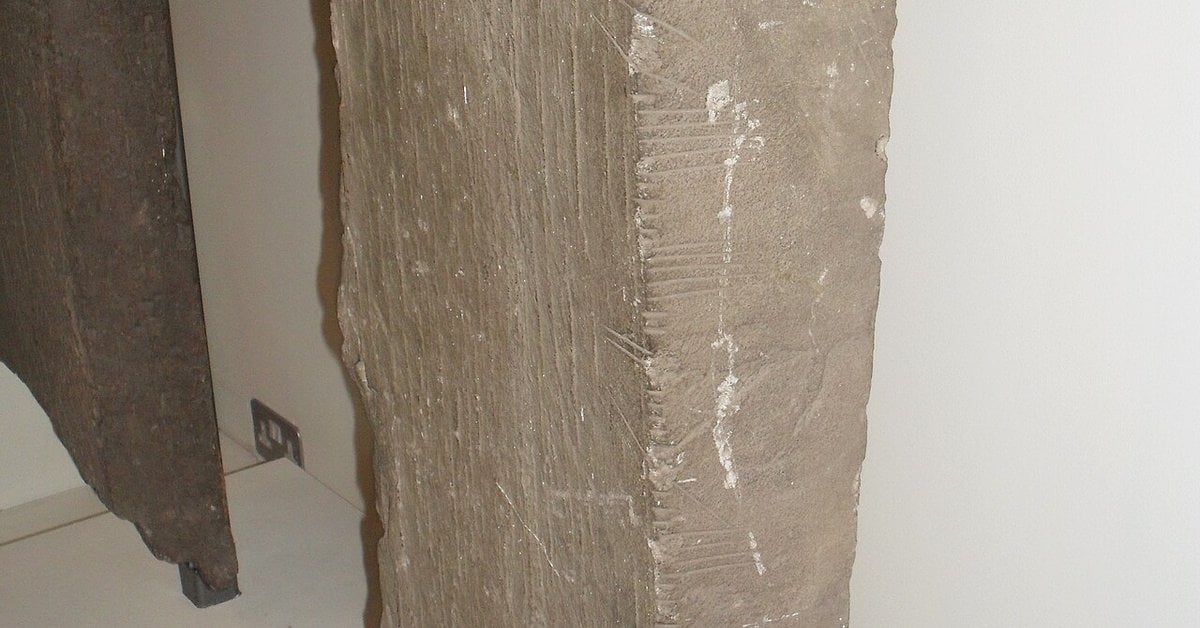
They look, at first, like scratches. Little notches cut along the edge of a long, narrow stone. But those marks are letters. And those letters, carved mostly between the 4th and 7th centuries, tell us the names of people who lived, died, and mattered in a world that was already ancient when the Vikings arrived.
What Is Ogham — and How Does It Work?
Ogham (pronounced OH-um or OG-um) is Ireland’s oldest indigenous writing system. It uses a series of lines and notches cut along a central vertical axis — typically the sharp edge of a stone — to represent letters.
Each letter in the Ogham alphabet corresponds to a tree. The letter B is beith — birch. The letter L is luis — rowan. The letter N is nin — ash. There are twenty base letters in total, arranged into four groups of five.
It is elegant, functional, and utterly unlike anything else in the ancient world. It was made for stone — for permanence.
Where Did Ogham Come From?
No one knows for certain. The most widely accepted theory is that Ogham emerged in Ireland sometime around the 4th century AD, possibly created by scholars who knew Latin and wanted a writing system suited to carving in stone.
The earliest inscriptions are almost entirely commemorative — short phrases recording a person’s name and their father’s name. A simple but deeply human act: leaving proof that you existed.
There are also older theories that Ogham may have been used on wood long before stone, carried as notched sticks through forests and across hills that no longer exist.
The Stones Themselves
There are roughly 400 surviving Ogham stones scattered across Ireland and parts of Britain, with the highest concentration in County Kerry, County Cork, and County Waterford.
Some stand in open fields where they have been for fifteen centuries. Others were moved into churches and museums for safekeeping. The National Museum of Ireland in Dublin holds a fine collection — but there is something profoundly different about finding one in a field, wind off the hills, moss creeping up its base.
If you are planning a trip to the south-west, the Dingle Peninsula and the Mizen Head area of Cork are your best chances of stumbling across one still standing in the landscape where it was first placed.
What the Inscriptions Actually Say
Most Ogham texts are maddeningly simple. A typical inscription reads something like: MAQQI DDOVVINIAS AVI CATTUVVIRR — meaning “son of Dovinia, grandson of Cattuvirr.”
These are not poems or histories. They are names. And that is exactly what makes them so quietly moving.
Someone stood in a field over 1,500 years ago, took a chisel to a stone, and carved: I was here. This person mattered. Remember them. That impulse — to mark presence, to insist on being remembered — is as human as anything we do today.
The Tree Alphabet and Irish Identity
The Ogham alphabet is deeply bound to the Irish concept of the natural world. Each letter carries not just a phonetic value but a symbolic one — a web of meaning drawn from the forests and hills of early Ireland.
Modern Irish people sometimes use Ogham in jewellery, tattoos, and art. Entire names can be rendered in these ancient notches, connecting the wearer to a lineage stretching back before Christianity, before the Vikings, before anything the modern world considers old.
It sits alongside other lesser-known Celtic symbols of Ireland as a reminder that Irish identity runs far deeper than shamrocks and leprechauns. Ogham is a quiet act of defiance and belonging — and it all began with someone scratching marks on a Kerry hillside.
Where to Find Ogham Stones Today
Most Ogham stones are in free, open-access locations — one of many reasons visiting Ireland needn’t cost a fortune. Some key sites to seek them out:
- Kilmalkedar Church, Dingle Peninsula, County Kerry — one of the richest Ogham sites in Ireland, with multiple stones along an ancient pilgrimage path
- Rath of the Synods, Hill of Tara, County Meath — at the ancient ceremonial heart of Ireland
- Ardfert Cathedral, County Kerry — a stunning early Christian site with an Ogham stone on the grounds
- Cork Public Museum — holds several inscriptions from Kerry and Cork with full translations
If you love this kind of deep Irish history, the Love Ireland newsletter sends stories like this straight to your inbox each week — history, folklore, and hidden corners of the island, for anyone who feels a pull towards Ireland.
Still Here, Still Speaking
There is something extraordinary about standing before an Ogham stone and realising that someone stood in that same spot, more than fifteen hundred years ago, and wanted to be known.
Ireland has always been a country that refuses to forget. These stones — battered, moss-covered, and easy to walk past — are part of why. Find one, and you are reading the oldest Irish words still standing in the world.
☘️ You Might Also Love
☘️ Want More Hidden Ireland?
Join 64,000+ subscribers who discover Ireland’s best-kept secrets every week.
Subscribe Free — Join the Community →
Free forever · Unsubscribe anytime · No spam
📥 Free Download: Ireland Travel Planning Guide
Our most popular resource — itineraries, insider tips, and the 50 places you must not miss.
Tours & experiences you might love


Powered by Viator. Some links are affiliate links — we may earn a small commission at no extra cost to you.
Secure Your Dream Irish Experience Before It’s Gone!
Planning a trip to Ireland? Don’t let sold-out tours or packed attractions spoil your journey. Iconic experiences like visiting the Cliffs of Moher, exploring the Rock of Cashel, or enjoying a guided walk through Ireland’s ancient past often sell out quickly—especially during peak travel seasons.

Booking in advance guarantees your place and ensures you can fully immerse yourself in the rich culture and breathtaking scenery without stress or disappointment. You’ll also free up time to explore Ireland’s hidden gems and savour those authentic moments that make your trip truly special.
Make the most of your journey—start planning today and secure those must-do experiences before they’re gone!