

Every year, before dawn on the last Sunday of July, a mountain in County Mayo does something extraordinary. Thousands of people — farmers, doctors, grandmothers, teenagers — begin climbing a 764-metre cone of quartzite rock. Many of them barefoot. They have been doing this, in some form, for over 3,000 years.
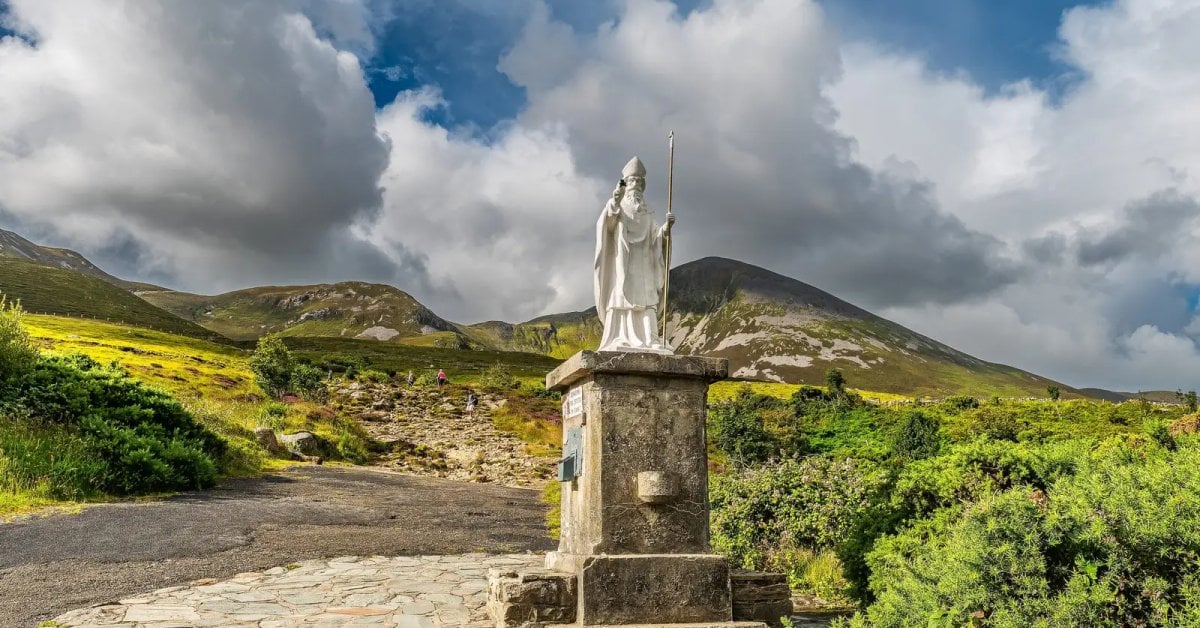
This is Reek Sunday. And it begins long before Christianity arrived in Ireland.
A God Named Lugh and the First Harvest
Before St Patrick ever set foot on Croagh Patrick, the ancient Irish celebrated Lúnasa (LOO-na-sa) on the first day of August — a festival honouring Lugh, the god of light, skill, and the harvest.
Lugh didn’t simply hand over the harvest. He won it. According to mythology, he defeated the forces of blight and sterility in a great contest, ensuring that crops would ripen and communities would survive the coming winter.
Lúnasa was the reward — a festival of gratitude, gathering, and relief.
The Mountain Nobody Could Ignore
Hilltops held deep significance during Lúnasa. People climbed them at dawn to pick bilberries — the first fruits of the season — to gather, dance, and watch the sun rise over a land that had (hopefully) provided enough.
Croagh Patrick, known locally as “the Reek,” was already a sacred site long before St Patrick fasted there for 40 days in 441 AD. The Christianisation of the festival was gradual and deliberate. Reek Sunday absorbed the old Lúnasa energy and gave it a new story — one that has endured ever since.
You can read more about the mountain’s deeper history in our guide to Croagh Patrick: Ireland’s Holy Mountain and the Spirit of the West.
What Reek Sunday Actually Looks Like
Nothing quite prepares you for Reek Sunday if you’ve never witnessed it.
The path is steep and loose, scattered with quartzite shale that shifts beneath your feet. At the bottom, pilgrims — many hundreds of them barefoot — join a trail that stretches up into cloud and mist.
At the summit, a small white chapel perches at 764 metres. Mass is said there throughout the day. People weep, pray, and sit in silence with the Atlantic spread below them. Then they descend — feet raw, faces luminous.
Four Festivals, Four Turning Points
The ancient Irish year revolved around four great festivals. Samhain marked the end of autumn. Imbolc (St Brigid’s Day) heralded early spring. Bealtaine blazed across May. And Lúnasa closed the summer with a mixture of thanksgiving and anxiety.
These weren’t holidays in any modern sense. They were turning points — moments when the community stopped, acknowledged the season’s power, and performed rituals to tip the balance towards survival.
Lúnasa specifically marked the uncertainty of the harvest. Would it be enough? The hill-climbing, the bilberry-picking, the communal fires — all of it was a way of giving thanks in advance and asking the earth to follow through.
The Bilberry Hills You’ve Probably Never Heard Of
Beyond Croagh Patrick, Lúnasa was celebrated on hundreds of hilltops across Ireland. The festival gave its name to Lúnasa — the Irish-language word for August itself.
Brian Friel’s beloved play Dancing at Lughnasa captures the strange, half-remembered wildness of the festival as it lingered in 1930s Donegal. In Kerry, Lúnasa coincided with Puck Fair in Killorglin — one of Ireland’s oldest gatherings, where a wild goat is crowned king of the town for three days each August. That tradition may well be older than Christianity itself.
Why This Festival Still Matters
Lúnasa has never entirely died — and that says something remarkable about the Irish character.
In an age of supermarkets and synthetic fibres, thousands of people still climb a fog-wrapped mountain barefoot each July. They don’t do it for Instagram. They do it because the practise reaches back across thousands of years and touches something that still feels real.
If you’re planning a summer visit, consider timing your trip to coincide with Reek Sunday at the end of July. Westport is the nearest town — vibrant, welcoming, and perfectly placed for exploring County Mayo. And for help planning the rest of your Irish adventure, the Love Ireland Planning Hub is the best place to start.
If you want more of Ireland’s ancient traditions delivered straight to your inbox, the Love Ireland newsletter at loveireland.substack.com covers everything the guidebooks miss.
Lúnasa is not a museum piece. It is an argument — still being made, year after year — that some things are older and more important than we’ve been led to believe. Ireland remembers. And every July, thousands climb through the clouds to prove it.
☘️ You Might Also Love
☘️ Want More Hidden Ireland?
Join 64,000+ subscribers who discover Ireland’s best-kept secrets every week.
Subscribe Free — Join the Community →
Free forever · Unsubscribe anytime · No spam
📥 Free Download: Ireland Travel Planning Guide
Our most popular resource — itineraries, insider tips, and the 50 places you must not miss.
Tours & experiences you might love


Powered by Viator. Some links are affiliate links — we may earn a small commission at no extra cost to you.
Secure Your Dream Irish Experience Before It’s Gone!
Planning a trip to Ireland? Don’t let sold-out tours or packed attractions spoil your journey. Iconic experiences like visiting the Cliffs of Moher, exploring the Rock of Cashel, or enjoying a guided walk through Ireland’s ancient past often sell out quickly—especially during peak travel seasons.

Booking in advance guarantees your place and ensures you can fully immerse yourself in the rich culture and breathtaking scenery without stress or disappointment. You’ll also free up time to explore Ireland’s hidden gems and savour those authentic moments that make your trip truly special.
Make the most of your journey—start planning today and secure those must-do experiences before they’re gone!