

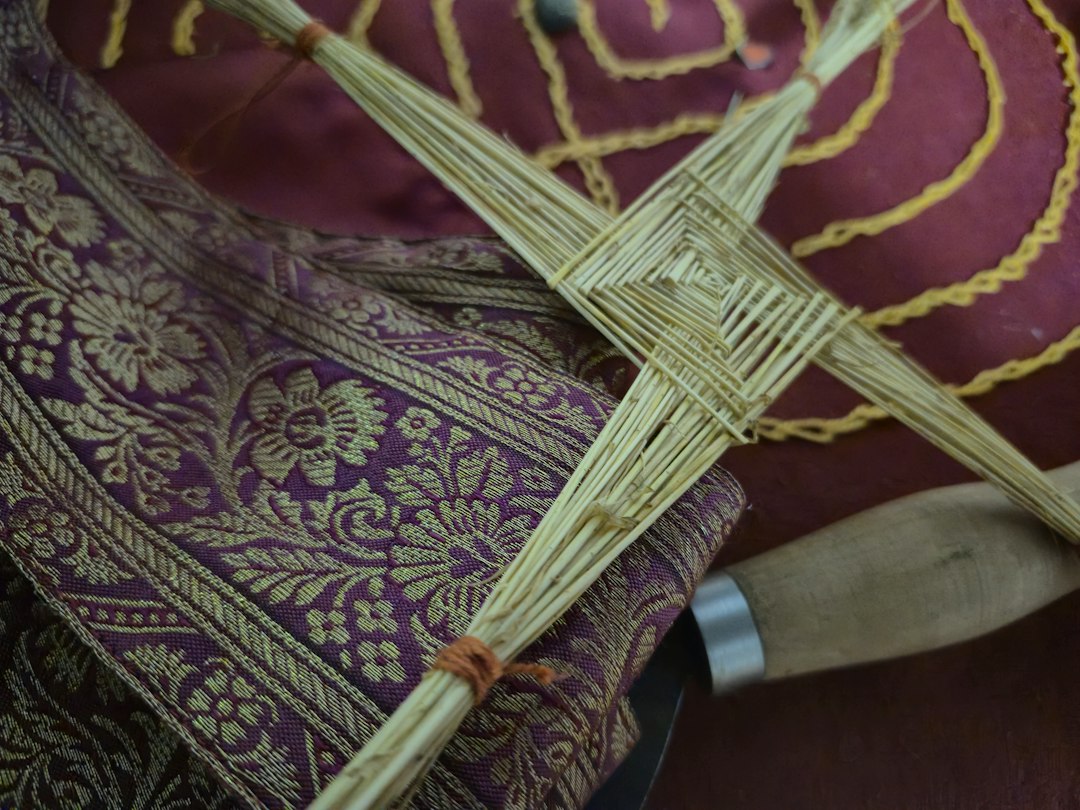
Pull a handful of green rushes from a wet field, fold and tuck them into a woven diamond with four arms radiating out, and you have made the same object Irish households have pinned above their doors for centuries. The St. Brigid’s Cross is woven fresh each year on 1 February — the feast of St. Brigid and the old festival of Imbolc that marks the first stirrings of spring — then hung in the rafters to guard the home. Here is what the cross is, where the legend of St. Brigid of Kildare comes in, how it is made and what it is believed to do. This is Guide № 010 in The Love Ireland Guide series.
Get the Full Collectible Guide (Free PDF)
St. Brigid’s Cross — in a beautifully designed, printable booklet. The Love Ireland Guide № 010.
What It Actually Is
A St. Brigid’s Cross is a small woven cross, most often built around a central plaited square or diamond with four radiating arms. It is traditionally made from green rushes (Juncus) gathered from damp ground, though straw or reeds are used in regions where rushes are scarce. The rushes are usually pulled by hand rather than cut, then folded one over another and bound at the tips, so no glue or thread is strictly needed.
The most familiar form is the four-armed cross, but it is far from the only one. Collectors and folklorists have recorded three-armed crosses, multi-armed lozenge and diamond designs, and wheel-like variants, with regional styles differing across the country. Many of these survive in the folk collections of the National Museum of Ireland, whose Country Life branch at Turlough Park in Mayo holds a substantial body of Irish material culture.
The Saint and the Legend
Brigid of Kildare (see also the story behind the name Brigid), traditionally dated to around 451–525, is one of Ireland’s three patron saints alongside Patrick and Columba (Colmcille). The best-known origin story tells that Brigid wove the first cross from rushes on the floor while sitting at the deathbed of a dying chieftain — often said to be a pagan lord, sometimes her own father. As she wove, she explained the meaning of the cross, and the man is said to have asked for baptism before he died.
Brigid’s monastery at Kildare became one of early medieval Ireland’s most important religious sites. The place is still marked today by St. Brigid’s Cathedral in Kildare town, while the modern Brigidine Solas Bhríde centre keeps her devotion and craft traditions alive with workshops and pilgrimages around her feast day.
How and When It’s Made
The cross is made on or around St. Brigid’s Day, 1 February, which in the old Gaelic calendar is Imbolc — the point midway between the winter solstice and the spring equinox. In many households the new cross is blessed, then hung over the door or in the roof space, and the previous year’s cross is taken down and, in some customs, burned. Making the cross is a hands-on tradition still taught in many Irish schools around 1 February, and detailed accounts of the local customs were recorded in the 1930s in the Schools’ Collection, now searchable through the National Folklore Collection.
What It’s Believed to Do
Traditionally the cross was hung to protect the house and its occupants — most commonly said to guard against fire, lightning, illness and evil, and to bring blessing on the home and livestock for the coming year. Because it was renewed annually, a rafter might hold a small stack of old crosses, one for each year the family had kept the custom. The symbol became so bound up with Irish identity that the national broadcaster RTÉ adopted a stylised St. Brigid’s Cross as its on-screen symbol from 1961, and versions of it stayed in the logo until 1995.
A Day, a Symbol, and a Revival
St. Brigid’s Day gained new prominence in 2023, when the Irish state made it a public holiday — the first Irish public holiday named for a woman. The holiday falls on the first Monday in February, or on 1 February itself when that date is a Friday, as confirmed by the Government of Ireland. Kildare, Brigid’s own county, has leaned into the revival, and visitors planning a trip around the feast can find events and workshops through Into Kildare.
Myths Worth Retiring
Myth: A St. Brigid’s Cross always has four arms. In reality, three-armed, multi-armed, lozenge and wheel-shaped versions are all well documented, with the design varying by region and by the maker’s local tradition.
Myth: It’s a purely Christian invention. The cross is genuinely tied to St. Brigid, but it is also widely linked to the pre-Christian festival of Imbolc and to older solar-wheel symbolism, and it is commonly understood as a Christian tradition layered over an earlier seasonal one.
Myth: It’s made from straw. Straw is used in some places, but the classic material is fresh green rushes pulled from wet ground, which fold and hold their shape without breaking.
Frequently Asked Questions
When are you supposed to make a St. Brigid’s Cross?
On or around St. Brigid’s Day, 1 February, which coincides with Imbolc and the traditional start of spring in Ireland. Many families make and hang the cross that day, sometimes replacing the previous year’s one.
Where can I see or learn to make one?
Historic examples are held in the folk collections of the National Museum of Ireland, and workshops around the feast day are run in Kildare by the Solas Bhríde centre, with wider events listed through Into Kildare.
How long should you keep the cross up?
Custom is to keep it for the year, then take it down when the new one is made the following 1 February. In some households the old cross is burned; in others the year’s crosses are simply left to gather in the rafters.
More The Love Ireland Guides
The Love Ireland Guide is a numbered series — one tightly focused subject at a time, each with its own downloadable collectible edition. Guide № 001 is Irish Soda Bread, Guide № 002 is St. Patrick’s Day, Guide № 003 is The Claddagh Ring, Guide № 004 is Guinness — The Pour, The Pint, The Ritual, Guide № 005 is Irish Pub Etiquette, Guide № 006 is Irish Slang & Hiberno-English, Guide № 007 is The Irish Wake, Guide № 008 is Irish Whiskey, and Guide № 009 is The Irish Trad Session. This is Guide № 010. More editions are on the way.
☘️ Join 64,000+ Ireland Lovers
Every week, get hidden stories, local secrets, and travel inspiration from people who live and love it.
Subscribe free — enter your email:
Tours & experiences you might love


Powered by Viator. Some links are affiliate links — we may earn a small commission at no extra cost to you.
Secure Your Dream Irish Experience Before It’s Gone!
Planning a trip to Ireland? Don’t let sold-out tours or packed attractions spoil your journey. Iconic experiences like visiting the Cliffs of Moher, exploring the Rock of Cashel, or enjoying a guided walk through Ireland’s ancient past often sell out quickly—especially during peak travel seasons.

Booking in advance guarantees your place and ensures you can fully immerse yourself in the rich culture and breathtaking scenery without stress or disappointment. You’ll also free up time to explore Ireland’s hidden gems and savour those authentic moments that make your trip truly special.
Make the most of your journey—start planning today and secure those must-do experiences before they’re gone!