

If you’ve ever eaten in Dublin and wondered why the city has its own dish — one that barely appears on menus today — the answer is simpler than you’d expect. Coddle is Dublin’s dish. And it’s been feeding the city on Saturday nights for over three hundred years.
What Is Dublin Coddle?
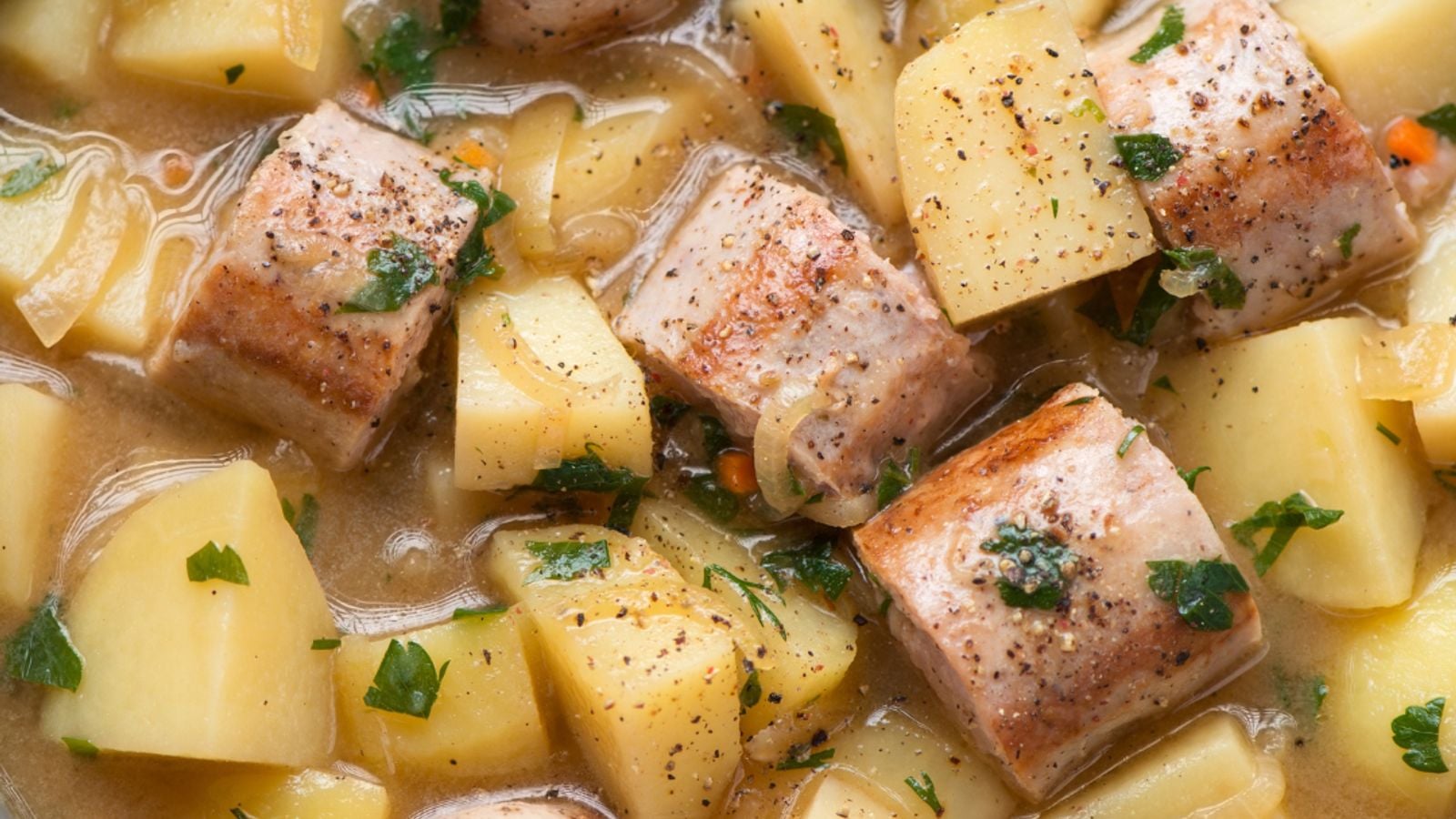
Coddle is a one-pot stew made from pork sausages, back bacon, potatoes, and onions, slow-cooked together in a light pork broth. It sounds straightforward. That’s the point.
It’s not glamorous. There’s no wine reduction, no fresh herbs, no elaborate technique. You layer the ingredients in a pot, add water or stock, and let time do the work. The result is something deeply comforting — soft, savoury, and unmistakably Dublin.
The word itself comes from the French caudle, meaning a warm, nourishing liquid given to the sick or elderly. But Dublin coddle is nothing like that. It’s a working-class supper dish, born from practicality, and made famous by repetition.
A Saturday Night Tradition
The story of coddle begins with Dublin’s Catholic majority and the tradition of eating no meat on Fridays. By Saturday, the fasting was over — and there was often leftover sausage and bacon from the week before.
Coddle used those leftovers. Everything went into the pot together. The longer it cooked, the better it tasted. It became the standard Dublin Saturday night supper — something warm and filling that could sit on the stove all evening without spoiling.
In the tight red-brick terraces of the Liberties, the Coombe, and the north inner city, Saturday coddle was as reliable as the church bells. You’d smell it from the street before you reached the door. Dublin has always had a talent for turning the ordinary into something worth celebrating.
James Joyce and the Literary Connection
☘️ Love Irish Food & Culture?
Every Wednesday, we send our best Irish recipes, food stories, and kitchen traditions straight to your inbox. Join 64,000+ readers who love Ireland.
Coddle turns up in the writing of James Joyce — the novelist who mapped Dublin’s streets and souls with extraordinary precision. In his work, coddle is shorthand for the working-class Dublin domestic scene: warm, modest, and irreplaceable.
Jonathan Swift — the satirist and author of Gulliver’s Travels — also wrote about coddle. Considering Swift was Dean of St Patrick’s Cathedral in the Liberties, he was very much in the right neighbourhood to eat it.
Brendan Behan included it too. For writers who loved Dublin’s working-class soul, coddle was the perfect symbol — unpretentious, reliable, and entirely local.
☘️ Enjoying this? 64,000+ Ireland lovers get stories like this every week. Subscribe free →
How It Was Made
The traditional method requires no exact recipe. You layer sliced sausages, rashers (back bacon), potato slices, and onion rings into a heavy-bottomed pot. Season generously with salt and white pepper. Cover with cold water or light stock.
The pot goes on a low heat for an hour or more. Some Dublin cooks swear it tastes better reheated the next morning. Others add pearl barley for body. Every household had their version, and each family thought theirs was the real one.
What you won’t find in any authentic version: tomatoes, cream, or thickening agents. Coddle is clear-broth, honest, and completely true to its ingredients. If someone tries to add a roux, they’re doing it wrong.
Why It Almost Disappeared — and Why It’s Coming Back
Through the 20th century, Dublin’s culinary landscape changed. Restaurants arrived. Supermarket convenience food took hold. The Saturday night supper traditions of the inner city faded as families moved to new suburbs and old neighbourhoods changed.
For decades, coddle was something your grandmother made. You’d rarely see it on a menu. A generation grew up without tasting it.
But it’s returning. A small number of Dublin restaurants now serve coddle as heritage food — a nod to the city’s working-class culinary past. Food writers have rediscovered it. Home cooks share their versions online. If you’re planning your trip to Ireland and want one dish that’s entirely, unapologetically Dublin — coddle is the one to find.
Coddle is not a showpiece dish. It won’t appear in a Michelin guide. But in a city that values honesty over performance, it fits perfectly. For three centuries, it kept Dublin families fed on cold Saturday evenings. It was the food you came home to, the smell that met you at the top of the stairs, the supper your mother kept warm while you were out.
That’s not nothing. That’s everything Dublin is about.
☘️ You Might Also Love
☘️ Join 64,000+ Ireland Lovers
Every Friday, get Ireland’s hidden gems, local secrets, and travel inspiration — the kind you won’t find in any guidebook.
Free forever · · Unsubscribe anytime
☘️ Get More Irish Recipes & Stories
Join 64,000+ readers for weekly Irish recipes, food traditions, travel guides, and hidden gems. Free every morning.
Tours & experiences you might love


Powered by Viator. Some links are affiliate links — we may earn a small commission at no extra cost to you.
Secure Your Dream Irish Experience Before It’s Gone!
Planning a trip to Ireland? Don’t let sold-out tours or packed attractions spoil your journey. Iconic experiences like visiting the Cliffs of Moher, exploring the Rock of Cashel, or enjoying a guided walk through Ireland’s ancient past often sell out quickly—especially during peak travel seasons.

Booking in advance guarantees your place and ensures you can fully immerse yourself in the rich culture and breathtaking scenery without stress or disappointment. You’ll also free up time to explore Ireland’s hidden gems and savour those authentic moments that make your trip truly special.
Make the most of your journey—start planning today and secure those must-do experiences before they’re gone!