

On a gentle hill in County Meath, surrounded by pale green grass and wide views of the Irish midlands, stands a stone that once chose kings. Not quietly — but loudly. According to legend, the Lia Fáil would let out a great cry the moment the rightful High King of Ireland placed his feet upon it.
What Is the Lia Fáil?
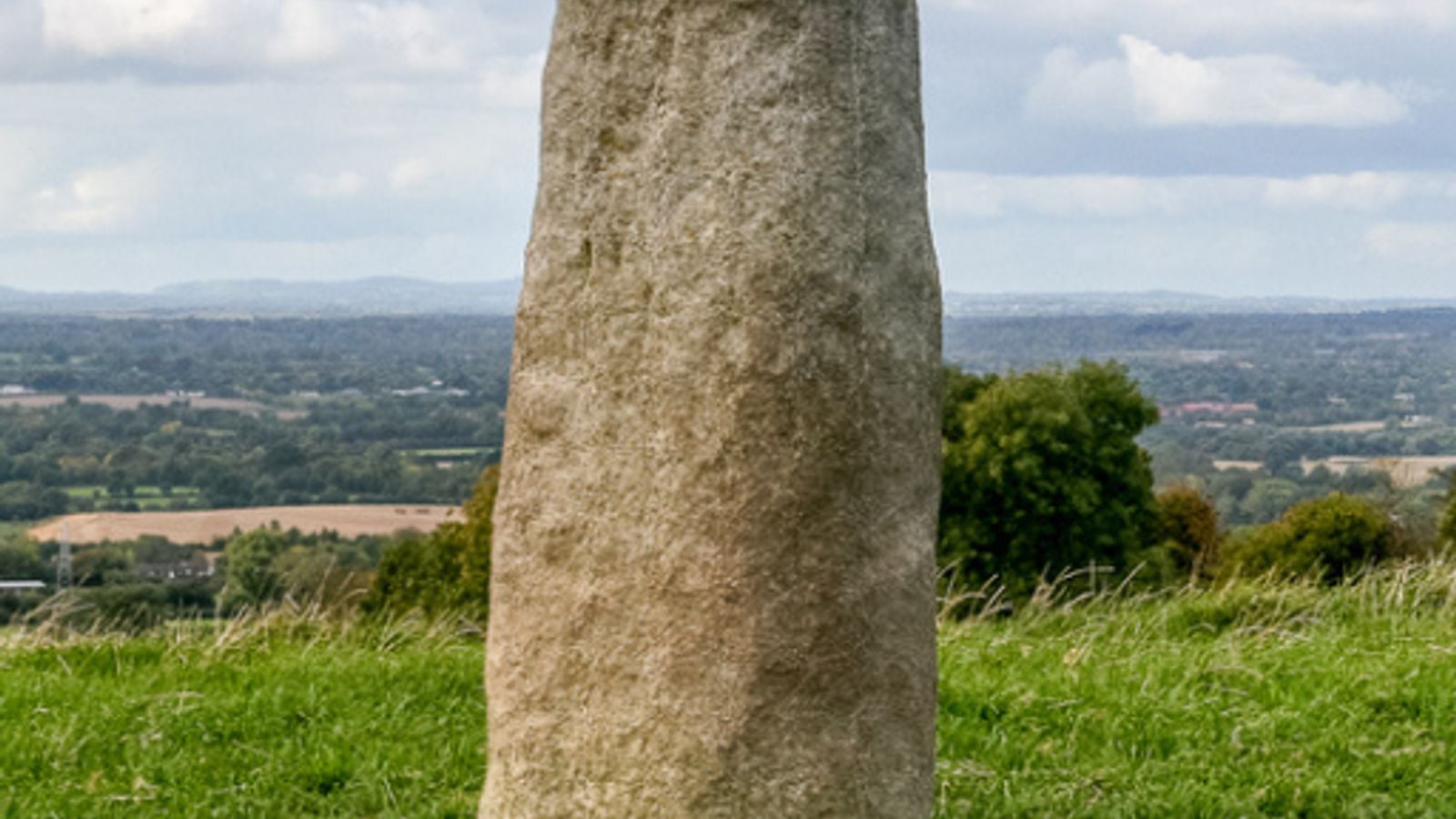
The Lia Fáil, pronounced Lee-uh Fawl, means “Stone of Destiny” in Irish. It is a tall, upright pillar stone — roughly shoulder height — that has stood on the Hill of Tara since ancient times.
Tara itself was the most sacred site in pre-Christian Ireland: the seat of the High Kings, the gathering place of the Brehon assembly, and the spiritual heart of the island. The stone was not simply a monument. It was considered alive, in its own quiet way — a judge of lineage and rightful rule.
A king who stood on it and heard nothing was not the true heir. A king who heard the stone cry out had the land’s own blessing. You can read more about the extraordinary ancient sites of County Meath in our complete guide to County Meath.
The Legend of the Screaming Stone
The story of the Lia Fáil is preserved in some of Ireland’s oldest written records — texts copied by early Christian monks who documented the pre-Christian myths long after the old beliefs had faded.
In these tales, the stone was one of four sacred treasures brought to Ireland by the Tuatha Dé Danann — the mythological divine race who inhabited the island before the arrival of the Gaelic Irish. The four treasures were the sword of Nuada, the spear of Lugh, the cauldron of the Dagda, and the stone.
Each treasure carried a different power. The stone’s power was the most dramatic — a groan or shriek audible across all of Ireland the moment a true king’s feet touched it. Not a sound of welcome. A declaration. Close by, Newgrange — older than the pyramids — shows just how deeply ancient this corner of Ireland truly is.
A King Without the Stone Was Nothing
☘️ Enjoying this? 64,000+ Ireland lovers get stories like this every week. Subscribe free →
The inauguration of a High King at Tara was one of the most important ceremonies in ancient Irish life. A candidate would approach the stone, and the crowd would fall silent. If the stone cried out, the gathered assembly erupted. If it stayed silent, the man’s claim was finished before it had begun.
The rite involved other elements too — the king would symbolically unite with the goddess of sovereignty, drink a ritual cup, and drive a chariot between standing stones. But the Lia Fáil was the centrepiece. No stone, no king. There was no appeal and no argument. The land had spoken.
What Happened to the Stone?
The stone still stands on the Hill of Tara today, though its history since ancient times has been complicated. For centuries, scholars debated whether this was the original Lia Fáil, or whether the true stone had been taken to Scotland — where it was known as the Stone of Scone, and sat beneath the coronation throne at Westminster for 700 years.
Most Irish historians believe the two stones are separate objects entirely. The Stone of Scone was returned to Scotland in 1996; the Lia Fáil never left Tara. Its current position, however, is not its original one. In the 19th century, the stone was moved a short distance to mark the grave of Irish rebels who died nearby in the 1798 rebellion — a well-meaning act that still frustrates archaeologists.
The stone itself is rough, weathered, and unadorned. It does not look like the axis of an ancient civilisation. That is part of what makes it so compelling.
Visiting the Hill of Tara Today
The Hill of Tara is one of the most visited ancient sites in Ireland, and one of the least understood by those who arrive expecting drama. There are no towering walls, no grand ruins. The hill is open grassland, with earthworks and mounds that need a guide — or a patient eye — to appreciate.
The Lia Fáil stands near the summit, plain and honest, behind a low railing. It does not look like the centre of a kingdom. It looks like what it is: a very old stone, having outlasted every king who ever stood before it.
The site is managed by the OPW and entry is free. A visitor centre operates during summer months. Tara sits near Navan in County Meath, about 45 minutes from Dublin by car. If you’re planning a trip to Ireland, the Hill of Tara deserves a morning of your time — especially if you come early, before the coaches arrive.
Why the Stone Still Matters
In modern Ireland, no one asks the stone to choose a leader. The idea of divine right to rule has long passed. But the Lia Fáil survives as a symbol of something older and more persistent: the belief that those who hold power must be accountable to something beyond themselves.
A king was not simply born at Tara. He was confirmed by the land itself — or he was not confirmed at all. The stone decided. Not the priests, not the nobility, not the armies gathered on the hill. The stone.
That is a quietly radical idea. And it is 3,000 years old.
The Lia Fáil sits on the hill now, patient as ever. Visitors photograph it. Schoolchildren ask what it did. And on certain evenings, when the light drops low across the Meath plain and the grass goes silver, it is not difficult to imagine that this quiet place was once the loudest spot in all of Ireland.
☘️ You Might Also Love
Tours & experiences you might love


Powered by Viator. Some links are affiliate links — we may earn a small commission at no extra cost to you.
Secure Your Dream Irish Experience Before It’s Gone!
Planning a trip to Ireland? Don’t let sold-out tours or packed attractions spoil your journey. Iconic experiences like visiting the Cliffs of Moher, exploring the Rock of Cashel, or enjoying a guided walk through Ireland’s ancient past often sell out quickly—especially during peak travel seasons.

Booking in advance guarantees your place and ensures you can fully immerse yourself in the rich culture and breathtaking scenery without stress or disappointment. You’ll also free up time to explore Ireland’s hidden gems and savour those authentic moments that make your trip truly special.
Make the most of your journey—start planning today and secure those must-do experiences before they’re gone!