

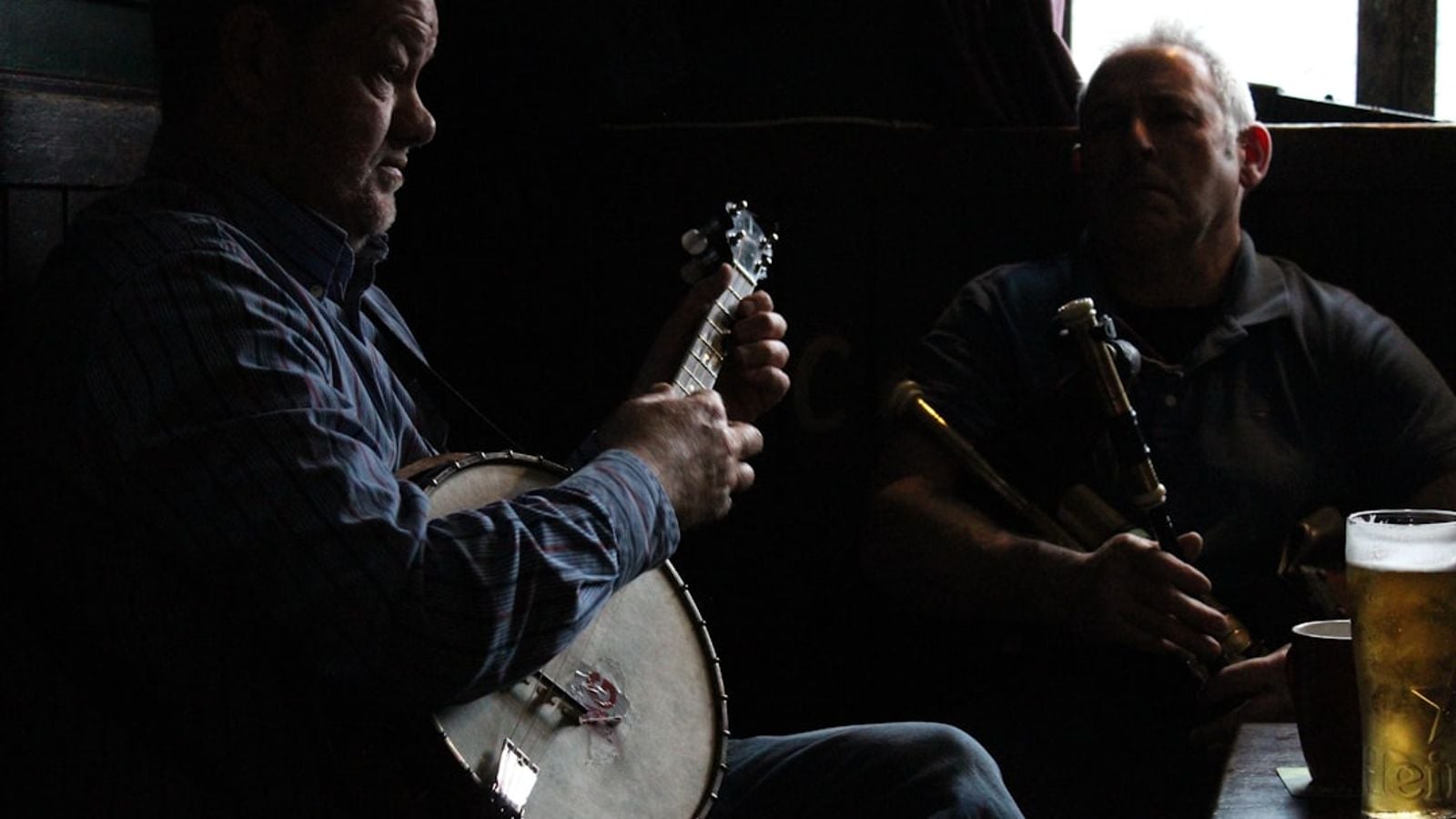
The first time you hear it, you might walk straight past. There is no sign on the door. No listing in any guide. Just the sound of a fiddle cutting through the noise of a busy pub, and a few people sitting close together in the corner, instruments on their laps, eyes on each other’s fingers.
That corner is one of the most important cultural spaces in Ireland. And if you have never been to a trad session, you have missed something that no tour guide can fully prepare you for.
A Session Is Not a Concert
The musicians don’t face the audience. They face each other.
That single detail tells you everything. A trad session is not a performance. It is a conversation — one that happens to be in music rather than words.
There is no stage, no set list, and no spotlight. The pub carries on around the players. Glasses clink. People talk. And the music fills every corner without demanding attention. That is entirely by design.
For visitors, the instinct is to stand and watch, to applaud loudly after every tune. Both responses are understandable. Both miss the point slightly. You are not expected to perform appreciation. You are welcome to simply be there.
How a Tune Gets Going
Nobody announces the next tune. Someone just starts one.
They lift their bow or put fingers to the holes and begin. If the others know it — and they usually do — they come in quietly, finding the melody within the first few bars. Within seconds, what was silence becomes a full trad set in motion.
The tune is not named first. It might be identified afterwards if someone asks — “Was that The Morning Dew? Thought so.” But during the session itself, names are irrelevant. The music speaks without introduction.
Tunes also never stand alone. They come in sets of two or three, linked together, the tempo usually lifting between each one. When the set ends, there is a pause. Do not rush to fill it. That pause is when the next tune is being chosen.
The Bodhrán Rule
No instrument in Irish trad comes with more unofficial warnings than the bodhrán.
The bodhrán (pronounced boh-RAWN) is the hand-held frame drum that gives trad its heartbeat. It looks simple. It is not. A badly played bodhrán — one that is off the beat, too loud, or played with no sensitivity to the music — can flatten an entire session.
This has led to a half-joking, half-serious tradition: bodhráns are not always welcome until the player proves they know what they are doing. The drum has been called “the most criticised instrument in Irish music.” The joke runs that you can tell a bodhrán player’s car in the car park — it’s the one with the pizza delivery sign on the roof.
It is said with affection. But the message is real: listen before you play.
☘️ Enjoying this? 64,000+ Ireland lovers get stories like this every week. Subscribe free →
The Unspoken Rules of Sitting In
If you play an instrument, you are welcome to bring it. But there is a right way to join a session.
You sit down. You listen. You wait until you know a tune well enough to come in cleanly — not a moment before. Joining on the wrong note, in the wrong key, or on a tune you half-know is poor form. Not rude exactly. But noticed.
Experienced players will often join mid-tune, picking up the thread as if they had been there from the start. That is the standard. The session flows like water — and adding yourself to it should feel the same way.
Volume matters too. A lone fiddle playing too loudly can overwhelm the group. The best session players adjust instinctively, always leaving space for the melody to breathe.
How the Tradition Passes On
One of the quietest traditions of the session is how knowledge moves between generations.
A ten-year-old might sit beside a 70-year-old master for an entire evening, not playing — just listening, watching the bow arm, memorising the ornamentation. No formal lesson. No structured learning. The tradition transfers by proximity and patience.
This is how Irish trad survived centuries of upheaval. Not through written notation — much of it was never written down — but through the session, night after night, town after town.
The Fleadh Cheoil, Ireland’s great annual music gathering, grew from exactly this culture. Thousands of musicians travel across the country every summer not just to compete but to find a session and sit in. If you are visiting, it is worth planning your Ireland trip around the musical calendar. And if the trad session sparks a deeper curiosity, sean-nós singing — the ancient, unaccompanied Irish vocal tradition — is the next door worth opening.
What the Session Is Really For
Nobody at a trad session is doing it for money. Nobody is doing it for fame.
They are doing it because the tunes need to be played. Because the session is the thread connecting them to everyone who played the same music before them. Because being in a corner of a pub in Dingle or Doolin or a village in Clare, playing a reel that is 200 years old with people who know every note — that is enough.
If you visit Ireland and find one, sit down. Order a drink. Do not photograph every second of it. Just listen.
You will understand Ireland better in that hour than in any museum.
☘️ You Might Also Love
Frequently Asked Questions
What is the historical significance of Unwritten Rules of an Irish Trad Session That Nobody Tells You?
This is one of Ireland’s fascinating historical and cultural stories — a reminder of the depth of Irish heritage that extends far beyond the better-known landmarks. These hidden histories are what make exploring Ireland so rewarding for curious visitors.
Where in Ireland can you learn more about this history?
Ireland’s network of local museums, heritage centres, and county archives hold remarkable collections of local history. The National Museum of Ireland (nationalmuseum.ie) and the National Library of Ireland also maintain extensive records of Irish cultural heritage.
Is this part of Irish culture still visible today?
Many aspects of Ireland’s ancient and folk culture are still visible if you know where to look. Local guides, heritage walks, and community festivals often reveal these hidden layers of Irish life that most tourists never see.
How does this story connect to modern Irish identity?
Irish people have a strong sense of connection to their heritage, and stories like this one are part of the cultural fabric that shapes modern Irish identity. The Irish language, traditional music, and folk customs all carry echoes of this long history.
☘️ Join 64,000+ Ireland Lovers
Every Friday, get Ireland’s hidden gems, local secrets, and travel inspiration — the kind you won’t find in any guidebook.
Subscribe free — enter your email:
Free forever · · Unsubscribe anytime
Tours & experiences you might love


Powered by Viator. Some links are affiliate links — we may earn a small commission at no extra cost to you.
Secure Your Dream Irish Experience Before It’s Gone!
Planning a trip to Ireland? Don’t let sold-out tours or packed attractions spoil your journey. Iconic experiences like visiting the Cliffs of Moher, exploring the Rock of Cashel, or enjoying a guided walk through Ireland’s ancient past often sell out quickly—especially during peak travel seasons.

Booking in advance guarantees your place and ensures you can fully immerse yourself in the rich culture and breathtaking scenery without stress or disappointment. You’ll also free up time to explore Ireland’s hidden gems and savour those authentic moments that make your trip truly special.
Make the most of your journey—start planning today and secure those must-do experiences before they’re gone!
Subscribe Free