

Irish soda bread recipe searches spike every time someone wants a taste of home — or a taste of Ireland for the first time. This is one of the simplest breads you can bake. No yeast, no kneading, no waiting for dough to rise. Just four ingredients, a hot oven, and about 45 minutes. The result is a dense, slightly tangy loaf with a golden crust and a soft, crumbly interior. Every Irish family has their version, and now you can have yours.
What’s the best Irish dish of all time? ☘️
Vote in our Best Irish Food poll — recipes nominated by the community.
What’s your Irish county’s signature dish? ☘️
Different counties claim different dishes — Your County’s Signature Food tells you which one your county is known for, with a short story behind it.
Why Irish Soda Bread Has No Yeast
Soda bread arrived in Ireland around 1840, when bicarbonate of soda — baking soda — became widely available. Before that, bread meant yeast or sourdough starters, both of which required time, warmth, and a reliable supply. Ireland had neither in abundance.
What Ireland did have was buttermilk. The acid in buttermilk reacts with bicarbonate of soda to produce carbon dioxide, which makes the dough rise. No yeast culture needed. No long fermentation. The bread could go from bowl to oven in under ten minutes.
This mattered enormously during the famine years and the lean decades that followed. Soda bread used soft Irish wheat, which had too low a gluten content for yeast breads but worked perfectly with soda. It became the bread of necessity, and then the bread of habit, and eventually the bread of identity. A loaf made the same way in County Clare as in County Cork as in County Down.
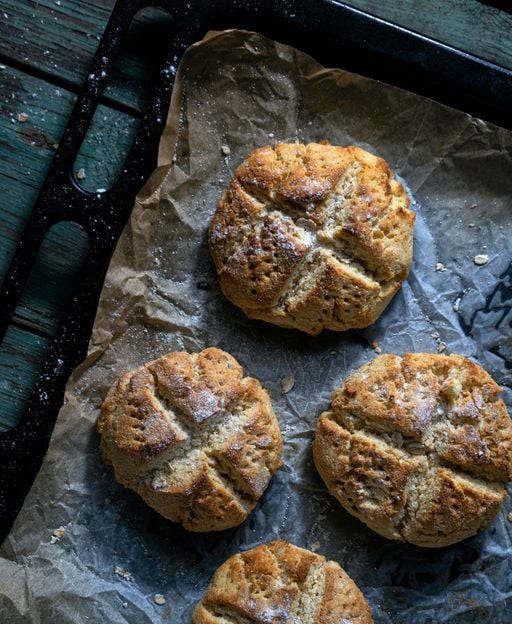
The cross cut on top is part of the tradition. One explanation is practical: it helps the bread bake through to the centre. The older explanation is that it was made to ward off evil and let the fairies out. Either way, it is as much a part of the loaf as the flour.
What You Need for This Irish Soda Bread Recipe
Classic white soda bread needs only four ingredients. That is not a simplification — that is the whole list.
- 450g (3½ cups) plain white flour — strong bread flour will make it tough. Use plain.
- 1 teaspoon salt
- 1 teaspoon bicarbonate of soda (baking soda) — not baking powder.
- 350–400ml (1½ cups) buttermilk — the amount varies. Add just enough to bring the dough together.
If you do not have buttermilk, add one tablespoon of white wine vinegar or lemon juice to 400ml of regular milk. Let it stand for five minutes. It will curdle slightly and work in the same way.
For brown soda bread, swap half or all of the white flour for wholemeal flour. The loaf will be denser and earthier. Many people prefer it. Some recipes add a tablespoon of oats to the top before baking, which gives a pleasant texture to the crust.
How to Make Irish Soda Bread — Step by Step
Before You Start
Preheat your oven to 200°C (400°F / Gas Mark 6). Lightly flour a baking tray or line it with parchment paper. Have your buttermilk measured and ready. This dough needs to go into the oven quickly once mixed — the soda starts reacting the moment it meets the acid in the buttermilk, so you want to bake it while the gas is still working.
Mixing the Dough
Sift the flour, salt, and bicarbonate of soda into a large mixing bowl. Make a well in the centre and pour in most of the buttermilk. Use a fork or your fingers to bring the dough together, adding the remaining buttermilk as needed. The dough should be soft and slightly sticky but not wet. If it is dry and crumbly, add a splash more buttermilk. If it sticks completely to your hands, add a little more flour.
The key rule with soda bread: do not overwork it. Mix until just combined and stop. Kneading develops gluten, and gluten is exactly what you do not want here. A rough, shaggy dough makes a better loaf than a smooth, over-worked one.
Shaping and Scoring
Turn the dough out onto a lightly floured surface. Shape it gently into a round about 5cm (2 inches) high. Place it on your prepared tray. Using a sharp knife or a blade, cut a deep cross across the top — cutting almost halfway through the loaf. Dust lightly with flour if you like a traditional look.
Baking
Bake at 200°C for 35–45 minutes. The loaf is done when it is golden brown and sounds hollow when you tap the bottom. If the top browns too quickly, cover it loosely with foil for the final ten minutes. Remove from the oven and cool on a wire rack for at least 20 minutes before cutting. Slicing it too soon means the inside will be doughy.
☘️ Enjoying this? 64,000+ Ireland lovers get stories like this every week. Subscribe free →
Tips for Perfect Soda Bread Every Time
- Cold buttermilk works better than room temperature. The reaction is more controlled and the dough stays workable longer.
- Sift the soda. Lumps of unsifted bicarbonate leave bitter spots in the finished bread. Always sift it through with the flour.
- Handle the dough as little as possible. Every squeeze and push after the buttermilk goes in is working against you.
- Get the oven hot before the dough goes in. A cold oven means a flat, dense loaf. 200°C is the minimum.
- The tap test is reliable. If the bottom of the loaf sounds hollow when you knock it with your knuckles, it is cooked through. If it sounds solid, give it another five minutes.
- Use fresh bicarbonate of soda. Old baking soda loses its potency. If yours has been in the cupboard for over a year, buy a new box.
Variations Worth Trying
The four-ingredient version is the classic, but Irish soda bread has as many regional variations as it has counties.
Brown soda bread uses wholemeal flour in place of white and has a deeper, more complex flavour. Many Irish families prefer it, and it holds together better for sandwiches.
Treacle bread adds a tablespoon of dark treacle or molasses to the mix. This gives a slightly sweet, dark loaf that is excellent toasted with salted butter.
Wheaten bread is the Northern Irish version, often made with a finer-milled wholemeal flour and sometimes including a small amount of oats. It is softer than southern soda bread and slightly sweeter.
Soda farls are soda bread cooked on a griddle rather than in the oven, cut into four triangular quarters. They are a staple of the Ulster fry and are best eaten straight off the pan, still hot, with butter.
Spotted dog adds raisins or sultanas and sometimes a small amount of sugar. It is closer to a tea bread than a traditional loaf, and children tend to love it.
How to Serve Irish Soda Bread
In Ireland, freshly baked soda bread is eaten with salted butter — nothing else. That is the benchmark. The bread is still warm, the butter melts into the crust, and there is nothing to improve on it.
Beyond that, soda bread has a natural affinity with Irish food more broadly. Serve it alongside a bowl of Irish stew to mop up the broth. Cut thick slices to accompany a bowl of vegetable soup. Toast it the morning after baking and layer it with smoked salmon and a squeeze of lemon. On a cheese board, a slice of brown soda bread holds its own against sharp aged cheddar or a creamy Irish blue.
Soda bread does not keep particularly well. It is at its best on the day it is baked and reasonable the next day. After that, toast it. Any leftover loaf can be sliced and frozen.
Bring a Taste of Ireland Into Your Kitchen
This Irish soda bread recipe is one of the most direct connections you can make to Irish food culture from your own home. It requires no specialist equipment, no unusual ingredients, and almost no skill beyond the patience to leave the dough alone. Make it once and you will understand why it has never needed to change.
If this recipe has sparked an interest in planning a trip to Ireland itself, our Ireland trip planning hub is where to start. For a route that takes in the landscapes that produced this bread — the farmhouse kitchens of the west, the villages of Clare and Kerry and Galway — our 7-day Ireland itinerary from the USA gives you the full picture. If you want more time, the 10-day Ireland itinerary for American travellers builds in the north and adds depth.
When to go matters too. Our guide to the best time to visit Ireland from the USA will help you plan a trip that works for your schedule and makes the most of the country at its finest.
Tours & experiences you might love


Powered by Viator. Some links are affiliate links — we may earn a small commission at no extra cost to you.
Secure Your Dream Irish Experience Before It’s Gone!
Planning a trip to Ireland? Don’t let sold-out tours or packed attractions spoil your journey. Iconic experiences like visiting the Cliffs of Moher, exploring the Rock of Cashel, or enjoying a guided walk through Ireland’s ancient past often sell out quickly—especially during peak travel seasons.

Booking in advance guarantees your place and ensures you can fully immerse yourself in the rich culture and breathtaking scenery without stress or disappointment. You’ll also free up time to explore Ireland’s hidden gems and savour those authentic moments that make your trip truly special.
Make the most of your journey—start planning today and secure those must-do experiences before they’re gone!