

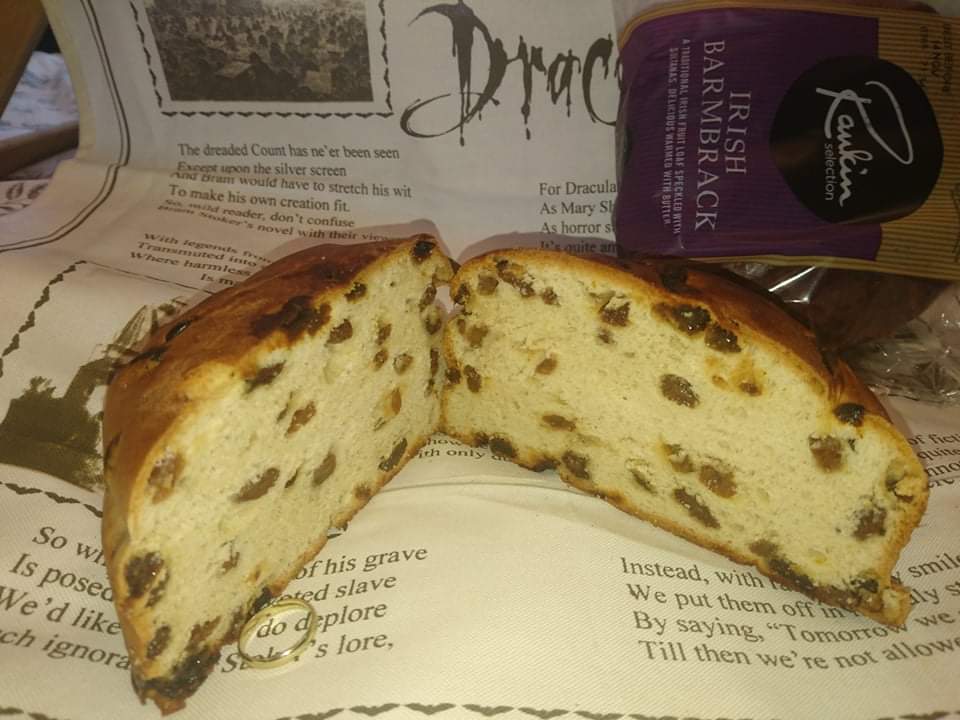
Every October, Irish families slice into a dense, spiced fruit loaf with something close to held breath. Somewhere inside is a ring, a coin, or a scrap of cloth — and whichever piece lands on your plate just told you what the coming year holds. This is barm brack: Ireland’s oldest fortune-telling bread, and it’s still on supermarket shelves today.
What Is Barm Brack?
The name comes from the Irish báirín breac, meaning “speckled loaf.” The speckles are raisins and sultanas, soaked overnight in strong tea — sometimes a splash of whiskey too — then baked into a sticky, dense bread that sits somewhere between a loaf and a fruitcake.
It’s eaten year-round in some parts of Ireland, but it truly belongs to Halloween. The tradition stretches back to Samhain, the ancient Celtic festival marking the end of harvest and the beginning of the dark half of the year.
If you’re curious about other famous Irish foods with deep cultural roots, barm brack is a fine place to start.
The Charms and What They Meant
In older times, Irish families baked a small collection of objects directly into the brack. Each one carried a different prophecy for the finder:
- A ring meant marriage before the next Halloween
- A coin meant wealth and good fortune in the year ahead
- A thimble warned the finder they would remain unmarried
- A piece of cloth or rag signalled financial hardship
- A pea meant poverty
- A stick foretold an unhappy marriage
The tension at the table was real. Nobody quite laughed it off.
The Samhain Connection
☘️ Love Irish Food & Culture?
Every Wednesday, we send our best Irish recipes, food stories, and kitchen traditions straight to your inbox. Join 64,000+ readers who love Ireland.
Barm brack belongs to the same world as Samhain — the Celtic belief that on the last night of October, the veil between the living and the dead grows thin. It was a time for divination of all kinds.
Apple peeling by candlelight was said to reveal the initial of a future spouse. Nuts thrown into a fire showed whether a relationship would last. Mirrors were draped and candles lit. Barm brack’s hidden charms were part of this broader attempt to read the future at the one moment when the universe might be listening.
☘️ Enjoying this? 64,000+ Ireland lovers get stories like this every week. Subscribe free →
How Shop-Bought Brack Changed Everything
The modern supermarket version — Boland’s is the most familiar — contains just one charm: a small plastic ring. The cloth, the coin, the pea, and the stick have all quietly disappeared. What was once a family ritual involving handwritten recipes and careful baking has largely been replaced by cellophane packaging and a bright gold ring.
Some families still bake their own. The old recipes are easy enough to find, and the act of making one — slipping in a coin wrapped in greaseproof paper — still feels like something worth doing.
The Taste Itself
The brack is genuinely good. Thick and moist, not too sweet, with a warmth from cinnamon and mixed peel. Spread with salted butter, it’s one of those tastes that feels more like a memory than a meal.
If you’re planning a trip to Ireland in autumn, you’ll find barm brack at every petrol station and corner shop from mid-September onwards. Some producers, like Avoca, sell their version year-round. Whether you believe in the charm or not, finding one in your slice still makes you pause.
What the Brack Says About Ireland
Fortune-telling bread doesn’t come from a society that takes life too lightly. Ireland’s autumn rituals grew out of a culture that looked at hard winters and uncertain harvests and tried to find meaning. The charms weren’t superstition for superstition’s sake.
They were a way of sitting with uncertainty. Of naming what you feared and what you hoped for, and eating cake together, and laughing a little. That impulse never really goes away. You can also find that same spirit in the comfort dishes Irish people still reach for on dark evenings.
The ring still turns up in slices today. And for a moment — in a kitchen in Cork, in Dublin, in a house in Boston or Melbourne that hasn’t forgotten where it came from — somebody still holds their breath.
☘️ You Might Also Love
☘️ Join 64,000+ Ireland Lovers
Every Friday, get Ireland’s hidden gems, local secrets, and travel inspiration — the kind you won’t find in any guidebook.
Free forever · · Unsubscribe anytime
☘️ Get More Irish Recipes & Stories
Join 64,000+ readers for weekly Irish recipes, food traditions, travel guides, and hidden gems. Free every morning.
Tours & experiences you might love


Powered by Viator. Some links are affiliate links — we may earn a small commission at no extra cost to you.
Secure Your Dream Irish Experience Before It’s Gone!
Planning a trip to Ireland? Don’t let sold-out tours or packed attractions spoil your journey. Iconic experiences like visiting the Cliffs of Moher, exploring the Rock of Cashel, or enjoying a guided walk through Ireland’s ancient past often sell out quickly—especially during peak travel seasons.

Booking in advance guarantees your place and ensures you can fully immerse yourself in the rich culture and breathtaking scenery without stress or disappointment. You’ll also free up time to explore Ireland’s hidden gems and savour those authentic moments that make your trip truly special.
Make the most of your journey—start planning today and secure those must-do experiences before they’re gone!