

Most people who own a Claddagh ring have never been told the rule. They slip it on a finger, admire the little crowned heart held between two hands, and carry on — never knowing that in Ireland, the way you wear that ring speaks volumes. Without a single word.
A Ring Born in a Galway Fishing Village
The Claddagh takes its name from an ancient fishing settlement just outside the walls of Galway City. For centuries, the Claddagh village operated almost as its own tiny republic — with its own king, its own laws, its own customs.
It was here, sometime in the 17th century, that the distinctive design first appeared. A goldsmith named Richard Joyce is most often credited with its creation. The story goes that he was captured by pirates on his way to the Caribbean, sold into slavery, and apprenticed to a Moorish goldsmith. All those years away, he fashioned the ring for the woman he loved at home in Galway.
When he was finally freed and returned to Ireland, she had waited. He gave her the ring. She married him. The design spread, and it never stopped.
What the Three Elements Actually Mean
The Claddagh is not decorative for decoration’s sake. Every element carries weight.
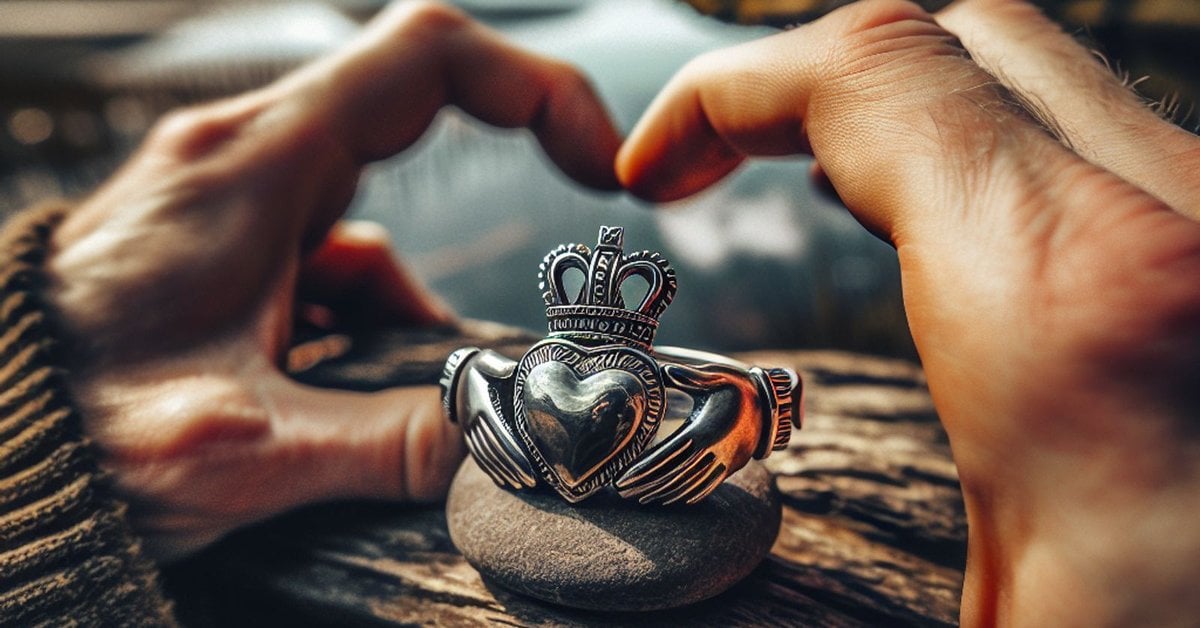
The heart at the centre represents love. The crown above it stands for loyalty. The two hands cradling the heart symbolise friendship. Together, the three form what Irish tradition holds as the complete foundation of any lasting relationship — not just passion, but faithfulness and genuine companionship.
It is a remarkably honest statement for a ring to make. Love alone isn’t enough. Loyalty alone isn’t enough. The hands — the act of choosing to hold someone’s heart — are what ties it all together.
For the full history behind the design, see the full history of the Claddagh Ring. And if you already know the meaning but need a refresher on the mechanics, our companion guide covers exactly which hand and finger it goes on.
The Rule Every Irish Person Learns Young
This is where most visitors get lost — and where Irish people silently notice. The ring communicates your relationship status, and the message is entirely in how you wear it.
Right hand, crown pointing outward (away from the heart): Your heart is open. You are single and available.
Right hand, crown pointing inward (toward the heart): Your heart has been captured. You are in a relationship.
Left hand, crown pointing inward: You are engaged.
Left hand, crown pointing inward, on the wedding finger: You are married.
Wear it the wrong way, and Irish people will quietly draw the wrong conclusions about your life. Wear it the right way, and you are speaking a language that has been spoken on this island for three hundred years.
Why Irish Mothers Still Pass It Down
The Claddagh has become one of Ireland’s most enduring inheritance traditions. Grandmothers press them into granddaughters’ palms. Mothers fasten them onto daughters’ fingers before they leave home — for college, for emigration, for marriage.
During the great waves of Irish emigration in the 19th century, Claddagh rings crossed the Atlantic in the pockets and purses of hundreds of thousands of Irish women. In Boston, New York, and Chicago, the ring became as much a symbol of Irish identity as it was of love. For the diaspora — many of whom feel an enduring pull back to the island their families left behind — the Claddagh is often the one physical object that connects them to home.
The Love Ireland newsletter readers often share stories of finding a grandmother’s Claddagh in a jewellery box, still carrying the dents and scratches of a long life. There is something deeply moving about holding one of those rings.
Where to Find Your Own
If you visit Ireland, Galway City is the natural place to look. Thomas Dillon’s on Quay Street — established in 1750 — claims to be the oldest Claddagh jewellers in the world. The shop still operates from the same narrow street where Galway’s Latin Quarter hums with music on summer evenings.
There are rings to suit every budget, from simple silver bands to elaborate gold settings set with Connemara marble or Irish gemstones. What matters more than the price is knowing which finger it belongs on — and which way the heart should face.
If you are planning your first trip to Ireland, putting Galway on your itinerary and leaving with a Claddagh ring is one of those quiet, lasting decisions you will never regret.
A Silent Language, Still Spoken
Once you know the rule, you will never look at a Claddagh the same way again. You will find yourself glancing at strangers’ hands — checking which way the heart points, reading the small story being told there without a word.
That is perhaps the most Irish thing about it. The deepest feelings never quite make it into speech. They find another way out.
☘️ You Might Also Love
☘️ Want More Hidden Ireland?
Join 64,000+ subscribers who discover Ireland’s best-kept secrets every week.
Subscribe Free — Join the Community →
Free forever · Unsubscribe anytime · No spam
📥 Free Download: Ireland Travel Planning Guide
Our most popular resource — itineraries, insider tips, and the 50 places you must not miss.
Tours & experiences you might love


Powered by Viator. Some links are affiliate links — we may earn a small commission at no extra cost to you.
Secure Your Dream Irish Experience Before It’s Gone!
Planning a trip to Ireland? Don’t let sold-out tours or packed attractions spoil your journey. Iconic experiences like visiting the Cliffs of Moher, exploring the Rock of Cashel, or enjoying a guided walk through Ireland’s ancient past often sell out quickly—especially during peak travel seasons.

Booking in advance guarantees your place and ensures you can fully immerse yourself in the rich culture and breathtaking scenery without stress or disappointment. You’ll also free up time to explore Ireland’s hidden gems and savour those authentic moments that make your trip truly special.
Make the most of your journey—start planning today and secure those must-do experiences before they’re gone!