

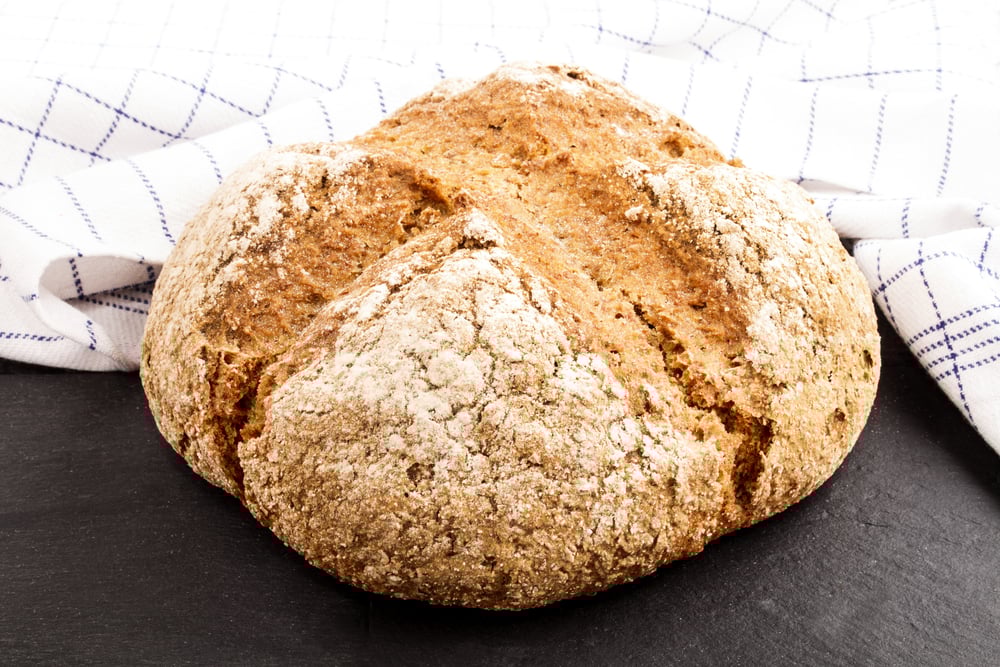
Watch any Irish grandmother make soda bread, and she does something before it goes into the oven. A quick, decisive cross, cut deep into the dough with a sharp knife. She doesn’t think about it. She’s done it ten thousand times. But if you ask her why, she might give you three different answers — and all of them are true.
The Science Says One Thing
The practical explanation is elegant. Soda bread uses bicarbonate of soda instead of yeast, which means the dough doesn’t need kneading and proving the way a yeast loaf does.
The cross cuts through the densest part of the dough, allowing heat to penetrate evenly from the centre outwards. Without it, the bread can emerge pale and gummy in the middle while the outside burns brown.
The cross, in other words, solves a genuine baking problem. But bread bakers were marking crosses on loaves centuries before bicarbonate of soda arrived in Ireland in the 1840s. The science explains the cross — it doesn’t explain why people were already doing it long before the chemistry existed.
The Old Story the Grandmothers Knew
In rural Ireland, the explanation was altogether different. The cross was cut to let the fairies out. Or, depending on who you asked, to let the devil out. Or to drive both away entirely.
In a country where the fairy world pressed close against the human one, ordinary household tasks were woven through with quiet rituals. You didn’t tempt fate by leaving bread uncrossed. Whatever mischief lurked in the wild hills and the dark bog might sneak into your food — and the cross was your protection.
It sounds like superstition. But to someone who had grown up watching roads bend around ancient fairy forts rather than disturb them, the invisible world was simply a fact of life. The cross on the bread was one more small act of common sense in a landscape full of things that required careful handling.
North and South Do It Differently
☘️ Love Irish Food & Culture?
Every Wednesday, we send our best Irish recipes, food stories, and kitchen traditions straight to your inbox. Join 64,000+ readers who love Ireland.
Cross the border into Ulster, and the soda bread changes shape entirely. Instead of a round loaf with a cross, Northern Irish cooks make a farl — a flat, griddle-cooked round divided into four triangles. The cross still appears, but it’s baked into the shape of the bread itself.
In Donegal, you might find a slightly different cut. In Cork, a different hand pressure. In every county, the same bread carries a regional fingerprint. A Mayo grandmother’s loaf and a Tyrone grandmother’s loaf taste subtly different — different ratios of buttermilk to flour, different crust depth — and both cooks will quietly insist their version is correct.
This is part of what makes Irish baking culture so rich. Unlike a French baguette, which is regulated to near-exactness, Irish soda bread belongs to whoever is making it. The cross stays. Everything else is negotiable.
A Blessing Before the Bake
There’s another explanation, one that sits beneath the folklore and the science both. The cross is a blessing. Before a loaf went into the oven, you marked it as something precious — something worth protecting.
In a cottage where bread was never guaranteed — where a wet summer could ruin the grain and a cold spring dry up the buttermilk — the act of blessing the loaf before baking was entirely rational. You did what you could. You crossed the bread. You hoped.
That gesture — hopeful, habitual, handed down — connects every Irish kitchen to every other Irish kitchen across generations. Like barm brack, which hides coins and rings inside its dough to tell your fortune, soda bread is bread that carries meaning far beyond nutrition.
The Bread That Never Changed
What’s remarkable about Irish soda bread is how little it has changed. The ingredients are still flour, salt, bicarbonate of soda, and buttermilk. The technique is still mix, shape, cross, bake.
The buttermilk is the key — its lactic acid reacts with the soda to create the rise, giving the bread its distinctive slight tang and dense, satisfying crumb. No yeast, no proving time, no fuss. It was designed to be made quickly, by tired hands at the end of a long day, in a kitchen that smelled of turf smoke and damp wool.
That bread is still on kitchen tables across Ireland. Still crossed before it bakes. Still pulled apart with bare hands and eaten warm with too much butter. The cross is still there — a habit, a reflex, a memory passed from hand to hand across a hundred years of Irish kitchens.
What That Simple Cut Contains
Ask an Irish person to explain the cross on their soda bread and you’ll get a different answer every time. It’s practical. It’s protection. It’s a blessing. It’s just what you do. None of these answers contradict each other.
That’s very Irish — the ability to hold several truths in one hand without needing to choose between them. The fairies might not be real. The science definitely is. And the grandmother who cuts the cross without thinking is doing something that has been done in Irish homes for centuries, carrying all of those meanings at once.
If you’d like to experience Irish food culture in person — from soda bread warm from the oven to farmers’ markets heaped with local produce — start by planning your trip to Ireland. There’s no better way to understand the country than at someone’s kitchen table.
That cross on the bread is a small thing. A gesture so old nobody knows exactly where it started, layered with so many meanings that nobody quite agrees on what it means. Practical and magical at once. Irish to the bone.
☘️ You Might Also Love
64,000 Ireland lovers can’t be wrong.
Every week, our free newsletter delivers hidden gems, seasonal guides, local stories, and practical travel tips — straight to your inbox. Join the community that loves Ireland as much as you do.
☘️ Get More Irish Recipes & Stories
Join 64,000+ readers for weekly Irish recipes, food traditions, travel guides, and hidden gems. Free every morning.
📥 Free Download: Ireland Travel Planning Guide
Our most popular resource — itineraries, insider tips, and the 50 places you must not miss.
Tours & experiences you might love


Powered by Viator. Some links are affiliate links — we may earn a small commission at no extra cost to you.
Secure Your Dream Irish Experience Before It’s Gone!
Planning a trip to Ireland? Don’t let sold-out tours or packed attractions spoil your journey. Iconic experiences like visiting the Cliffs of Moher, exploring the Rock of Cashel, or enjoying a guided walk through Ireland’s ancient past often sell out quickly—especially during peak travel seasons.

Booking in advance guarantees your place and ensures you can fully immerse yourself in the rich culture and breathtaking scenery without stress or disappointment. You’ll also free up time to explore Ireland’s hidden gems and savour those authentic moments that make your trip truly special.
Make the most of your journey—start planning today and secure those must-do experiences before they’re gone!