

They arrived without invitation, without warning, and without faces.
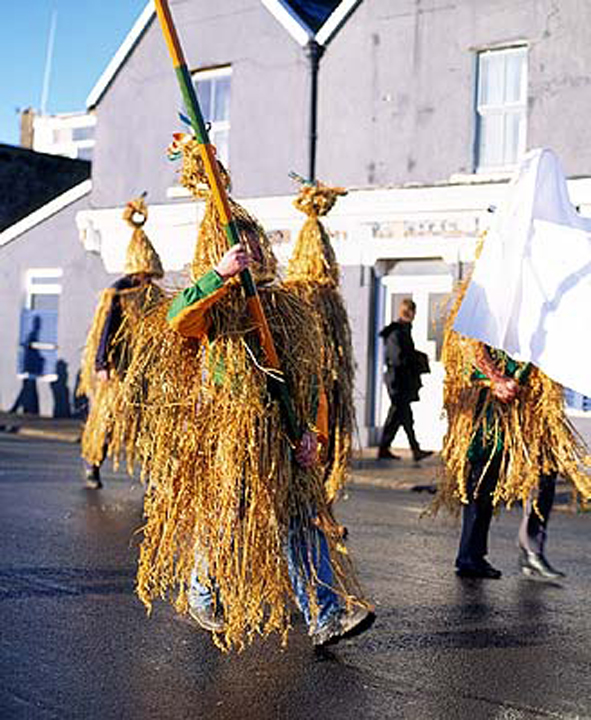
On a wedding day in rural Connacht, the sound of music at the door meant only one thing: the Straw Boys had come. Dressed from head to foot in elaborate suits of woven straw — conical hats, flowing capes, their identities completely hidden — they demanded entry. And the groom, however surprised, was expected to let them in.
To refuse was unthinkable.
Who Were the Straw Boys?
The Straw Boys were a group of young men from the local community — neighbours, cousins, perhaps brothers of the groom himself — who dressed in disguise and arrived uninvited at weddings and dances, and sometimes other communal gatherings.
The tradition was strongest in Connacht, particularly in counties Galway, Roscommon, Mayo, and Leitrim. In English they were called the Straw Boys, and in Irish the buachaillí tuí — though other regional names for related mumming customs, such as Mummers or Wren Boys, existed elsewhere in Ireland.
Their costumes were extraordinary, though they varied from parish to parish. Most combined a tall, hand-plaited straw hat or mask with straw ropes wound around ordinary clothes, sometimes turned inside out — enough, in every version, to keep the wearer’s face and identity hidden. No name was given.
The disguise was essential. Though everyone usually knew perfectly well who was underneath, it was considered impolite — and very bad form — to acknowledge it.
What Happened When They Arrived
The Straw Boys did not simply knock. They arrived as a procession, with a designated captain who would negotiate entry at the door.
Once inside, they claimed their prize: a dance with the bride. Every member of the group took a turn, moving through formal patterns while the wedding guests watched on. The bride was expected to dance willingly, with grace and good humour.
After the dancing came the hospitality. Food was produced, whiskey was poured, and the Straw Boys were treated as honoured — if unexpected — guests. Then, as suddenly as they had arrived, they left. Sometimes they visited more than one wedding in a single evening.
Why the Groom Dared Not Turn Them Away
To refuse the Straw Boys was to invite misfortune. No one quite agreed on what form that misfortune would take — but no one was willing to find out.
Some families believed the couple would never prosper. Others held that the harvest would fail, or that children would not come. The belief was vague but powerful, rooted in something much older than any particular wedding.
Hospitality — fáilte — was not simply politeness in rural Ireland. It was a sacred obligation. A house that welcomed strangers, even disguised ones, was a house that would be looked after in return.
The Meaning Hidden in the Straw
Scholars have long debated the origins of the Straw Boys tradition. Some connect it to harvest customs, where straw held the spirit of the last sheaf of corn — the cailleach, the old woman of the harvest. Woven straw carried protective and ritual power in rural Ireland.
Others link it to older pre-Christian rites around threshold moments. Marriage was one of the most powerful transitions in a life, and disguise, ritual performance, and communal witness were thought to guard the couple from ill fortune.
Whatever its origin, the Straw Boys belonged to a world where the boundary between ordinary life and something stranger was always thin.
Where the Tradition Survived Longest
The tradition began to fade during the twentieth century as rural communities changed and weddings moved from farmhouses to hotel function rooms.
It clung on longest in remote parts of the west of Ireland and along the Ulster border, where community life still centred on families who had lived beside one another for generations. Even today, occasional revivals take place — a Straw Boys group appearing at a traditional Irish wedding by prior arrangement, the costumes reconstructed, the dances rehearsed.
It is not quite the same. But something of it survives.
What the Straw Boys Remind Us
Before wedding venues and curated playlists, the Irish wedding was a community event in the fullest sense. Everyone arrived — invited or not. Everyone danced. Everyone was fed.
The Straw Boys were the strangest expression of that truth: in rural Ireland, a wedding was never just the couple’s. It belonged to the place, the people, and the traditions that had formed them.
The next time you admire a Claddagh ring or hear of the matchmaking festival at Lisdoonvarna, remember that Irish love and marriage have always been bound up in something larger than two people. They were bound up in community, obligation, and something just this side of magic.
If you are planning a trip to Ireland, look for the places where the old ways still linger — in music sessions, in pattern days, in the fields where no tree is ever cut down. The Straw Boys may be gone, but what they represented never really left.
☘️ You Might Also Love
☘️ Want More Hidden Ireland?
Join 64,000+ subscribers who discover Ireland’s best-kept secrets every week.
Subscribe Free — Join the Community →
Free forever · Unsubscribe anytime · No spam
📥 Free Download: Ireland Travel Planning Guide
Our most popular resource — itineraries, insider tips, and the 50 places you must not miss.
Tours & experiences you might love


Powered by Viator. Some links are affiliate links — we may earn a small commission at no extra cost to you.
Secure Your Dream Irish Experience Before It’s Gone!
Planning a trip to Ireland? Don’t let sold-out tours or packed attractions spoil your journey. Iconic experiences like visiting the Cliffs of Moher, exploring the Rock of Cashel, or enjoying a guided walk through Ireland’s ancient past often sell out quickly—especially during peak travel seasons.

Booking in advance guarantees your place and ensures you can fully immerse yourself in the rich culture and breathtaking scenery without stress or disappointment. You’ll also free up time to explore Ireland’s hidden gems and savour those authentic moments that make your trip truly special.
Make the most of your journey—start planning today and secure those must-do experiences before they’re gone!